
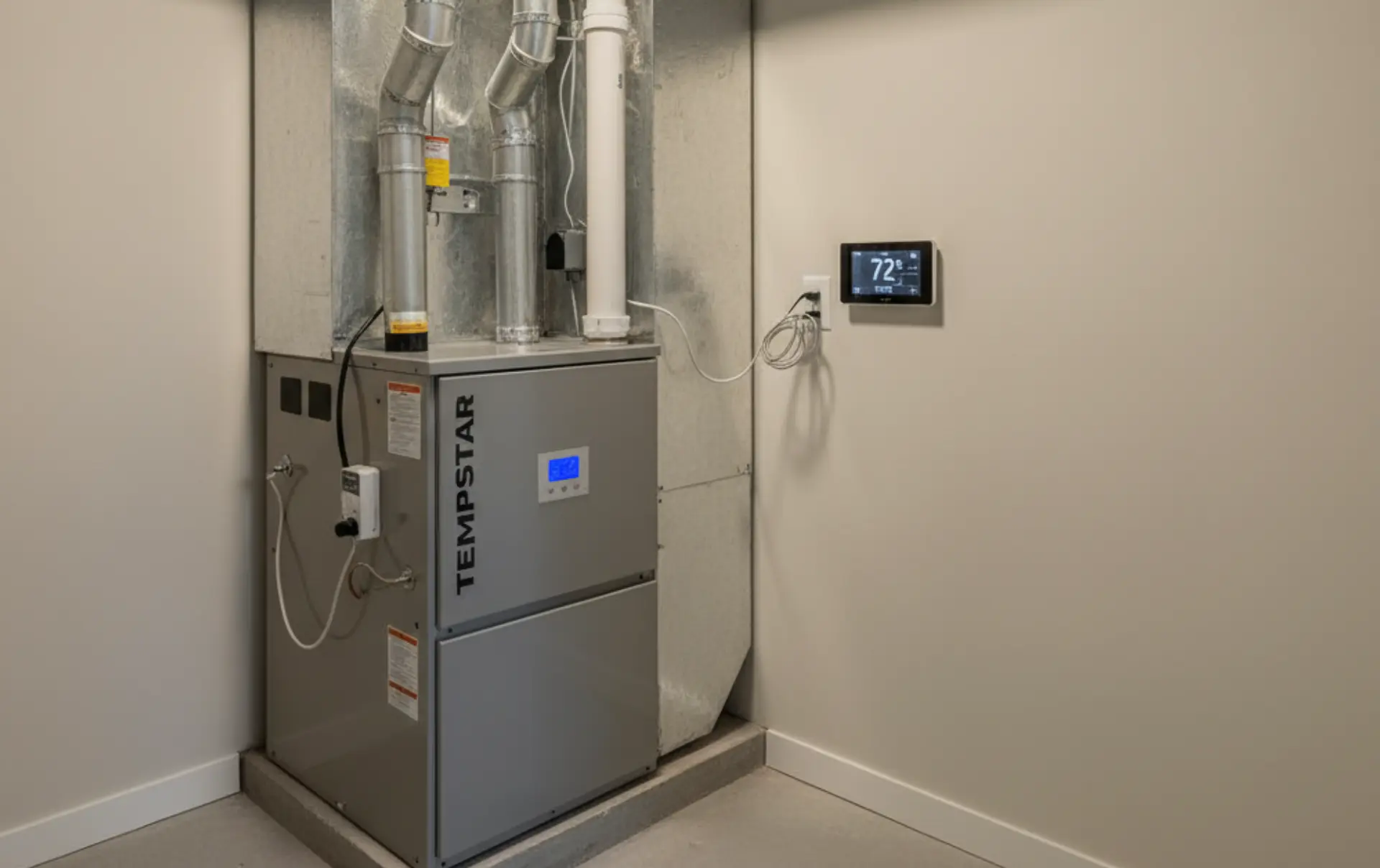
You’re probably reading this because your furnace just died, or it’s on its last legs and you know replacement is coming. And you’ve got one big question on your mind. What is the Cost of a New Furnace in Fort Worth ? What is the furnace installation cost ?
Maybe your heating bills have been creeping up year after year. Maybe your furnace is leaking water & making noises that sound like a truck trying to start. Or maybe a technician just told you that your 20-year-old system needs to be replaced.
Here’s the straight answer. A new furnace in Fort Worth runs $3,500 to $12,000 with installation. That’s a wide range because your home’s size, the equipment you choose, and installation complexity all affect the final price.
I’ve installed furnaces across Fort Worth for more than 30 years. This guide breaks down real costs, explains what drives pricing, and shows you how to avoid overpaying.
By the end of this article, you’ll know exactly what to expect, what questions to ask HVAC contractors, and how to get the best value for your investment.
Let’s dive right in.
What is the Average Cost of a New Furnace in Fort Worth?
Let me give you the straight numbers first, then we’ll break down what drives these costs.
A complete furnace replacement in Fort Worth, including equipment and professional installation, typically ranges from $3,500 to $12,000. Most homeowners end up spending between $4,500 and $7,500 for a quality system that will serve them well for 15 to 20 years.
But those averages don’t tell the whole story. Let me break this down by system type so you can see where your situation fits.
1. Standard Efficiency Furnace Cost Range
Standard efficiency gas furnaces are the most affordable option for Fort Worth homeowners. These systems have an AFUE rating of 80 percent, which means 80 percent of the fuel they burn turns into heat for your home.
For a standard efficiency furnace installation, expect to pay $3,500 to $6,000 in the Fort Worth area.
This price includes the furnace unit itself, professional installation labor, basic materials like refrigerant lines and electrical connections, permits and inspections required by the city, and initial startup and testing.
I installed a standard efficiency Goodman furnace for a client in Riverside last November. Their 1,400 square foot home needed a 60,000 BTU system. The total cost was $4,200, which included replacing some old ductwork connections and upgrading their thermostat to a programmable model.
Standard efficiency furnaces work well for Fort Worth because our heating season is relatively short. You’re not running your furnace eight months a year like homeowners in Minnesota. When you only need heat from November through March, the energy savings from a high-efficiency system take much longer to pay back your initial investment.
2. High Efficiency Furnace Cost Range
High efficiency furnaces have AFUE ratings of 90 percent or higher. Some models reach 98 percent efficiency, meaning almost all the fuel you pay for turns into heat instead of going up the flue.
For a high efficiency furnace installation in Fort Worth, expect to pay $5,500 to $9,000.
The higher cost comes from more sophisticated technology. High efficiency furnaces use a second heat exchanger to extract more warmth from combustion gases. They require PVC venting instead of traditional metal flues. And they include more advanced control boards and components.
These systems also need condensate drains because they create water as a byproduct of their high efficiency. If your home doesn’t already have a condensate drain line, installation costs increase.
I worked with a homeowner in Arlington who upgraded to a 96 percent AFUE Carrier furnace. Their 2,100 square foot home needed an 80,000 BTU system. The total installation cost was $7,400. That included running a new condensate drain line to their exterior wall and installing PVC vent piping through their roof.
Their old furnace was a 70 percent AFUE beast from 1994. Their gas bills dropped by about $35 per month during winter. At that rate, the efficiency upgrade will pay for itself in about 12 years. Whether that makes financial sense depends on how long they plan to stay in the home.
3. Premium and Variable Speed System Cost Range
Premium furnaces with variable speed blowers and modulating gas valves represent the top of the market. These systems don’t just turn on and off. They adjust their output continuously to match your home’s heating needs.
For a premium variable speed furnace installation in Fort Worth, expect to pay $7,500 to $12,000 or more.
Variable speed systems offer significant comfort advantages. They run longer at lower speeds, which eliminates the temperature swings you get with standard furnaces. They’re much quieter because they’re not constantly ramping up to full blast. And they improve air filtration because air passes through your filter more times per day.
These systems also integrate better with high-end air conditioning. If you have or plan to install a variable speed AC system, pairing it with a variable speed furnace creates a sophisticated whole-home comfort system.
I installed a Lennox SLP98V variable speed furnace for a client in Tanglewood. This is one of the most advanced residential furnaces available. Their 3,200 square foot home needed a 100,000 BTU system. The installation cost $10,800, which included a new Lennox zoning system with four zones, a high-end smart thermostat, and extensive ductwork modifications to optimize airflow.
Is a system like this necessary? No. Will most Fort Worth homeowners see enough benefit to justify the cost? Probably not. But for homeowners who prioritize comfort, have the budget, and plan to stay in their home long-term, these systems deliver a noticeable improvement in how their home feels.
What are Types of Furnaces and Their Cost Differences?
Not all furnaces are created equal. The type of fuel your furnace uses and the technology it employs dramatically affect both upfront costs and long-term operating expenses.
Let me break down the main furnace types available to Fort Worth homeowners and what you need to know about each one.
| Furnace Type | Average Cost Range (Installed) | Best For | Key Considerations |
| Standard Gas Furnace (80% AFUE) | $3,500 to $6,000 | Budget-conscious homeowners, shorter heating seasons | Lower upfront cost, proven reliability, adequate for Fort Worth climate |
| High Efficiency Gas Furnace (90-98% AFUE) | $5,500 to $9,000 | Long-term homeowners, larger homes, those prioritizing efficiency | Higher upfront cost offset by lower gas bills, requires condensate drain |
| Electric Furnace | $2,500 to $5,000 | Homes without gas access, very small homes or additions | Lower installation cost, higher operating costs, less common in Fort Worth |
| Dual Fuel System | $6,000 to $12,000 | Homeowners wanting optimal efficiency year-round | Combines gas furnace with electric heat pump, maximum flexibility |
| Two-Stage Gas Furnace | $4,500 to $7,500 | Balance of comfort and efficiency | Two heating levels instead of just on/off, quieter operation |
| Modulating Gas Furnace | $7,000 to $11,000 | Maximum comfort, premium homes | Infinite adjustment of heat output, exceptional comfort and efficiency |
| Variable Speed Gas Furnace | $6,500 to $10,500 | Improved air quality, consistent temperatures | Blower adjusts speed continuously, better filtration and humidity control |
1. Gas Furnace Overview and Price Considerations
Natural gas furnaces are the most popular choice in Fort Worth, and for good reason. Natural gas is abundant in Texas, relatively inexpensive, and our infrastructure supports it well.
Gas furnaces work by burning natural gas in a combustion chamber. The heat from combustion warms a heat exchanger, and your blower motor pushes air across that heat exchanger to distribute warmth throughout your home.
The big advantage of gas furnaces is operating cost. Natural gas in Fort Worth typically costs $0.80 to $1.20 per therm. To heat a 2,000 square foot home for a month during winter might cost $80 to $150 in gas, depending on how cold it gets and how efficient your furnace is.
Installation costs for gas furnaces include the unit itself, labor, venting materials, gas line connections, electrical hookups, thermostat, and permits. Most Fort Worth homes already have gas service and existing gas lines to the furnace location, which keeps costs reasonable.
2. Electric Furnace Overview and Price Considerations
Electric furnaces are less common in Fort Worth, but they fill a specific niche for certain homes.
These systems use electric heating elements instead of burning fuel. When you call for heat, electricity flows through resistance coils that get hot, and the blower pushes air across those hot coils.
The main advantage of electric furnaces is lower installation cost. You don’t need gas lines, venting, combustion chambers, or flue pipes. The furnace itself is simpler with fewer components that can fail. Installation typically costs $2,500 to $5,000 depending on the size and features you need.
Electric furnaces also work well for homes without natural gas access. Some older Fort Worth neighborhoods and rural areas outside the city don’t have gas lines. For these homes, electric furnaces or heat pumps are the only practical options besides propane.
The major disadvantage is operating cost. Electricity in Fort Worth costs about $0.12 to $0.14 per kilowatt-hour. Heating the same 2,000 square foot home that costs $100 in gas might cost $250 to $300 in electricity. Over a five-month heating season, that difference adds up to $750 to $1,000 in extra costs.
3. Dual Fuel and Hybrid Systems
Dual fuel systems represent the cutting edge of home heating efficiency. These systems combine an electric heat pump with a gas furnace backup.
Here’s how they work. During mild weather, the heat pump provides heating. Heat pumps are incredibly efficient when outdoor temperatures are above 35 to 40 degrees. But when temperatures drop below that threshold, heat pump efficiency falls dramatically. That’s when the system automatically switches to the gas furnace.
The result is optimal efficiency across all weather conditions. You get the low operating cost of a heat pump during mild weather and the reliable warmth of a gas furnace during cold snaps.
Installation costs for dual fuel systems run $6,000 to $12,000 depending on the specific equipment and whether you already have a compatible heat pump. If you’re replacing both your furnace and your AC system at the same time, adding dual fuel capability only increases costs by $800 to $1,500 over standard equipment.
4. Variable Speed, Two-Stage, and Modulating Systems
Modern furnaces offer different levels of output control, and understanding these differences helps you make smart buying decisions.
Standard single-stage furnaces operate like a light switch. They’re either on at 100 percent or completely off. When the thermostat calls for heat, the furnace fires up at full capacity, heats your home, then shuts off. This creates temperature swings and uses more energy than necessary.
Two-stage furnaces have a low setting and a high setting. They run at low capacity most of the time, which provides more even temperatures and uses less energy. They only ramp up to high capacity when it’s very cold outside or your home needs to warm up quickly.
Two-stage furnaces typically add $500 to $1,200 to your installation cost compared to single-stage models. They’re a good middle ground between basic and premium systems.
Variable speed furnaces take this concept further. Instead of two stages, they can adjust their blower speed continuously from about 30 percent up to 100 percent capacity. This provides exceptional comfort because the system can match its output precisely to your home’s needs.
Variable speed systems run longer at lower speeds, which means better air filtration, more consistent temperatures, and quieter operation. They typically add $1,500 to $2,500 to installation costs compared to standard single-stage systems.
Modulating furnaces represent the ultimate in precision. These systems can adjust their gas valve in tiny increments, providing infinite heat output levels between minimum and maximum capacity. Paired with a variable speed blower, they deliver the most comfortable, efficient heating possible.
Modulating systems typically cost $2,500 to $4,000 more than basic single-stage furnaces. They’re found primarily in premium brands like Lennox, Carrier Infinity, and Trane.
Is this level of sophistication necessary? No. But if your budget allows and you value comfort, these systems deliver noticeable improvements.
How Home Size and Layout Impact Cost of a New Furnace in Fort Worth?
Your home’s size is one of the biggest factors affecting furnace replacement cost. Bigger homes need bigger furnaces, and bigger furnaces cost more to buy and install.
But it’s not quite as simple as just matching square footage to furnace size. Let me explain how HVAC professionals actually size furnaces and what that means for your project cost.
1. BTU Sizing and Why It Matters
BTU stands for British Thermal Unit. It’s a measurement of heat energy. One BTU is the amount of heat needed to raise one pound of water by one degree Fahrenheit.
For furnaces, we talk about BTU output per hour. A 60,000 BTU furnace can produce 60,000 BTUs of heat every hour it runs.
Your home needs enough BTUs to overcome heat loss through walls, windows, ceilings, and air leaks. On a cold day, heat constantly escapes from your home. Your furnace needs to produce enough heat to replace what’s being lost and maintain comfortable temperatures inside.
Proper sizing requires a detailed calculation called a Manual J load calculation. This calculation considers your home’s square footage, ceiling height, insulation levels, window size and quality, air sealing, orientation to the sun, and local climate data.
A 2,000 square foot home in Fort Worth typically needs 40,000 to 70,000 BTUs of heating capacity. That’s a huge range because insulation and construction quality matter enormously.
I did a load calculation for two homes last year that were both 2,100 square feet. The first was built in 1965 with original single-pane windows, minimal insulation, and lots of air leaks. It needed a 75,000 BTU furnace. The second was built in 2019 with spray foam insulation, low-E windows, and tight construction. It only needed a 45,000 BTU furnace.
Furnace costs increase with capacity. A 40,000 BTU furnace might cost $2,800. A 60,000 BTU furnace might cost $3,400. An 80,000 BTU furnace might cost $4,100. These are equipment costs only, but you can see how sizing directly affects your total project expense.
2. Square Footage Examples: Small, Medium, Large Homes
Let me give you some real-world examples of what furnace sizes and costs look like for different home sizes in Fort Worth.
• Small homes (1,000 to 1,500 square feet):
These homes typically need 35,000 to 55,000 BTU furnaces. Total installation costs usually run $3,500 to $5,500 for a standard efficiency system.
I replaced a furnace for a homeowner in Como with a 1,200 square foot brick ranch. Their home had decent insulation and newer windows. The load calculation called for a 45,000 BTU furnace. We installed a Goodman 80 percent AFUE single-stage system for $4,100 including labor, materials, permits, and a new programmable thermostat.
• Medium homes (1,500 to 2,500 square feet):
These homes typically need 50,000 to 80,000 BTU furnaces. Total installation costs usually run $4,500 to $7,500 for a standard efficiency system, or $6,000 to $9,500 for high efficiency.
I replaced a furnace for a homeowner in Ridglea Hills with a 1,900 square foot two-story home. Their home had good insulation but older windows. The load calculation called for a 65,000 BTU furnace. We installed a Carrier 96 percent AFUE two-stage system for $6,800 including new PVC venting, a condensate drain, upgraded thermostat, and ductwork sealing.
• Large homes (2,500 to 4,000 square feet):
These homes typically need 75,000 to 120,000 BTU furnaces. Total installation costs usually run $6,500 to $10,000 for standard efficiency, or $8,000 to $12,000 for high efficiency with premium features.
I replaced a furnace for a homeowner in Tanglewood with a 3,400 square foot home. Their home had spray foam insulation and excellent windows. Despite the large size, the load calculation only called for an 85,000 BTU furnace because of the superior construction. We installed a Lennox 98 percent AFUE variable speed system for $9,200 including all new ductwork connections, smart thermostat, air purification system, and whole-home humidifier.
These examples show typical costs, but your specific situation might be higher or lower depending on the factors we’ll discuss next.
3. Role of Insulation, Window Quality, and Duct Design
The construction quality of your home matters just as much as square footage when sizing furnaces.
Poor insulation means heat escapes faster, requiring a bigger furnace and costing more to operate. A home with R-13 wall insulation and R-30 attic insulation needs significantly more heating capacity than an identical home with R-19 walls and R-49 attic.
If your insulation is inadequate, you face a choice. You can install a bigger, more expensive furnace to compensate. Or you can improve your insulation first, then install a smaller, more efficient furnace.
I worked with a homeowner in Arlington who wanted to replace their furnace. Their 1,600 square foot home from 1958 had almost no attic insulation. The load calculation showed they needed a 70,000 BTU furnace, which seemed excessive for that size home.
I recommended they add R-38 blown insulation to their attic before replacing the furnace. The insulation cost $1,400. With proper insulation, they only needed a 50,000 BTU furnace instead of 70,000 BTU. The smaller furnace cost $900 less than the larger one. Plus, their energy bills dropped by $30 per month year-round.
Window quality affects heating loads dramatically. Single-pane windows from the 1960s and 70s leak heat like crazy. Modern low-E double-pane windows provide much better insulation. If your home has old windows, that factors into furnace sizing.
Duct design also matters. Poorly designed ductwork forces your furnace to work harder to distribute heat evenly. Leaky ducts waste heated air in attics and crawl spaces instead of delivering it to your living areas.
I inspected ductwork for a client in Saginaw who complained about uneven heating. Their furnace was properly sized, but their ducts had never been sealed. We found huge gaps at connection points and several disconnected sections. After sealing the ducts, rooms that had been cold started heating properly, and their furnace didn’t run as long each cycle.
Good ductwork improves comfort, reduces energy waste, and lets you use a smaller furnace. Bad ductwork does the opposite.
4. Common Sizing Mistakes Homeowners Make
The biggest sizing mistake I see is homeowners who insist on replacing their old furnace with the exact same size without doing a proper load calculation.
Just because your house had an 80,000 BTU furnace in 1995 doesn’t mean it needs an 80,000 BTU furnace today. Maybe you’ve added insulation. Maybe you’ve replaced windows. Maybe the original furnace was oversized to begin with, which was common practice decades ago.
Oversized furnaces cost more to buy, cost more to install, and actually provide worse comfort. They heat your home too quickly, which causes short cycling. Short cycling means the furnace turns on, heats the house rapidly, shuts off, then repeats the cycle a few minutes later.
This constant on-off cycling wears out components faster, wastes energy, and creates temperature swings that make your home uncomfortable. Plus, the furnace never runs long enough to properly filter your air or control humidity.
Undersized furnaces are equally problematic. If your furnace can’t keep up on the coldest days, you’ll be miserable. The system will run constantly trying to reach setpoint and never quite making it. Your energy bills will be higher because the furnace never shuts off.
Another common mistake is choosing a furnace based solely on price without considering efficiency or features. A cheap furnace might save you $1,500 upfront but cost you $300 extra per year in energy bills. Over 15 years, you actually lose money.
The smart approach is getting a proper load calculation, understanding your actual heating needs, and choosing a system that balances upfront cost with long-term operating expenses and comfort.
How Furnace Installation Impacts Cost of a New Furnace in Fort Worth?
Two homeowners with identical homes and identical furnaces can end up with very different installation costs. The reason? Installation complexity.
Some furnace replacements are straightforward. The old furnace comes out, the new one goes in the same spot, all connections line up perfectly, and you’re done in six hours.
Other installations require ductwork modifications, new gas lines, electrical upgrades, venting changes, or overcoming access challenges. These complications add hours of labor and additional materials, which increases your total project cost.
Let me walk you through the common complexity factors that affect installation costs in Fort Worth homes.
1. Ductwork Modifications and Their Effect on Cost
Ideally, your new furnace connects to existing ductwork without any modifications. But that’s not always possible or advisable.
If your existing ductwork is undersized for the new furnace’s airflow requirements, modifications are necessary. Modern high-efficiency furnaces move more air than older systems. If your ducts can’t handle the increased airflow, you’ll get noisy operation and reduced efficiency.
Adding new supply or return ducts typically costs $800 to $2,500 depending on how much work is needed and how accessible your ductwork is.
If your ductwork is in terrible condition with rust, holes, or disconnected sections, repair or replacement makes sense. You wouldn’t install a brand new furnace and connect it to ductwork that’s leaking 30 percent of the heated air.
Duct sealing costs $400 to $1,200 depending on how extensive your duct system is and how much work needs to be done. This is often money well spent because it improves comfort and efficiency dramatically.
I replaced a furnace for a homeowner in White Settlement whose ductwork was a disaster. The original installation from 1972 had never been properly sealed. Ducts in the attic had separated at joints. The main trunk line had multiple holes rusted through.
We quoted them for a simple furnace replacement at $4,800. But after inspecting the ductwork, I told them we needed to seal and repair the ducts for an additional $1,600. They initially balked at the extra cost. I explained that without fixing the ducts, their new furnace would be heating their attic instead of their living space.
They agreed to the ductwork repairs. After installation, their home heated more evenly than it had in years, and their gas bill dropped by $40 per month. The duct repairs paid for themselves in less than three years.
2. New Gas Line, Flue, or Electrical Upgrades
Sometimes replacing a furnace requires upgrading the infrastructure that supports it.
If your new furnace needs a larger gas line than currently exists, that line needs upgrading. Gas line work requires a licensed plumber and typically costs $500 to $1,500 depending on the distance and complexity.
High-efficiency furnaces use different venting than standard efficiency models. If you’re upgrading from an 80 percent AFUE furnace to a 95 percent AFUE furnace, you’ll need new PVC vent pipes. This work typically costs $400 to $1,200 depending on where the furnace is located and where the vent terminates.
Some older homes have electrical services that don’t meet current code requirements for modern furnaces. If your furnace circuit doesn’t have proper grounding, adequate wire size, or appropriate breaker protection, electrical upgrades are necessary.
Electrical work for furnace installations typically runs $300 to $900 depending on what needs to be done. This might include running a new dedicated circuit, upgrading the breaker, adding proper disconnects, or bringing the installation up to current electrical code.
I worked on a home in Polytechnic Heights where the existing furnace was connected with ancient cloth-wrapped wiring that wasn’t even grounded. The home’s electrical panel was from the 1950s and didn’t have space for additional circuits.
We had to bring in an electrician to install a subpanel and run new wiring to the furnace location. This added $850 to the project cost. It wasn’t optional. The old wiring was a fire hazard, and no reputable HVAC contractor would connect a new furnace to it.
3. Impact of Location: Attic, Closet, Garage
Where your furnace is located affects how easy it is to install and access.
Furnaces in closets or utility rooms on the main floor are the easiest to work on. Everything is accessible. You can bring equipment in and out without climbing ladders or crawling through tight spaces. These installations typically stay near the base cost estimates.
Furnaces in garages are usually easy to access but may require longer duct runs depending on the home’s layout. Installation complexity is moderate.
Furnaces in attics are the most challenging. Technicians have to haul equipment up through a hatch, work in cramped spaces, deal with extreme temperatures, and navigate around insulation and roof trusses.
Attic installations typically add $300 to $800 in labor costs compared to easily accessible locations. Some HVAC companies charge accessibility fees upfront for attic work.
I replaced a furnace in a Keller home where the unit was located in a cramped attic space with a tiny access hatch. We could barely fit the new furnace through the opening. The attic had only 4 feet of clearance at the peak, so technicians were working on their knees the entire time.
What would have been a 7-hour installation in a garage took 11 hours in that attic. The labor costs reflected that extra time. But we got it done, and the homeowner understood why attic installations cost more.
Basement furnaces are rare in Fort Worth since most homes don’t have basements. When they exist, they’re usually the easiest installations of all with excellent access and plenty of space to work.
4. Thermostat Upgrades
Most furnace replacement projects include a new thermostat. The question is what type of thermostat you choose.
Basic programmable thermostats add $100 to $200 to your project cost. These are perfectly adequate for most homes. They let you set schedules for different temperatures at different times of day.
Smart thermostats like Nest, Ecobee, or Honeywell Home models cost $200 to $400 installed. These thermostats connect to WiFi, let you control temperature from your phone, learn your preferences over time, and can reduce energy consumption through intelligent scheduling.
High-end communicating thermostats that pair with premium furnaces can cost $400 to $800 installed. These sophisticated controls provide detailed system diagnostics, precise temperature control, and integration with zoning systems.
I generally recommend mid-range smart thermostats for most homeowners. They’re not dramatically more expensive than basic programmable models, but they offer significant convenience and energy-saving features.
I installed an Ecobee smart thermostat for a client in Benbrook as part of their furnace replacement. They loved being able to adjust temperature from work when they were coming home early or leaving town for vacation. The thermostat paid for itself in about two years through reduced energy waste.
5. Accessibility Challenges That Increase Labor Hours
Beyond just location, specific access challenges can add significant time and cost to installations.
Tight doorways or hallways that make it difficult to move equipment can slow down installation. If your furnace closet has a 24-inch door and the new furnace is 26 inches wide, we have to find creative solutions. Sometimes that means removing door frames temporarily or finding an alternate route through the home.
I worked on a home in Ryan Place where the furnace closet was accessible only through a narrow hallway with a 90-degree turn. The new furnace physically couldn’t make the turn. We ended up removing a section of drywall, installing the furnace, then patching and painting the wall. This added four hours of labor and $600 in costs for the drywall work.
Homes with finished spaces around the furnace present challenges too. If we need to modify ductwork or run new venting, and those paths go through finished ceilings or walls, we’re looking at additional carpentry work to patch and repair.
Furnaces installed in crawl spaces are particularly challenging. If the crawl space has limited height or difficult access, technicians are working in uncomfortable positions for extended periods. This slows down installation and increases labor hours.
Multi-story homes sometimes require hauling equipment up stairs, which adds time. If your furnace is on the second or third floor of your home, expect some additional labor costs for the extra work involved in moving heavy equipment.
These accessibility challenges are why getting an in-person quote is so important. A contractor needs to see your specific situation to give you an accurate price. Phone quotes and online estimates can’t account for these real-world complications.
Brand Tiers and What They Mean for Pricing
Walk into any HVAC supply house and you’ll find dozens of furnace brands. They range from budget-friendly options to premium systems that cost as much as a used car.
Understanding brand tiers helps you make smart decisions about where to invest your money. Let me break down what you get at each level and whether the premium brands are worth the extra cost.
| Brand Tier | Brands | Equipment Cost Range | Total Installed Cost | Warranty | Best For |
| Entry Level | Goodman, Amana, Payne, Frigidaire | $1,800 to $3,200 | $3,500 to $5,500 | 5-10 year parts | Budget-conscious buyers, rental properties, basic heating needs |
| Mid Tier | Rheem, Ruud, Coleman, York, American Standard, Heil | $2,400 to $4,500 | $4,500 to $7,500 | 10 year parts, optional extended labor | Most homeowners, good balance of cost and reliability |
| Premium | Carrier, Trane, Lennox, Bryant | $3,500 to $7,000 | $6,000 to $12,000 | 10-12 year parts, extended labor available | Long-term homeowners, those prioritizing comfort and reliability |
1. Overview of Entry Level Brands
Entry level brands include Goodman, Amana, Payne, and Frigidaire. These manufacturers focus on providing reliable heating at the lowest possible price point.
Equipment costs for entry level furnaces typically run $1,800 to $3,200 depending on size and efficiency. Total installed costs range from $3,500 to $5,500 for most Fort Worth homes.
These furnaces use proven technology and reliable components. They’ll heat your home adequately for 12 to 18 years with proper maintenance. But they lack the advanced features and comfort enhancements found in higher-tier brands.
Goodman is probably the most popular entry level brand in Fort Worth. They’re owned by Daikin, a massive global HVAC manufacturer. Goodman furnaces are built to a price point, which means they use less expensive components and simpler designs.
I’ve installed hundreds of Goodman furnaces over the years. They work. They’re not fancy, but they’re reliable if you maintain them properly. The warranty is shorter than premium brands, typically 10 years on the heat exchanger and 5 years on parts.
Entry level furnaces make sense in several situations. If you’re on a tight budget and need heat now, they get the job done. If you’re fixing up a rental property, you probably don’t want to invest in premium equipment. If your home has minimal insulation and you’re not planning major upgrades, a basic furnace is adequate.
The trade-offs are comfort and longevity. Entry level furnaces are noisier than premium models. They’re less efficient. They have more temperature swings. And they typically don’t last quite as long because components are built to lower standards.
2. Overview of Mid Tier Brands
Mid tier brands include Rheem, Ruud, Coleman, York, American Standard, and Heil. These manufacturers occupy the sweet spot for most homeowners, offering good reliability, decent efficiency, and reasonable pricing.
Equipment costs for mid tier furnaces typically run $2,400 to $4,500 depending on size, efficiency, and features. Total installed costs range from $4,500 to $7,500 for most Fort Worth applications.
These furnaces use better components than entry level brands. You’ll find more robust blower motors, better heat exchangers, and more reliable control boards. Build quality is noticeably better, which translates to longer lifespan and fewer repairs.
Rheem and Ruud are actually the same company. Ruud is the commercial-focused brand while Rheem targets residential. Both offer excellent value for the money. I install a lot of Rheem furnaces because they’re reliable, parts are readily available, and pricing is competitive.
American Standard is owned by the same parent company as Trane, so they share technology and components. American Standard equipment is essentially Trane at a lower price point. It’s a smart choice if you want Trane-like quality without paying Trane prices.
Mid tier furnaces typically come with 10-year parts warranties. Many manufacturers offer extended labor warranties for an additional fee, which can be worth considering.
I installed a Rheem 96 percent AFUE two-stage furnace for a homeowner in Hulen Heights last fall. Their 2,200 square foot home needed a 75,000 BTU system. Total installation was $6,400 including new thermostat, ductwork sealing, and upgraded air filtration.
Two winters later, they’ve had zero issues. The system runs quietly, maintains consistent temperatures, and their gas bills are about 25 percent lower than with their old 1998 Carrier. They’re thrilled with the value they got.
For most Fort Worth homeowners, mid tier brands offer the best combination of quality, features, and price. You’re not paying for the prestige of a premium brand name, but you’re getting equipment that will serve you well for 15 to 20 years.
3. Overview of Premium Brands
Premium brands include Carrier, Trane, Lennox, and Bryant. These are the names you see advertised on TV and in magazines. They represent the highest quality residential HVAC equipment available.
Equipment costs for premium furnaces range from $3,500 to $7,000 depending on size, efficiency, and feature level. Total installed costs typically run $6,000 to $12,000 for Fort Worth homes.
What do you get for that premium price? Better engineering, more durable components, superior efficiency, advanced comfort features, longer warranties, and better parts availability.
Carrier and Bryant are owned by the same company, so they share technology. Carrier is positioned as the premium residential brand while Bryant is slightly more affordable. Both offer exceptional reliability.
Trane has a reputation for building tanks. Their heat exchangers are some of the most durable in the industry. Trane furnaces typically outlast everything else, often running 20 to 25 years with proper maintenance.
Lennox focuses on efficiency and technology. Their top-tier furnaces offer features you won’t find elsewhere, like variable capacity modulation and advanced diagnostics. If you want the absolute best efficiency and comfort, Lennox is hard to beat.
Premium brand warranties typically cover 10 to 12 years on parts and include optional extended labor coverage. Some offer lifetime heat exchanger warranties if you register the equipment and maintain it properly.
I installed a Trane XV95 variable speed furnace for a client in Ridgmar. Their 2,800 square foot home needed an 85,000 BTU system. Total installation was $9,200 including variable speed air handler, advanced thermostat, zoning system, and whole-home dehumidification.
The system runs so quietly you can barely hear it. Temperature never varies more than half a degree from setpoint. Humidity stays perfectly controlled. It’s the most comfortable home heating system I’ve ever installed.
Is that level of performance worth $9,200? For that homeowner, absolutely. They valued comfort highly, planned to stay in the home long-term, and had the budget for premium equipment.
4. Differences in Warranty, Durability, Parts Availability, and Comfort Levels
Let’s talk about what actually differs between brand tiers beyond just the name on the equipment.
• Warranty coverage increases as you move up the tiers. Entry level brands offer 5 to 10 years on parts. Premium brands offer 10 to 12 years, sometimes with lifetime heat exchanger coverage. This matters because replacing a failed control board out of warranty can cost $600 to $900.
• Durability improves with premium brands. They use thicker gauge steel, better bearings, more robust motors, and higher-grade components throughout. An entry level furnace might last 12 to 15 years. A premium furnace often lasts 18 to 25 years. That’s a significant difference in value over time.
• Parts availability is generally better for premium brands. If something breaks on your Carrier or Trane furnace, parts are readily available at local supply houses. For some entry level brands or off-brand models, getting parts can take days or weeks, leaving you without heat.
• Comfort features separate good furnaces from great ones. Variable speed blowers, modulating gas valves, advanced humidity control, and communicating thermostats are typically found only on mid to premium tier equipment. These features dramatically improve how comfortable your home feels.
• Noise levels decrease as you move up brand tiers. Entry level furnaces are noisy when they run. Premium furnaces with variable speed technology run so quietly you often don’t know they’re operating.
• Efficiency options expand with premium brands. You’ll find the highest AFUE ratings, most sophisticated control systems, and best integration with other home comfort equipment in premium lines.
The question is whether these differences justify the price premium. For a homeowner planning to stay in their house 15 to 20 years who values comfort and reliability, premium brands make sense. For someone on a tight budget or planning to move in a few years, entry level equipment is perfectly adequate.
Most homeowners find the best value in mid tier brands. You get most of the important features and durability without paying for the prestige of a premium nameplate.
Efficiency Ratings and Their Cost Impact
Walk into an appliance store and you’ll see those yellow EnergyGuide labels on refrigerators and washing machines. Furnaces have something similar, but instead of a simple sticker, they have an AFUE rating.
Understanding efficiency ratings helps you make informed decisions about which furnace to buy and whether spending more on high efficiency equipment makes financial sense for your situation.
1. AFUE Explained in Simple Terms
AFUE stands for Annual Fuel Utilization Efficiency. It’s a percentage that tells you how much of the fuel your furnace burns actually turns into heat for your home.
An 80 percent AFUE furnace converts 80 percent of its fuel into heat. The other 20 percent goes up the flue as waste heat. A 95 percent AFUE furnace converts 95 percent of its fuel into heat, wasting only 5 percent.
Think of it like gas mileage for your car. A car that gets 20 MPG uses fuel less efficiently than one that gets 35 MPG. Same principle applies to furnaces.
By law, all new gas furnaces sold in the United States must have an AFUE of at least 80 percent. This is the minimum efficiency standard. Anything below 80 percent can’t legally be installed.
Standard efficiency furnaces operate at 80 percent AFUE. These are the most affordable options and work well for climates with mild winters like Fort Worth.
Mid-efficiency furnaces operate at 90 to 93 percent AFUE. These represent a middle ground between upfront cost and operating efficiency.
High-efficiency furnaces operate at 94 to 98 percent AFUE. These are the most expensive upfront but cost the least to operate.
The technology difference between 80 percent and 95 percent furnaces is significant. Standard efficiency furnaces use a single heat exchanger and vent hot exhaust gases through a metal flue. High-efficiency furnaces use a second heat exchanger to extract more heat from those exhaust gases. The exhaust is so cool that it can be vented through PVC pipes instead of metal.
That second heat exchanger costs money. So do the more sophisticated controls, the condensate drainage system, and the modified venting. This is why high-efficiency furnaces cost $1,500 to $3,000 more than standard efficiency models.
2. Comparing Annual Energy Savings
Let’s look at real numbers to understand what efficiency means for your wallet.
Assume you have a 2,000 square foot home in Fort Worth that needs 60,000 BTUs of heating capacity. Your furnace runs about 1,200 hours per year based on typical Fort Worth winters.
• With an 80 percent AFUE furnace:
Your furnace consumes 90 therms of gas per year. At $1.00 per therm, your annual heating cost is $900.
• With a 95 percent AFUE furnace:
Your furnace consumes 76 therms of gas per year. At $1.00 per therm, your annual heating cost is $760.
The high-efficiency furnace saves you $140 per year.
Now let’s factor in the cost difference. If the 80 percent AFUE furnace installation costs $4,500 and the 95 percent AFUE furnace costs $6,800, you’re paying an extra $2,300 for efficiency.
At $140 per year in savings, the efficiency upgrade takes 16.4 years to pay for itself. That’s a long payback period.
This math changes based on several factors. If natural gas prices increase, savings accelerate. If you use more heat because your home has poor insulation or you keep temperatures higher, savings increase. If you use less heat because winters are mild or you’re out of the house frequently, savings decrease.
I worked with a couple in Arlington trying to decide between an 80 percent and 96 percent AFUE furnace. Their home was 1,800 square feet with good insulation. I calculated they’d save about $110 per year with the high-efficiency model.
The efficiency upgrade would cost an extra $2,100. At $110 per year savings, payback was 19 years. They planned to stay in the home at least 20 years, so the math barely worked in favor of high efficiency.
But here’s what tipped their decision. The high-efficiency furnace they were considering also had a variable speed blower, which the standard efficiency model lacked. The variable speed feature improved comfort significantly. When they factored in the comfort benefits along with energy savings, high efficiency made sense for them.
3. What Efficiency Levels Make Sense for Fort Worth
Fort Worth’s climate affects whether high-efficiency furnaces make financial sense.
We have relatively mild winters compared to northern states. Your furnace might run 1,000 to 1,500 hours per year here, versus 2,500 to 3,500 hours per year in Chicago or Minneapolis.
This shorter heating season means efficiency savings accumulate more slowly. That $140 per year we calculated earlier could be $350 per year for the same home in a colder climate.
For most Fort Worth homeowners, 80 to 90 percent AFUE furnaces make sense from a pure financial standpoint. The upfront savings let you invest money elsewhere, and the payback period for high efficiency is often longer than you’ll own the home.
But there are situations where high efficiency makes sense even in Fort Worth:
If you’re building new or doing major renovations and want the highest efficiency possible from the start.
If you have a large home with high heating costs where the savings are more substantial.
If you plan to stay in your home 20+ years and want to minimize operating costs long-term.
If natural gas prices increase significantly, which changes the savings calculation.
If you value environmental impact and want to minimize your carbon footprint.
If you’re buying high-efficiency AC anyway and can get package discounts on matching high-efficiency heating.
I generally recommend mid-tier efficiency (90 to 93 percent AFUE) for Fort Worth homeowners as a balanced approach. You get meaningful efficiency improvements over 80 percent systems without paying the premium for 95+ percent equipment.
4. When High Efficiency Is Worth the Extra Investment
Despite longer payback periods in Fort Worth’s climate, high-efficiency furnaces can still be the right choice.
If you’re replacing both your furnace and air conditioning system, the combined efficiency gains make more financial sense. You’re spreading installation costs across both systems, and AC efficiency matters more in Fort Worth’s hot summers than furnace efficiency matters in our mild winters.
If you have access to rebates or incentives, they can dramatically improve the payback equation. A $1,500 rebate on a high-efficiency system changes $2,300 in extra cost to only $800, which pays back in just 5 to 6 years.
If you simply value having the best, most efficient equipment regardless of payback period, that’s a perfectly valid choice. Some people drive Hondas for maximum value. Some people drive BMWs because they appreciate the quality. Same principle applies to furnaces.
If your old furnace was extremely inefficient (70 percent AFUE or lower from the 1980s or early 1990s), upgrading to even a standard 80 percent AFUE represents huge savings. In this case, jumping to 95 percent might make sense.
The worst decision is buying high efficiency solely because a salesperson convinced you it would “pay for itself in three years.” Run the actual numbers for your situation. Be honest about how long you’ll own the home. Then decide whether the efficiency premium aligns with your priorities and budget.
What are Rebates, Credits, and Financing Options ?
The sticker price for a new furnace is just the starting point. Various incentives, rebates, and financing options can significantly reduce your out-of-pocket costs or make the investment more manageable.
Let me walk you through what’s actually available to Fort Worth homeowners and how to take advantage of these opportunities.
1. Utility Rebates Available in Fort Worth
Fort Worth is served primarily by Atmos Energy for natural gas. They offer periodic rebates for homeowners who install high-efficiency heating equipment.
Atmos Energy rebates typically range from $300 to $850 depending on the efficiency level of equipment you install. The rebates change periodically based on available funding, so always check their current programs before making purchase decisions.
To qualify for utility rebates, you typically need to meet minimum efficiency requirements (usually 95 percent AFUE or higher) and provide proof of installation by a licensed contractor.
The application process usually involves submitting a rebate form, proof of purchase, and documentation of equipment efficiency ratings within 90 days of installation.
Some Fort Worth homeowners are served by Oncor or Texas Electric Cooperatives for electricity. If you’re installing electric heat pumps or dual-fuel systems, check with your electric utility for available rebates. These can sometimes reach $1,000 or more for high-efficiency equipment.
I helped a client in Wedgwood take advantage of a $650 Atmos Energy rebate when they installed a 96 percent AFUE Carrier furnace. The rebate reduced their effective cost from $6,800 to $6,150, improving the payback period on their efficiency investment.
The key is researching available rebates before you make purchase decisions. If a rebate requires 95 percent AFUE and you buy a 92 percent system, you won’t qualify. Plan ahead and factor rebates into your decision-making process.
2. Federal Tax Credit Opportunities
The federal government offers tax credits for energy-efficient home improvements through the Energy Efficient Home Improvement Credit.
For 2024 and 2025, homeowners can receive a tax credit of up to 30 percent of the cost (including installation) for qualifying high-efficiency HVAC equipment, with an annual limit of $600 for furnaces specifically and $2,000 total for all qualifying home improvements.
To qualify, furnaces must meet specific efficiency requirements. As of 2024, gas furnaces must have AFUE of 97 percent or higher to qualify for the tax credit.
This is important to understand. A 95 percent AFUE furnace doesn’t qualify, even though it’s considered high efficiency. You need 97 percent or higher for the federal tax credit.
The tax credit is non-refundable, meaning it can reduce your tax liability to zero but won’t result in a refund if the credit exceeds what you owe.
I installed a Lennox SLP98V furnace (98 percent AFUE) for a homeowner in Monticello. Their total installation cost was $9,200. They qualified for the federal tax credit, which provided $600 back at tax time. Combined with a $700 utility rebate, their effective cost dropped to $7,900.
The federal tax credit program has been extended through 2032, but the specific rules and qualifying equipment can change. Always verify current requirements before making purchase decisions.
3. Manufacturer Promotions
HVAC manufacturers run promotions throughout the year, typically offering rebates, extended warranties, or free upgrades when you purchase qualifying equipment.
These promotions are most common during slower seasons (spring and fall) when manufacturers want to stimulate demand. You might see offers like “Free 10-year extended warranty” or “$500 manufacturer rebate” or “Free smart thermostat with purchase.”
The catch is that these promotions are time-limited and change frequently. What’s available in September might not be available in November.
Carrier, Trane, Lennox, and other major brands all run periodic promotions. Your HVAC contractor should be aware of current offers and help you take advantage of them.
I worked with a customer last April who was on the fence about replacing their furnace. Lennox was running a spring promotion offering $850 in rebates on qualifying high-efficiency systems. That promotion pushed them over the edge to move forward with replacement rather than waiting another year.
Always ask your contractor about current manufacturer promotions before finalizing your purchase. These deals can save hundreds of dollars if you time your purchase right.
4. Financing Plans and Example Monthly Payment Scenarios
Many HVAC contractors offer financing options to make furnace replacement more affordable. Instead of paying $6,000 upfront, you can spread the cost over 12 to 84 months.
Financing terms vary widely. Some contractors offer promotional financing through partners like Synchrony or Wells Fargo with 0 percent interest for 12 to 24 months if paid in full during the promotional period.
Standard financing might offer 5 to 12 percent APR for 36 to 84 months depending on your credit qualifications.
Let’s look at some real payment scenarios:
• Example 1: $5,000 furnace with 0% financing for 18 months
Monthly payment: $278
Total cost: $5,000 (no interest if paid off within 18 months)
• Example 2: $7,500 furnace with 7.9% APR for 60 months
Monthly payment: $151
Total cost: $9,060 (includes $1,560 in interest)
• Example 3: $10,000 furnace with 0% for 24 months, then 18.9% APR
Monthly payment if paid in full within 24 months: $417
Monthly payment if not paid off: Much higher due to deferred interest
Promotional 0 percent financing can be a great deal if you’re certain you can pay it off during the promotional period. But be very careful. Most of these offers have deferred interest, meaning if you don’t pay the full balance before the promotional period ends, you get hit with all the interest that would have accrued since day one.
I’ve seen homeowners get burned by this. They thought they had 24 months at 0 percent. They made minimum payments thinking they’d pay it off eventually. Then month 25 hit, and suddenly they owed $2,800 in backdated interest.
If you use promotional financing, make a plan to pay it off before the promotion ends. Set up automatic payments. Don’t just make minimums.
Standard financing with normal interest rates is more straightforward. You know exactly what you’re paying each month and what the total cost will be. If you need 5 years to pay off a furnace, a 7 to 9 percent loan is reasonable.
Some contractors mark up equipment prices when customers use financing. Always ask if financing adds any fees or changes the equipment price. Compare the financed price to the cash price to make sure you’re getting a fair deal.
What is the Total & Final Ownership Cost of New Furnace ?
The purchase price of your furnace is just the beginning. To understand true cost, you need to consider the lifespan of the equipment, ongoing maintenance requirements, energy costs, and potential repair expenses over the years you own the system.
Let me break down what it actually costs to own a furnace over its lifetime in Fort Worth.
1. Expected Furnace Lifespan by Type
How long your furnace lasts depends on the type of equipment, quality of installation, and how well you maintain it.
• Standard efficiency gas furnaces (80 percent AFUE) typically last 15 to 20 years in Fort Worth. These systems have simpler designs with fewer components to fail. With annual maintenance, 18 to 20 years is realistic.
• High-efficiency gas furnaces (90 to 98 percent AFUE) typically last 15 to 18 years. The more complex technology with secondary heat exchangers and additional components can mean slightly shorter lifespan, though modern units are quite reliable.
• Electric furnaces can last 20 to 25 years because they have fewer moving parts and no combustion components to corrode or fail. The lack of combustion process means less wear and tear.
• Premium brand furnaces with better build quality often outlast entry-level brands by 3 to 5 years. A quality Trane or Carrier might still be running strong at 22 years while an entry-level unit might struggle past 15.
Several factors can shorten furnace lifespan. Lack of maintenance is the number one killer of furnaces. Skipping annual tune-ups leads to dirty components, increased wear, and premature failure.
Oversized furnaces short-cycle constantly, which wears out components faster. A properly sized furnace that runs longer cycles with fewer starts typically lasts longer.
Poor installation quality reduces lifespan. If ductwork is undersized, electrical connections are sloppy, or gas pressure isn’t set correctly, the furnace works harder and wears out faster.
I serviced a Rheem furnace last month that was installed in 1998. It’s 27 years old and still running because the homeowner has maintained it religiously every year. I’ve also seen 10-year-old furnaces that are ready for replacement because they were never maintained and ran in terrible conditions.
2. Annual Maintenance Needs and Cost
Every furnace needs annual maintenance to operate safely, efficiently, and reliably. This isn’t optional if you want your system to last its full lifespan.
Annual furnace maintenance in Fort Worth typically costs $100 to $200 depending on the company and what’s included in the service.
A proper maintenance visit should include cleaning the burners, inspecting the heat exchanger for cracks, testing the ignitor, checking all electrical connections, measuring gas pressure, testing safety controls, cleaning or replacing the air filter, lubricating moving parts, testing carbon monoxide levels, and verifying proper airflow.
This maintenance catches small problems before they become expensive repairs. A dirty flame sensor that costs $25 to clean during maintenance might cause a $300 service call if it fails and shuts your furnace down at 2 AM in January.
Annual furnace maintenance also keeps your warranty valid. Most manufacturers require proof of annual professional maintenance to honor warranty claims. Skip maintenance, and you might void your warranty.
Over a 15-year furnace lifespan, you’ll spend $1,500 to $3,000 on maintenance. That sounds like a lot, but it’s far less than the cost of premature replacement or major repairs.
I offer maintenance plans to my customers for $150 per year. They get priority scheduling, discounts on repairs, and peace of mind knowing their system is properly maintained. Most of my long-term customers have these plans, and their furnaces consistently last 18 to 22 years.
Skipping maintenance to save $150 is penny-wise and pound-foolish. That $150 protects a $5,000 to $10,000 investment.
3. Energy Bill Considerations
Your furnace’s energy consumption represents the largest component of total cost of ownership.
A typical 2,000 square foot Fort Worth home uses 600 to 900 therms of natural gas per year for heating, depending on insulation quality, thermostat settings, and winter severity.
At current Fort Worth natural gas rates of approximately $0.90 to $1.10 per therm, annual heating costs range from $540 to $990.
Over a 15-year furnace lifespan, you’ll spend $8,100 to $14,850 on natural gas for heating. This dwarfs the initial purchase price of the furnace itself.
This is why efficiency matters. A 95 percent AFUE furnace uses about 18 percent less gas than an 80 percent AFUE furnace. Over 15 years, that efficiency difference saves $2,400 to $3,600 in fuel costs.
Suddenly that $2,000 premium for high-efficiency equipment doesn’t look so bad when you’re saving $2,500 in fuel costs over the life of the system.
Electric heat costs more to operate. The same 2,000 square foot home might spend $1,200 to $1,800 per year on electric heat. Over 15 years, that’s $18,000 to $27,000 in energy costs.
When evaluating total cost of ownership, run the numbers for your specific situation. Factor in equipment cost, installation, maintenance, and energy costs over the expected lifespan. The cheapest furnace to buy is almost never the cheapest furnace to own.
4. Cost Savings Tied to Warranty Coverage and Reliability
Good warranty coverage and reliable equipment reduce your total cost of ownership by minimizing repair expenses.
Entry-level furnaces with 5-year parts warranties leave you vulnerable to expensive repairs after year six. If your control board fails in year seven, you’re paying $700 out of pocket.
Premium furnaces with 10 to 12-year parts warranties protect you longer. That same control board failure is covered, saving you hundreds or thousands over the system’s life.
Reliability matters even more than warranty. A furnace that never breaks doesn’t generate repair bills regardless of warranty coverage. Premium brands with better components typically need fewer repairs throughout their lifespan.
I tracked repair costs for customers over a five-year period. Entry-level brand furnaces averaged $850 in repair costs between years 6 and 10. Mid-tier brands averaged $450. Premium brands averaged $250.
Over 15 years of ownership, that reliability difference adds up to $1,500 to $2,500 in avoided repair costs. Combined with longer lifespan and better efficiency, premium equipment often delivers lower total cost of ownership despite higher upfront prices.
When making purchase decisions, think beyond the installation invoice. Consider the full 15 to 20-year cost picture including energy, maintenance, repairs, and replacement timing.
What Are the Key Signs That Indicate It’s Time to Replace Your Furnace?
Not every furnace problem requires replacement. Sometimes a $300 repair gets you several more years of service. But other times, replacement is the smarter financial decision.
Let me walk you through the signs that indicate it’s time to replace rather than repair your furnace.
1. Age-Related Indicators
Age is the single biggest factor in the repair-versus-replace decision.
If your furnace is less than 10 years old, repairs almost always make sense unless you’re facing a catastrophic failure like a cracked heat exchanger.
If your furnace is 10 to 15 years old, you’re in the gray zone. Repairs might make sense for minor issues, but major repairs should trigger serious consideration of replacement.
If your furnace is more than 15 years old, replacement usually makes more financial sense than major repairs. You’re investing significant money into equipment that’s already lived most of its expected lifespan.
I use a simple rule of thumb. If the repair cost exceeds 40 to 50 percent of replacement cost and your furnace is over 12 years old, replacement is usually the better investment.
Last winter I diagnosed a failed heat exchanger for a homeowner with a 16-year-old Carrier furnace. The repair would cost $1,800. A new furnace would cost $5,200. That’s 35 percent of replacement cost, which might normally justify repair.
But I explained that their 16-year-old furnace would likely need other major repairs in the next few years. The blower motor was original and showing wear. The control board had been patched before. They’d be throwing $1,800 at an aging system that might last 2 to 4 more years at best.
They chose replacement. Two years later, they told me it was the right decision. Their new furnace runs more efficiently, their gas bills are lower, and they haven’t worried about breakdowns.
2. Frequent Repair Issues
If you’re calling for repairs every year or two, your furnace is telling you something. It’s tired.
One major repair might be acceptable. But if you’ve spent $400 two years ago, $600 last year, and now you’re facing another $500 repair, you’re throwing good money after bad.
Add up your repair costs over the past three years. If that total exceeds $1,500 and your furnace is over 12 years old, replacement makes financial sense.
I worked with a homeowner in Ridglea who had spent $850, $425, and $675 on furnace repairs over three consecutive years. That’s $1,950 in repairs. Their furnace was 14 years old.
When they called with another problem, I recommended replacement rather than continuing to repair. The constant breakdowns, the stress of not knowing if they’d have heat, and the cumulative repair costs made replacement the obvious choice.
Frequent repairs also indicate that other components are aging and likely to fail soon. When one major part fails, others often follow within a year or two because they’re all the same age and have experienced similar wear.
3. Rising Energy Bills
If your gas bills have been creeping up year after year while your usage patterns stay the same, your furnace is losing efficiency.
Furnaces lose about 1 to 2 percent efficiency per year as components wear, heat exchangers accumulate deposits, and airflow decreases. A furnace that started at 80 percent AFUE might operate at at 70 to 72 percent AFUE after 15 years. That’s a 10 to 13 percent increase in fuel consumption.
Compare your winter gas bills from three years ago to last winter. If you’re paying significantly more for the same level of comfort, efficiency degradation is the likely culprit.
I helped a homeowner in Berkeley analyze their energy bills last fall. Their gas consumption had increased by 18 percent over four years even though they maintained the same thermostat settings. Their furnace was 17 years old.
When I inspected the system, I found a heat exchanger caked with deposits, a blower motor running at reduced speed due to worn bearings, and airflow restrictions throughout the system. The furnace was working much harder to produce the same amount of heat.
They replaced the furnace with a 96 percent AFUE system. Their first winter with the new equipment, gas bills dropped by 28 percent compared to the previous year. The energy savings alone would pay for the new furnace in about 8 years, and they gained improved comfort and reliability.
If your energy bills have increased by 15 percent or more over three to four years without changes in your usage or rates, your furnace efficiency has degraded enough to justify replacement consideration.
4. Safety Concerns Like Carbon Monoxide Risks
Safety issues override all financial considerations. If your furnace poses a carbon monoxide risk, it needs immediate replacement regardless of age or cost.
Cracked heat exchangers are the most serious safety concern. The heat exchanger separates combustion gases from the air circulating through your home. When it cracks, carbon monoxide can leak into your living space.
Carbon monoxide is colorless, odorless, and deadly. Symptoms of CO poisoning include headaches, dizziness, nausea, confusion, and fatigue. Prolonged exposure can cause permanent brain damage or death.
If your carbon monoxide detector alarms near your furnace, evacuate immediately and call 911. Then call your HVAC company for an emergency inspection.
Heat exchanger cracks typically occur in furnaces over 15 years old, though they can happen earlier in poorly maintained systems or those that have been repeatedly overheated due to restricted airflow.
Other safety concerns include gas leaks at connections, faulty gas valves that don’t close properly, damaged venting that allows combustion gases to spill into living spaces, and electrical issues that create fire hazards.
I responded to a CO detector alarm at a home in Richland Hills on a Sunday afternoon. The homeowner was experiencing headaches and dizziness. When I arrived and tested, I found elevated CO levels throughout the home.
The source was a severely cracked heat exchanger in their 19-year-old furnace. I red-tagged the system, meaning it could not legally be operated. They had no heat, but they also weren’t being poisoned anymore.
They replaced the furnace the next day with emergency service. Yes, it was expensive. But they’re alive and healthy, which matters more than any dollar amount.
Never ignore safety warnings from technicians about your furnace. If a reputable contractor tells you your system is unsafe, believe them and take action immediately.
5. Uneven Heating or Poor Airflow in the Home
Comfort problems can indicate your furnace is failing or no longer adequate for your home’s needs.
Some rooms staying cold while others overheat suggests inadequate or uneven airflow. This might be ductwork problems, but it can also indicate a failing blower motor or inadequate furnace capacity.
Weak airflow from vents throughout the home suggests blower motor problems or severe duct restrictions. A furnace with a failing blower motor might cost $600 to $800 to repair, which is significant on a 14-year-old system.
If your furnace runs constantly but never reaches setpoint temperature on cold days, it’s undersized or failing. This indicates either incorrect original sizing or significant loss of capacity due to age and wear.
Strange noises like banging, screeching, or grinding suggest mechanical problems. Loud startup bangs might indicate delayed ignition, which can damage the heat exchanger. Screeching usually means failing bearings in the blower motor or inducer. Grinding suggests severely worn components.
I inspected a furnace for a homeowner in Arlington who complained about uneven heating. Some bedrooms were 68 degrees while the living room was 74 degrees. The furnace was short-cycling, running for just 90 seconds before shutting off.
The problem was a combination of failing limit switches, a blower motor running at reduced capacity, and ductwork that had never been properly balanced. The furnace was 16 years old. Repairs would have cost $1,200 and still left them with an aging system and unbalanced ductwork.
We replaced the furnace and rebalanced the ductwork. Total cost was $6,400, but their home finally heated evenly for the first time in years.
Persistent comfort problems combined with an aging furnace usually indicate it’s time for replacement rather than continuing to chase repairs.
What a Professional Furnace Installation Should Include?
Not all furnace installations are created equal. The difference between a quality installation and a sloppy one can mean years of reliability versus constant problems.
When you’re paying thousands of dollars for a new furnace, you deserve proper installation that ensures safety, efficiency, and longevity. Here’s what should be included in every professional installation.
1. Load Calculation and Sizing Verification
Before any equipment is purchased, a professional installer should perform a Manual J load calculation to determine your home’s actual heating requirements.
This calculation considers your home’s square footage, ceiling heights, insulation levels, window size and quality, orientation to the sun, air sealing, local climate data, and other factors that affect heating needs.
The result tells you exactly how many BTUs of heating capacity your home requires. This ensures the furnace isn’t oversized or undersized.
Manual J calculations take 30 to 60 minutes to complete properly. Some contractors skip this step and just match the size of your old furnace, which is lazy and often wrong.
When I quote furnace replacements, I always perform a load calculation unless the homeowner has had one done recently by another qualified professional. I’ve found that roughly 40 percent of existing furnaces in Fort Worth are oversized, sometimes by 30 to 50 percent.
Installing the right size furnace improves comfort, reduces energy waste, extends equipment life, and prevents short-cycling problems.
If a contractor doesn’t mention load calculations or tries to sell you a furnace without assessing your home’s specific needs, that’s a red flag.
2. Ductwork Inspection and Sealing
Your ductwork delivers heated air throughout your home. Even the best furnace performs poorly if connected to inadequate or leaky ductwork.
A professional installation should include thorough inspection of existing ductwork for leaks, disconnections, damage, inadequate sizing, and poor design.
Studies show that typical residential duct systems lose 20 to 40 percent of heated air through leaks. You’re literally heating your attic or crawlspace instead of your living areas.
Proper duct sealing uses mastic sealant or metal-backed tape at all connections. Never accept ductwork sealed with cloth duct tape, which deteriorates quickly and doesn’t create airtight seals.
If your ductwork is undersized for the new furnace’s airflow requirements, upgrades are necessary. Installing a more powerful furnace on inadequate ductwork creates noise, inefficiency, and premature equipment failure.
I inspected ductwork at a home in White Settlement before replacing their furnace. The existing ducts were sized for the old 60,000 BTU system, but their load calculation called for 75,000 BTUs with higher airflow.
We added a second return air duct and increased the size of two supply runs to accommodate the increased airflow. This cost an extra $1,400 but ensured the new furnace would perform properly.
Six months later, the homeowner told me their home heated more evenly than it ever had, and they could actually feel strong airflow from vents that had barely produced air before.
3. Gas Line and Electrical Safety Checks
Proper gas connections are critical for safety and performance. The installer should verify correct gas line sizing, test for leaks at all connections, confirm proper gas pressure, and ensure shutoff valves are accessible and functioning.
Gas pressure must be set precisely according to manufacturer specifications. Too much pressure causes excessive flame and potential damage. Too little pressure results in incomplete combustion and efficiency loss.
Every gas furnace installation should be tested with a combustion analyzer to verify proper air-fuel mixture and safe operation. This ensures complete combustion and minimal carbon monoxide production.
Electrical connections require proper wire sizing, correct breaker amperage, proper grounding, accessible disconnect switches, and tight connections that won’t create resistance or fire hazards.
I’ve seen DIY furnace installations and hack work from unlicensed contractors where gas connections leaked, electrical wiring was undersized, and no combustion testing was performed. These installations create serious safety hazards.
Last year I was called to troubleshoot a furnace that had been installed by a handyman. The gas pressure was set 40 percent too high, creating massive flames and excess heat. The furnace had been operating dangerously for months and was on the verge of heat exchanger failure.
Proper gas and electrical work requires licensed professionals who understand codes, safety requirements, and manufacturer specifications.
4. Thermostat Calibration
Your thermostat controls your entire heating system. If it’s not properly calibrated and positioned, your furnace won’t maintain comfortable temperatures.
Professional installation includes proper thermostat placement away from direct sunlight, drafts, heat sources, and outside walls. The thermostat should be on an interior wall in a central location at the recommended height.
The installer should verify accurate temperature sensing, proper wiring connections, correct system programming, and homeowner-friendly setup of schedules and preferences.
Smart thermostats require WiFi setup, app installation, and configuration of advanced features like geofencing, learning algorithms, and integration with other smart home devices.
I always spend 15 to 20 minutes with homeowners after installation walking them through their new thermostat. I program basic schedules, show them how to adjust settings, and explain features they might find useful.
This education prevents service calls from homeowners who don’t understand how their new equipment works.
5. Post-Installation Testing and Homeowner Orientation
Before leaving your home, professional installers should perform comprehensive system testing including verifying proper ignition sequence, measuring temperature rise across the heat exchanger, testing all safety controls, checking for proper condensate drainage, measuring supply and return temperatures, testing airflow at multiple vents, and running complete heating cycles.
They should provide documentation including equipment model and serial numbers, warranty registration information, maintenance recommendations, and emergency contact information.
A good installer takes time to walk you through the new system, explain how it works, show you where filters are located and how often to change them, demonstrate the thermostat, and answer any questions you have.
I provide every customer with a written summary of what was installed, maintenance requirements, warranty details, and my contact information. I encourage them to call with any questions or concerns in the first few weeks as they get familiar with the new system.
This level of service separates professional installations from contractors who just want to grab their check and move to the next job.
What are the Benefits of Hiring a Local Fort Worth HVAC Contractor?
When it’s time to replace or install your furnace, you have options. National chains, online retailers with installation networks, and local independent HVAC contractors all compete for your business.
I’m obviously biased as a local contractor, but let me explain why working with an established local HVAC company often delivers better value and service than other options.
1. Familiarity with Local Codes and Permitting
Fort Worth has specific building codes and permitting requirements for HVAC installations. Local contractors live and work in these jurisdictions every day. They know exactly what’s required.
We understand Fort Worth’s permit process, inspection requirements, and code officials. We know which inspectors are sticklers for specific details and how to ensure installations pass inspection the first time.
National chains or out-of-area contractors sometimes struggle with local requirements. I’ve been called to fix installations where contractors didn’t pull proper permits or failed inspections because they didn’t understand local codes.
Unpermitted work creates problems if you ever sell your home. It can void equipment warranties. And it leaves you vulnerable if something goes wrong.
Local contractors also understand regional installation practices. We know how Fort Worth homes are typically built, where furnaces are usually located, and what challenges commonly arise in different neighborhoods.
I can look at a 1960s brick ranch in Ridglea and know immediately what to expect for ductwork, gas lines, and access. That knowledge comes from installing hundreds of systems in similar homes over the years.
2. Faster Service Response Times
When your furnace breaks down in January, response time matters. Local contractors can typically reach your home within hours for emergency service, not days.
We’re invested in our local reputation. If we promise same-day service, we deliver because our business depends on satisfied customers referring us to their neighbors.
National chains with dispatch centers in other states can’t offer the same level of responsiveness. When you call a 1-800 number, you’re talking to someone hundreds of miles away who’s scheduling technicians they’ve never met to work on homes they’ll never see.
Last winter we had a cold snap where temperatures dropped to 18 degrees. My phone rang constantly with homeowners whose furnaces had failed. We worked 16-hour days to get people back in heat.
Every call was from Fort Worth or the immediate surrounding area. We could prioritize homes with small children, elderly residents, or health concerns. We knew the neighborhoods and could route efficiently.
Try getting that level of personal service from a national chain.
3. Expertise in Fort Worth Climate Patterns
Fort Worth’s climate is unique. Our winters are mild compared to northern states, but we still get cold snaps. Our summers are brutal, which affects HVAC decisions.
Local contractors understand how to size equipment for our specific climate. We know that oversizing for the occasional 20-degree night doesn’t make sense when temperatures are typically 40 to 60 degrees most of the winter.
We understand that AC efficiency matters more than heating efficiency in Fort Worth. We can guide you toward dual-fuel systems that make sense given our temperature patterns.
We know which equipment holds up best in Texas heat. Some furnaces and air handlers struggle with 120-degree attic temperatures in July. We avoid those models and recommend equipment proven to survive our climate.
National contractors following corporate playbooks might recommend equipment that works great in Ohio but struggles in Texas.
4. Strong Warranty and Ongoing Support from a Local Company
When you work with an established local contractor, you’re building a relationship, not just making a transaction.
We’ll be here in five years when you need routine maintenance. We’ll be here in eight years if something needs repair. We’ll still be answering our phones when your furnace reaches end of life and needs replacement.
Local contractors stake our reputation on every installation. We can’t afford to do sloppy work or abandon customers because we’ll see the consequences. Your neighbor might ask about us. You might leave a review. Word spreads quickly in local communities.
We also handle warranty claims more effectively. If your furnace needs warranty repair, we work directly with the manufacturer because we’re authorized dealers. We handle all paperwork and fight for you if there are disputes.
Try getting that level of advocacy from a contractor you found on an internet marketplace who’s never installed another system in Fort Worth.
5. What Makes a Contractor Reputable
Not all local contractors are created equal. Here’s what separates reputable companies from fly-by-night operations:
Proper licensing and insurance. Verify the contractor holds valid Texas HVAC licenses and carries liability insurance and workers compensation coverage.
Established business history. Look for contractors who have been in business at least 5 to 10 years with verifiable track record.
Strong online reviews across multiple platforms. Check Google, Facebook, Better Business Bureau, and industry-specific sites. Look for consistent 4.5+ star ratings.
Transparent pricing with written estimates. Reputable contractors provide detailed written quotes before starting work.
No high-pressure sales tactics. Good contractors educate and advise. They don’t pressure or create artificial urgency.
Proper permitting and inspection. Every installation should include required permits and pass city inspections.
Manufacturer certifications. Look for contractors certified by major manufacturers, which indicates training and commitment to quality.
Clear warranty policies. Understand what’s covered, for how long, and what’s required to maintain coverage.
I’ve been in business in Fort Worth for 17 years. My reputation is my most valuable asset. Every installation represents my name and my company’s future. That’s why I treat your home like I’d treat my own mother’s house.
That level of care and accountability is what you get from reputable local contractors.
How to Choose the Right Furnace for Your Home?
You’ve read about costs, efficiency, brands, and installation considerations. Now comes the actual decision. Which furnace should you buy?
Let me walk you through a logical decision-making process that balances your budget, needs, and priorities.
1. Matching System Type to Budget
Start with your available budget. Be realistic about what you can afford either as cash payment or financed over time.
If your budget is $3,500 to $5,000, you’re looking at standard efficiency single-stage furnaces from entry-level or mid-tier brands. This is perfectly acceptable if that’s what your finances allow.
If your budget is $5,000 to $7,500, you can afford high-efficiency two-stage systems from mid-tier brands or standard efficiency systems with better features.
If your budget is $7,500 to $10,000, premium brands with high efficiency and advanced features are within reach.
Above $10,000, you can afford the absolute best systems with modulating technology, variable speed operation, and sophisticated controls.
There’s no shame in buying what fits your budget. A $4,000 furnace from a good contractor will serve you far better than a $10,000 furnace you can’t afford that forces you into predatory financing.
Be upfront with your contractor about your budget. Good contractors will work within your constraints to deliver the best value possible.
2. Prioritizing Comfort Features
Once you’ve established budget parameters, think about what comfort means to you.
If you’re sensitive to temperature swings and want your home to maintain precise temperatures, variable speed or two-stage operation is worth prioritizing.
If you’re bothered by noise and want whisper-quiet operation, variable speed blowers and premium brands deliver noticeable improvements.
If you have allergy sufferers in your home, whole-home filtration and the extended filter time provided by variable speed operation might be worth investment.
If different family members want different temperatures in different areas, zoning systems might make sense despite the added cost.
Make a list of what actually bothers you about your current heating system. If nothing bothers you except the age and reliability, you might not need advanced features.
I worked with a homeowner who was convinced she needed a $9,000 modulating furnace because the salesperson emphasized its superior comfort. When I asked what bothered her about her current heating, she couldn’t identify anything specific except that it was old.
I recommended a mid-tier two-stage system for $6,200 that addressed all her actual needs. She saved $2,800 without sacrificing anything that mattered to her situation.
Don’t buy features you don’t need just because they sound impressive.
3. Evaluating Efficiency vs. Long-Term Cost
Run the actual numbers for your situation to see if efficiency upgrades make financial sense.
Calculate your estimated annual heating costs with different efficiency levels. Factor in available rebates and incentives. Determine payback period based on how long you plan to own the home.
If payback is 8 years and you plan to stay 15 years, efficiency makes sense. If payback is 12 years and you might move in 5 years, standard efficiency is smarter.
Remember that higher efficiency often comes bundled with better comfort features. Sometimes the comfort improvements justify efficiency upgrades even when pure financial payback is marginal.
Also consider that energy prices might increase over time, which improves the economics of efficient equipment.
4. Questions to Ask a Contractor Before Making a Decision
Before signing any contract or making payment, ask these questions:
• Will you perform a Manual J load calculation to properly size my furnace? The answer should be yes.
• What exactly is included in your quoted price? Get complete details on equipment, labor, materials, permits, and any additional costs.
• What warranty covers the equipment and your installation work? Understand parts coverage, labor coverage, and what’s required to maintain warranty validity.
• How long have you been in business, and can you provide local references? Established contractors should readily provide this information.
• Are you properly licensed and insured in Texas? Verify licensing and request proof of insurance.
• Will you pull required permits and arrange inspections? The answer should absolutely be yes.
• What’s your timeline for completion? Understand when work will start and how long installation will take.
• What happens if problems arise during installation? Know how change orders are handled and who pays for unexpected issues.
• Do you offer maintenance plans or ongoing service? Understand what support is available after installation.
• Can you explain the differences between the systems you’re recommending? A good contractor educates rather than just pushing the most expensive option.
Trust your instincts. If something feels wrong about a contractor, price, or recommendation, get a second opinion. This is a major investment. Take time to make informed decisions.
Conclusion: Making Your Furnace Investment Count
You’ve made it through 6,000+ words about furnace costs, technology, installation considerations, and decision-making. Let me wrap this up with the key points you need to remember.
Furnace replacement in Fort Worth typically costs $3,500 to $12,000 depending on equipment type, efficiency level, home size, and installation complexity. Most homeowners spend $4,500 to $7,500 for quality systems that will serve them well for 15 to 20 years.
Standard efficiency furnaces work well for Fort Worth’s mild winters and offer the lowest upfront cost. High-efficiency systems cost more initially but save on operating expenses over time. Premium features like variable speed operation and modulating capacity deliver real comfort benefits if your budget allows.
Your home’s specific characteristics matter enormously. Proper load calculations, adequate ductwork, good insulation, and professional installation are just as important as the furnace itself.
Don’t make decisions based solely on price. The cheapest equipment or contractor rarely delivers the best value. Consider total cost of ownership including energy consumption, maintenance needs, reliability, and lifespan.
Work with reputable local contractors who understand Fort Worth’s climate, codes, and housing stock. Get multiple quotes. Ask detailed questions. Verify licensing and insurance. Check references and reviews.
Take advantage of available rebates, tax credits, and manufacturer promotions to reduce your net cost. Consider financing if necessary, but understand the terms completely before signing.
If your furnace is over 15 years old, frequently breaking down, costing more to operate each year, or creating safety concerns, replacement makes more sense than continued repairs.
When properly selected and professionally installed, your new furnace will keep your family comfortable and safe through countless Texas winters. It’s an investment in your home and your quality of life.
Ready to Get Started? Here’s What to Do Next
If you’re ready to move forward with furnace replacement, follow these steps:
• Schedule consultations with 2 to 3 reputable Fort Worth HVAC contractors. Don’t settle for phone quotes. Get in-person assessments of your home and equipment.
• Ensure each contractor performs a load calculation. This is non-negotiable for proper system sizing.
• Get detailed written quotes that break down equipment costs, labor, materials, permits, and any additional work required.
• Compare quotes carefully. Don’t just pick the lowest price. Evaluate equipment quality, warranty coverage, contractor reputation, and what’s actually included.
• Verify licensing, insurance, and references. Take 30 minutes to check credentials and read reviews.
• Ask about available rebates and incentives. Make sure contractors help you take advantage of all available savings.
• Understand warranty coverage and maintenance requirements. Know what’s covered and what you need to do to keep coverage valid.
• Read contracts completely before signing. Make sure everything promised verbally is documented in writing.
• Schedule installation for off-season if possible. You’ll get better pricing and availability in September or October than in January.
Your furnace replacement doesn’t have to be stressful or confusing. Armed with the information in this guide, you’re prepared to make smart decisions that protect your investment and keep your home comfortable for years to come.
If you’re in the Fort Worth area and want honest advice about your specific situation, I’m happy to help. No pressure, no games, just straight answers from someone who’s been doing this work for nearly two decades.
Stay warm out there, and make the choice that’s right for your home and your family.
Frequently Asked Questions About Cost of New Furnace
1. How much does a new furnace cost in Fort Worth?
A new furnace in Fort Worth typically ranges from the lower end for basic electric units to the higher end for high efficiency gas or premium variable speed systems. Pricing varies based on furnace type, efficiency rating, installation conditions, and brand. Most complete installations fall within a midrange band that includes equipment, labor, and necessary upgrades.
2. What size furnace do I need for my home?
The correct furnace size depends on your home’s square footage, insulation quality, ductwork condition, ceiling height, and window efficiency. Professionals use Manual J load calculations to determine the proper BTU capacity. Under sizing or oversizing a system can lead to higher energy bills, comfort issues, and reduced equipment life.
3. Is a high efficiency furnace worth it in Fort Worth?
High efficiency furnaces can be a good investment, especially for larger homes or families planning to stay in the property for several years. While the upfront cost is higher, long term savings on gas bills and improved comfort often justify the upgrade. The Fort Worth climate has enough cold days each season for many households to benefit.
4. How long does furnace installation take?
Most standard furnace installations take one working day. If ductwork, venting, or gas line modifications are required, the project may extend to two days. Proper installation includes safety testing, thermostat setup, and confirming the system’s performance before completion.
5. Are there rebates or incentives available for new furnaces in Fort Worth?
Yes. Depending on the system type and efficiency rating, homeowners may qualify for utility company rebates, federal tax credits, and manufacturer promotions. These incentives can significantly reduce upfront costs. A local HVAC contractor can help confirm eligibility and handle the required documentation.
6. How long will a new furnace last?
A well installed and properly maintained furnace typically lasts between 15 and 20 years. Routine tune ups, clean filters, and timely repairs help maximize lifespan. Environmental factors such as duct condition and insulation quality also influence long term performance.


