

Pay cost to replace an HVAC system in Fort Worth is one of the biggest investments you’ll make as homeowner. The real cost goes far beyond the price tag on the equipment.
You’re dealing with labor, energy efficiency requirements, ductwork conditions, and the unique demands of North Texas heat. Most homeowners underestimate the total expense because they only focus on the unit itself.
This guide breaks down every cost factor you need to know. You’ll learn what Fort Worth homeowners actually pay, what drives those costs up or down, and how to avoid expensive surprises.
Whether you’re replacing just the AC, just the furnace, or the entire system, you’ll get clear answers on pricing, efficiency ratings, hidden costs, and when replacement makes more sense than another repair.
Ready to replace your HVAC system? Request a free quote from a licensed Fort Worth contractor today.
What Is the Average Cost to Replace an HVAC System in Fort Worth?
Most homeowners want a clear number first, so let’s start there.
What do most Fort Worth homeowners actually pay?
In Fort Worth, a full HVAC replacement typically costs $7,500 to $15,000. That range depends on system size, efficiency level, and installation complexity.
Smaller homes with straightforward installations land on the lower end. Larger homes with upgraded equipment or challenging layouts push toward the higher end.
According to HomeAdvisor, the national average for HVAC replacement is $7,000 to $12,500. Fort Worth falls slightly higher due to local demand for heavy duty cooling systems.
What price range should homeowners expect by system type?
Not every replacement involves a full system. Here’s what you’ll pay depending on what you’re replacing:
AC only replacement: $4,500 to $8,500
This covers the outdoor condenser unit, indoor evaporator coil, refrigerant lines, and labor. If your furnace is still in good shape, replacing just the AC can save money upfront.
Furnace only replacement: $3,500 to $7,000
This includes the furnace unit, gas line connections, venting, electrical work, and installation labor. Most Fort Worth homes use gas furnaces, which are more affordable than electric or oil options.
Full HVAC system replacement: $7,500 to $15,000+
This covers both heating and cooling equipment, labor, permits, system testing, and disposal of old units. It’s the most complete option and the one that makes the most sense for aging systems.
Higher end systems with advanced features like variable speed blowers, two stage compressors, or smart thermostats can exceed $15,000. Homes with complex ductwork or electrical upgrades can also push costs higher.
The U.S. Department of Energy recommends replacing your entire system if both components are over 10 to 15 years old. Mismatched systems reduce efficiency and increase long term costs.
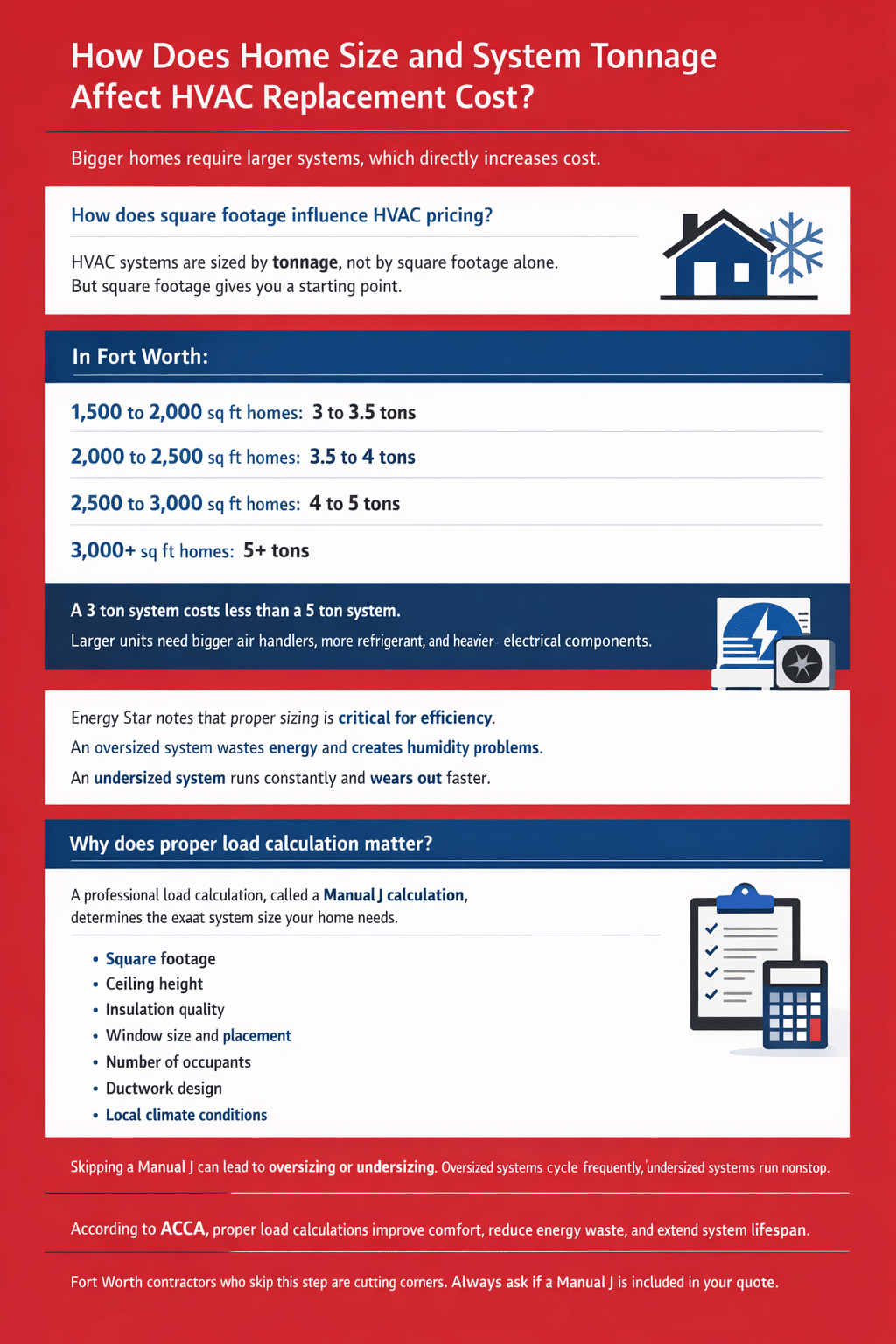
How Does Home Size and System Tonnage Affect HVAC Replacement Cost?
Bigger homes require larger systems, which directly increases cost.
How does square footage influence HVAC pricing?
HVAC systems are sized by tonnage, not by square footage alone. But square footage gives you a starting point.
In Fort Worth:
- 1,500 to 2,000 sq ft homes often need 3 to 3.5 tons
- 2,000 to 2,500 sq ft homes often need 3.5 to 4 tons
- 2,500 to 3,000 sq ft homes often need 4 to 5 tons
- 3,000+ sq ft homes may need 5+ tons
A 3 ton system costs less than a 5 ton system. The equipment itself is more expensive, and installation takes longer.
Larger systems also require bigger air handlers, more refrigerant, and heavier duty electrical components. All of this adds to the total price.
Energy Star notes that proper sizing is critical for efficiency. An oversized system wastes energy and creates humidity problems. An undersized system runs constantly and wears out faster.
Why does proper load calculation matter?
A professional load calculation, called a Manual J calculation, determines the exact system size your home needs.
This calculation factors in:
- Square footage
- Ceiling height
- Insulation quality
- Window size and placement
- Number of occupants
- Ductwork design
- Local climate conditions
Skipping a Manual J can lead to oversizing or undersizing. Both mistakes increase long term costs.
Oversized systems cycle on and off too frequently, which reduces efficiency and creates uneven temperatures. Undersized systems run nonstop, driving up energy bills and shortening equipment life.
According to ACCA (Air Conditioning Contractors of America), proper load calculations improve comfort, reduce energy waste, and extend system lifespan. It’s a step you should never skip.
Fort Worth contractors who skip this step are cutting corners. Always ask if a Manual J is included in your quote.
What Is Included in a Full HVAC Replacement Versus a Basic Change-Out?
Not all replacements include the same scope of work. Understanding the difference can save you from unexpected costs.
What does a basic HVAC change-out include?
A basic change-out is the most affordable option. It includes:
- New indoor and outdoor units (evaporator coil and condenser)
- Standard installation labor
- Refrigerant connection and system startup
That’s it. No thermostat upgrade. No ductwork inspection. No electrical updates.
This option works if your home’s infrastructure is already in good shape. But it leaves room for future problems.
What does a full HVAC replacement include?
A full replacement goes beyond swapping equipment. It includes:
- New HVAC equipment (condenser, air handler or furnace, evaporator coil)
- Thermostat replacement (often a programmable or smart thermostat)
- Electrical and drain line updates to meet current code
- Permit and inspection to ensure legal compliance
- Removal and disposal of old equipment
- System testing and commissioning to verify proper operation
Full replacements cost more upfront. But they reduce future repair risks and ensure your system meets Fort Worth building codes.
The International Code Council sets mechanical codes that require permits for HVAC replacement. Skipping permits can result in fines, insurance issues, or problems when selling your home.
Fort Worth requires permits for HVAC replacement. A licensed contractor handles this for you.
How Does the Fort Worth Climate Impact HVAC System Cost?
North Texas heat places heavy demand on cooling systems. That demand affects pricing.
Why do Fort Worth systems cost more than cooler regions?
Fort Worth averages over 100 days above 90°F each year. Summer temperatures regularly exceed 100°F.
This extreme heat requires:
- Higher capacity systems to handle peak cooling loads
- Stronger compressors that can sustain heavy use
- Better airflow design to maintain comfort during heat waves
All of this increases both equipment and installation costs.
According to NOAA’s National Centers for Environmental Information, Fort Worth’s climate zone demands robust cooling capacity. Systems installed here work harder and longer than those in milder climates.
Homeowners in cooler regions can get by with smaller, less expensive systems. In Fort Worth, undersizing your AC is a recipe for discomfort and premature failure.
How does humidity affect system selection?
Fort Worth’s summer humidity averages 60 to 70 percent. High humidity makes your home feel hotter and reduces comfort.
Proper dehumidification requires:
- Variable speed blowers that run longer at lower speeds
- Two stage or modulating compressors that adjust output
- Properly sized ductwork to maintain consistent airflow
These features add $1,000 to $3,000 to your total cost. But they’re worth it.
The EPA’s Indoor Air Quality guide recommends keeping indoor humidity between 30 and 50 percent. Standard systems struggle to hit this target in Fort Worth’s climate.
Variable speed systems remove more moisture without overcooling your home. They’re a smart investment for local conditions.
What Is the Cost Difference Between Replacing Only the AC, Only the Furnace, or the Entire System?
Homeowners often try to replace only what has failed. That’s not always the best financial decision.
When does replacing only the AC make sense?
If your furnace is under 10 years old and still running efficiently, replacing just the AC can save money upfront.
AC only replacement costs: $4,500 to $8,500
This includes the outdoor condenser, indoor evaporator coil, refrigerant lines, and labor.
But there’s a catch. Your new AC must be compatible with your existing furnace. Mismatched systems reduce efficiency and void warranties.
Carrier and other manufacturers recommend matched systems for optimal performance. Check compatibility before committing to AC only replacement.
When does replacing only the furnace make sense?
If your AC is relatively new but your furnace is failing, replacing just the furnace makes sense.
Furnace only replacement costs: $3,500 to $7,000
This includes the furnace unit, gas line connections, venting, electrical work, and installation labor.
Again, compatibility matters. A new high efficiency furnace may not pair well with an older AC.
When is full system replacement the smarter option?
If one component is over 12 to 15 years old, replacing everything at once avoids:
- Mismatched efficiency that wastes energy
- Higher labor costs later when the second component fails
- Repeated breakdowns that disrupt comfort
Full system replacement costs $7,500 to $15,000, but it’s often the best long term value.
According to Consumer Reports, replacing both components together ensures compatibility, maximizes efficiency, and extends equipment life.
You also avoid paying for labor twice. Installing both components at once is cheaper than two separate service calls.
How Do SEER2 and AFUE Efficiency Ratings Change HVAC Replacement Costs?
Efficiency ratings directly affect both upfront price and long term savings.
What are SEER2 and AFUE ratings?
SEER2 (Seasonal Energy Efficiency Ratio 2) measures cooling efficiency. Higher numbers mean better efficiency.
As of January 2023, new AC units must meet minimum SEER2 ratings set by the U.S. Department of Energy:
- South and Southwest regions (including Texas): Minimum 14 SEER2 for split systems
- High efficiency models: 16 to 22+ SEER2
AFUE (Annual Fuel Utilization Efficiency) measures furnace efficiency. It shows what percentage of fuel converts to heat.
- Standard efficiency furnaces: 80 percent AFUE
- High efficiency furnaces: 90 to 98+ percent AFUE
How much more does a high efficiency system cost?
Standard efficiency systems (14 to 16 SEER2, 80 percent AFUE) cost less upfront.
High efficiency systems (18+ SEER2, 95+ percent AFUE) can add $1,500 to $4,000 to your total price.
That increase comes from:
- More advanced compressors
- Variable speed blowers
- Better heat exchangers
- Enhanced refrigerant management
Are higher efficiency systems worth it in Fort Worth?
Yes. Fort Worth’s long cooling season makes high efficiency systems a smart investment.
A 14 SEER2 system uses about 25 percent more energy than an 18 SEER2 system.
Over a 15 year lifespan, the energy savings can offset the higher upfront cost.
Energy Star estimates that upgrading from a 10 year old system to a high efficiency model can reduce cooling costs by 20 to 40 percent.
Fort Worth’s average cooling season runs from May through September, with peak demand in July and August. Higher SEER2 ratings deliver bigger savings during these months.
If you plan to stay in your home for more than five years, high efficiency pays off.
What Hidden or Unexpected Costs Can Increase HVAC Replacement Prices?

How Much Does Labor Cost for HVAC Replacement in Fort Worth?
Labor is a major part of your total cost. Understanding this helps you evaluate quotes.
What percentage of the total cost is labor?
Labor typically accounts for 40 to 60 percent of the total HVAC replacement price.
On a $10,000 system, that’s $4,000 to $6,000 for labor alone.
Labor costs include:
- Removing old equipment
- Installing new equipment
- Connecting refrigerant lines
- Wiring electrical components
- Testing and commissioning
- Cleanup and disposal
According to Angi (formerly Angie’s List), labor rates vary by region. Fort Worth’s competitive market keeps labor rates reasonable compared to larger metros like Dallas.
Why does quality installation matter more than brand?
Even premium HVAC brands fail early if installed incorrectly.
Proper installation requires:
- Accurate refrigerant charge to prevent compressor damage
- Correct airflow to maintain efficiency and comfort
- Sealed ductwork to prevent energy loss
- Proper electrical connections to avoid safety hazards
According to Trane, improper installation is the leading cause of early system failure. Quality installation extends equipment life and maximizes efficiency.
Don’t choose a contractor based on price alone. Experience, licensing, and reputation matter more.
Ask for references. Check reviews on Google My Business and the Better Business Bureau. Verify licensing through the Texas Department of Licensing and Regulation.
Are Rebates, Tax Credits, or Financing Options Available in Fort Worth?
Many homeowners overlook available savings. Taking advantage of incentives reduces your out of pocket cost.
What incentives can reduce HVAC replacement cost?
Federal energy efficiency tax credits
The Inflation Reduction Act offers tax credits for high efficiency HVAC systems.
As of 2024, you can claim:
- Up to $2,000 for heat pumps
- Up to $600 for central AC systems
- Up to $2,000 for heat pump water heaters
These credits apply to systems that meet specific efficiency thresholds.
Check the IRS website for current requirements and deadlines.
Manufacturer rebates
HVAC manufacturers offer rebates on select models.
Rebates range from $300 to $1,500 depending on brand and efficiency level.
Check with manufacturers like Lennox, Carrier, and Trane for current offers.
Utility company incentives
Oncor Electric Delivery and other Texas utilities offer rebates for energy efficient HVAC upgrades.
Rebates vary by efficiency level and equipment type.
Check your utility provider’s website for available programs.
How does financing affect affordability?
Financing spreads costs over time, making higher efficiency systems more accessible without large upfront payments.
Many contractors offer financing through partners like GoodLeap or ServiceFinance.
Common financing options include:
- 0% APR for 12 to 24 months with approved credit
- Low interest loans for longer terms
- Deferred interest promotions that waive interest if paid in full
Monthly payments make high efficiency systems more affordable. Instead of paying $12,000 upfront, you might pay $250 per month for four years.
Always read the terms carefully. Deferred interest plans can charge retroactive interest if you don’t pay in full by the deadline.
When Does Replacing an HVAC System Cost Less Than Continuing Repairs?
This is often the most important question. Knowing when to stop repairing saves money long term.
When should homeowners stop repairing and replace instead?
Replacement usually makes sense when:
The system is over 12 to 15 years old
HVAC manufacturers estimate average system lifespans at 15 to 20 years. Once you pass 12 years, repair costs rise and efficiency drops.
Repairs exceed 30 percent of replacement cost
If a repair costs $3,000 and replacement costs $10,000, you’re spending 30 percent of replacement on a temporary fix.
At that point, replacement makes more financial sense.
Energy bills continue to rise
Aging systems lose efficiency. If your energy bills keep climbing despite normal usage, your system is working harder and costing more to run.
According to Energy Star, a 10 year old system can use 20 to 40 percent more energy than a new high efficiency model.
Comfort problems persist
If your home has hot and cold spots, high humidity, or inconsistent temperatures, your system isn’t performing properly.
Replacing it solves comfort issues that repairs can’t fix.
How does replacement save money long term?
New systems reduce repair costs, lower energy bills, and improve reliability during extreme Fort Worth summers.
Here’s how the math works:
Old system: $200 per month in cooling costs, $500 to $1,000 per year in repairs
New high efficiency system: $140 per month in cooling costs, minimal repairs under warranty
Annual savings: $720 in energy costs, $750 in avoided repairs = $1,470 per year
Over 10 years, that’s $14,700 in savings, which offsets the replacement cost.
Plus, you get better comfort, improved air quality, and peace of mind.
What Should Fort Worth Homeowners Do Before Replacing an HVAC System?
Before committing to replacement, take these steps to ensure you get the best value.
Get a load calculation
Insist on a Manual J load calculation from any contractor you’re considering.
This calculation determines the exact system size your home needs. It factors in square footage, insulation, windows, ceiling height, and local climate.
A proper load calculation prevents oversizing and undersizing, both of which cost you money.
According to ACCA, proper sizing improves comfort, reduces energy waste, and extends system lifespan.
Compare efficiency options
Ask contractors to quote both standard efficiency and high efficiency systems.
Compare upfront costs, energy savings, and payback periods.
High efficiency systems cost more initially but save money over time. In Fort Worth’s climate, the savings add up quickly.
Confirm permit inclusion
Ask if permits and inspections are included in the quote.
Permits cost $100 to $300 but are required by Fort Worth building codes.
Reputable contractors handle permits for you. Avoid anyone who suggests skipping this step.
Review warranties and labor coverage
HVAC warranties typically include:
- Parts warranty: 5 to 10 years from the manufacturer
- Labor warranty: 1 to 2 years from the contractor
Some manufacturers offer extended warranties for an additional fee.
Ask about:
- What’s covered
- How long coverage lasts
- Whether labor is included
- Registration requirements
Registering your system with the manufacturer within 60 to 90 days is often required to activate the full warranty.
Get multiple quotes
Get at least three quotes from licensed Fort Worth contractors.
Compare:
- Equipment brands and models
- Efficiency ratings
- Scope of work
- Warranty coverage
- Permit inclusion
- Total price
The lowest price isn’t always the best value. Look for contractors with strong reputations, proper licensing, and clear communication.
Check contractor credentials through the Texas Department of Licensing and Regulation and read reviews on Google and the BBB.
Conclusion
Replacing an HVAC system in Fort Worth is a significant investment, but it doesn’t have to be overwhelming.
Most Fort Worth homeowners pay $7,500 to $15,000 for a full system replacement, depending on home size, efficiency level, and installation complexity.
Understanding what drives costs helps you make smarter decisions. Proper system sizing, efficiency ratings, ductwork condition, and local climate all play a role.
Don’t focus only on upfront price. Factor in long term energy savings, repair costs, and comfort improvements.
Take advantage of federal tax credits, manufacturer rebates, and utility incentives. Financing options make high efficiency systems more affordable.
Work with licensed contractors who provide Manual J load calculations, handle permits, and offer strong warranties.
Ready to replace your HVAC system? Get a free quote from a trusted Fort Worth contractor today. Invest in comfort, efficiency, and peace of mind.
FAQs
How long does it take to replace an HVAC system in Fort Worth?
Most HVAC replacements take one to two days for a standard installation. Complex jobs involving ductwork modifications, electrical upgrades, or challenging access can take three to five days. Your contractor should provide a clear timeline during the estimate process.
Can I replace just the outdoor AC unit and keep my old indoor unit?
Technically yes, but it’s not recommended. Mismatched systems reduce efficiency and may void manufacturer warranties. If your indoor unit is over 10 years old, replacing both components together saves money long term and ensures optimal performance. Always verify compatibility with your contractor.
What HVAC brands are best for Fort Worth’s climate?
Reliable brands for Fort Worth include Carrier, Trane, Lennox, Rheem, and Goodman. All offer models designed for extreme heat and humidity. However, proper installation matters more than brand. Even premium brands fail early if installed incorrectly. Choose a reputable contractor over a specific brand.
Do I need to replace my thermostat when I replace my HVAC system?
Not always, but it’s often a good idea. New HVAC systems work best with compatible thermostats. If your current thermostat is more than 10 years old or doesn’t support your new system’s features, upgrading to a programmable or smart thermostat improves comfort and efficiency. Many contractors include thermostat replacement in full system packages.
How much can I save with a high efficiency HVAC system in Fort Worth?
High efficiency systems can reduce cooling costs by 20 to 40 percent compared to older models. On a typical Fort Worth home, that’s $600 to $1,200 per year in energy savings. Over a 15 year lifespan, you could save $9,000 to $18,000, which often offsets the higher upfront cost of high efficiency equipment.
Are HVAC financing options worth it?
Yes, if you choose the right plan. 0% APR financing for 12 to 24 months can make high efficiency systems affordable without interest charges. Longer term loans with low interest rates also work well. Avoid deferred interest plans that charge retroactive interest if not paid in full. Always read terms carefully and calculate total cost including interest.


