

When temperatures drop during a Texas cold snap, your heating system kicks into overdrive. It runs longer cycles, works harder, and puts stress on parts that may have been sitting idle for months.
Most homeowners don’t think about their furnace until something goes wrong. But here’s what you need to know: small maintenance issues can quietly turn into serious fire hazards. And if a fire starts, your insurance company will investigate whether you kept up with basic care.
An HVAC maintenance plan isn’t just about comfort or efficiency. It’s about safety and protection. It creates a documented record that proves you maintained your system responsibly. That record can make the difference between a smooth insurance claim and a denied payout.
In this guide, you’ll learn how heating systems become fire risks, why insurance companies investigate HVAC fires so closely, and how a maintenance plan protects both your home and your financial security.
If your system hasn’t been inspected in over a year, now is the time to schedule service. Don’t wait until something breaks or worse.
1. What Is an HVAC Maintenance Plan and How Does It Work?
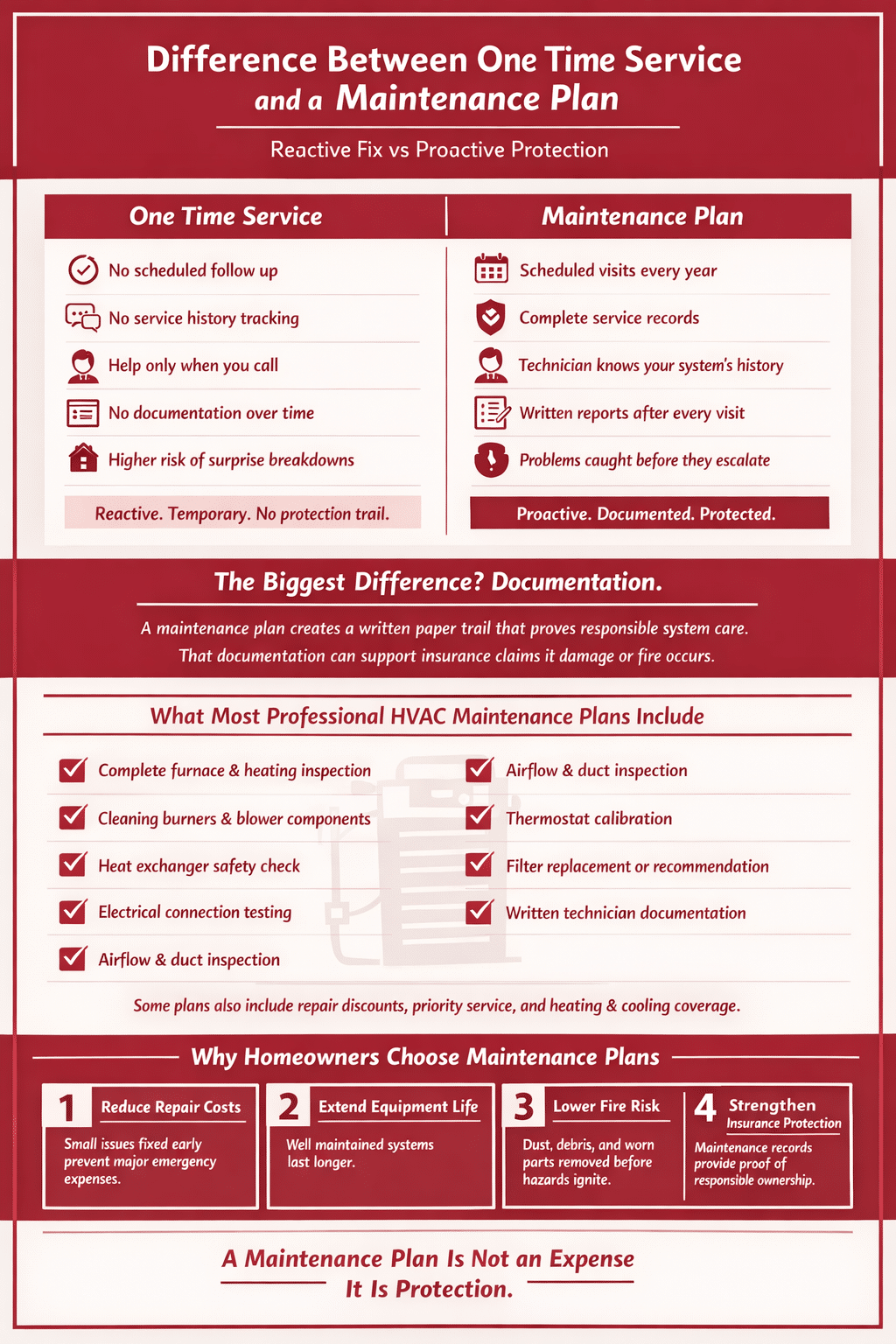
An HVAC maintenance plan is a scheduled service program where a licensed technician inspects, cleans, and documents your heating and cooling system at least once per year to keep it safe, efficient, and compliant with insurance expectations.
Think of it like regular oil changes for your car. You don’t wait until the engine seizes. You follow a schedule that prevents problems before they start.
2. Why HVAC Systems Work Harder During Texas Winters
Texas winters are unpredictable. You might wake up to 70 degree sunshine one day and a hard freeze the next.
That kind of temperature swing puts serious stress on your heating system.
• Texas Climate Realities
Texas doesn’t have a typical winter. Instead, you get sudden cold fronts that drop temperatures 30 or 40 degrees overnight.
When that happens, your furnace doesn’t just cycle on and off a few times. It runs continuously for hours, sometimes days, trying to keep your home warm.
That extended runtime creates mechanical stress. Motors that normally rest between cycles are running nonstop. Ignition systems fire repeatedly. Electrical components heat up and cool down over and over.
And because Texas homes aren’t always insulated for extreme cold, your system works even harder to compensate.
• Increased Mechanical Stress
When your furnace runs longer than usual, several things happen:
Motors run longer. Blower motors and fan motors that usually cycle a few times per hour are now running continuously. This generates heat and wears down bearings faster.
Ignition cycles increase. Gas furnaces ignite and reignite as they try to maintain temperature. Each ignition cycle creates a small burst of heat and stress on the igniter and burner assembly.
Electrical components heat up repeatedly. Capacitors, contactors, and wiring heat up during operation. Repeated heating and cooling can loosen connections and degrade insulation.
All of this stress happens at once during a cold snap. If your system hasn’t been maintained, weak points fail fast.
• Dust and Air Quality in Texas Homes
Texas air is dry, especially in winter. Dry air carries more dust, pollen, and particulates.
That dust settles inside your furnace. It coats burners, clogs blower wheels, and covers electrical components.
Clogged filters are common in Texas homes because filters fill up faster in dusty conditions. A dirty filter restricts airflow, which causes overheating.
Dust inside the furnace compartment can ignite if it contacts hot surfaces or open flames. This is one of the most common causes of HVAC fires.
When you combine mechanical stress from long run cycles with dust buildup from Texas air quality, you get a recipe for equipment failure and fire risk.
3. How Heating Systems Can Become Fire Hazards
Most people don’t realize how easily a furnace can become a fire hazard. It’s not a sudden event. It’s a slow accumulation of small problems.
Here are the most common ways heating systems turn dangerous.
• Dirty Air Filters and Overheating
Your air filter’s job is to keep dust out of the blower and heat exchanger. When it gets clogged, airflow drops.
Restricted airflow means your furnace can’t pull enough cool air through the system to balance the heat being generated. The furnace overheats.
Modern furnaces have a safety switch called a limit switch. When the temperature gets too high, the limit switch shuts the system down.
But if the filter stays dirty, the limit switch trips repeatedly. Over time, this damages the switch and stresses other components.
In older systems without working safety switches, overheating can cause the blower motor to burn out or ignite nearby dust and debris.
How a maintenance plan prevents it: Technicians check and replace filters during every visit. They also test airflow to make sure the system isn’t running hot.
• Dust Accumulation Inside Furnace Compartments
Even with a clean filter, dust still gets inside the furnace over time. It settles on burners, heat exchangers, and blower components.
When the burners ignite, dust near the flame can catch fire. This is called burner contamination.
Dust can also disrupt the flame pattern, causing irregular combustion. An irregular flame burns hotter in some spots and can damage the heat exchanger.
In gas furnaces, dust around the pilot light or igniter creates a fire risk every time the system starts.
How a maintenance plan prevents it: Technicians vacuum and clean the burner assembly, blower compartment, and surrounding areas. This removes combustible dust before it becomes a problem.
• Cracked Heat Exchangers
The heat exchanger is a metal chamber where combustion gases heat up the air that flows into your home. It’s designed to keep combustion gases separate from breathable air.
Over years of heating and cooling, the metal fatigues. Cracks develop.
A cracked heat exchanger is dangerous for two reasons:
- Flame rollout. Flames can escape through cracks and ignite dust or other materials outside the combustion chamber.
- Carbon monoxide leakage. Combustion gases, including carbon monoxide, can leak into your home’s air supply.
Cracks often develop slowly. They start small and grow over time, especially in systems that overheat frequently due to poor airflow.
How a maintenance plan prevents it: Technicians visually inspect the heat exchanger for cracks, rust, and structural damage. Catching a crack early prevents both fire risk and carbon monoxide poisoning.
• Electrical Failures
Furnaces use a lot of electricity. Motors, igniters, fans, and control boards all draw power through wiring and connections.
Over time, connections loosen. Wire insulation wears down. Electrical components degrade.
Loose wire connections create resistance, which generates heat. If the connection gets hot enough, it can arc and spark.
Arc faults are one of the leading causes of electrical fires in homes. They happen when electricity jumps across a gap in a connection, creating a small spark.
Worn insulation exposes bare wires. If two wires touch, they short circuit. This creates intense heat that can ignite nearby materials.
Overloaded circuits happen when your furnace draws more power than the circuit can handle. This is common in older homes with outdated wiring.
How a maintenance plan prevents it: Technicians tighten all electrical connections, inspect wiring for damage, and test capacitors and contactors. They catch worn components before they fail.
• Blocked or Closed Supply Vents
Many homeowners close vents in unused rooms to save energy. This seems logical, but it creates a dangerous pressure imbalance.
When too many vents are closed, the furnace can’t push air through the system efficiently. Pressure builds up inside the ductwork.
This causes several problems:
Heat buildup in the furnace because air isn’t moving fast enough to carry heat away.
Stress on the blower motor because it’s working harder to push air through restricted ducts.
Overheating that trips the limit switch repeatedly.
In extreme cases, blocked vents can cause the furnace to overheat so badly that internal components ignite.
How a maintenance plan prevents it: Technicians measure static pressure and airflow. They’ll tell you if you’re blocking too many vents and creating unsafe conditions.
4. Are HVAC Fires Common in Texas Homes?
HVAC fires happen more often than most people realize. Nationally, heating equipment is one of the leading causes of home fires.
• National Heating Equipment Fire Data
According to the National Fire Protection Association (NFPA), heating equipment causes an average of 48,000 home fires per year in the United States.
These fires result in hundreds of deaths, thousands of injuries, and over a billion dollars in property damage annually.
The majority of these fires are preventable. They happen because of dirty equipment, mechanical failure, or lack of maintenance.
• Texas Specific Factors
Texas has unique factors that increase HVAC fire risk:
Aging systems. Many Texas homes, especially in established neighborhoods, have HVAC systems that are 15 to 20 years old or older. Older systems are more likely to fail.
Infrequent maintenance culture. Because Texas winters are mild compared to northern states, some homeowners don’t prioritize heating system maintenance. They assume the system is fine because it worked last year.
Older ductwork in longstanding homes. Homes built in the 1970s, 80s, and 90s often have original ductwork that’s dirty, damaged, or poorly sealed. This increases fire risk.
• Why Most HVAC Fires Are Preventable
The good news is that most HVAC fires don’t happen suddenly. They’re the result of gradual neglect.
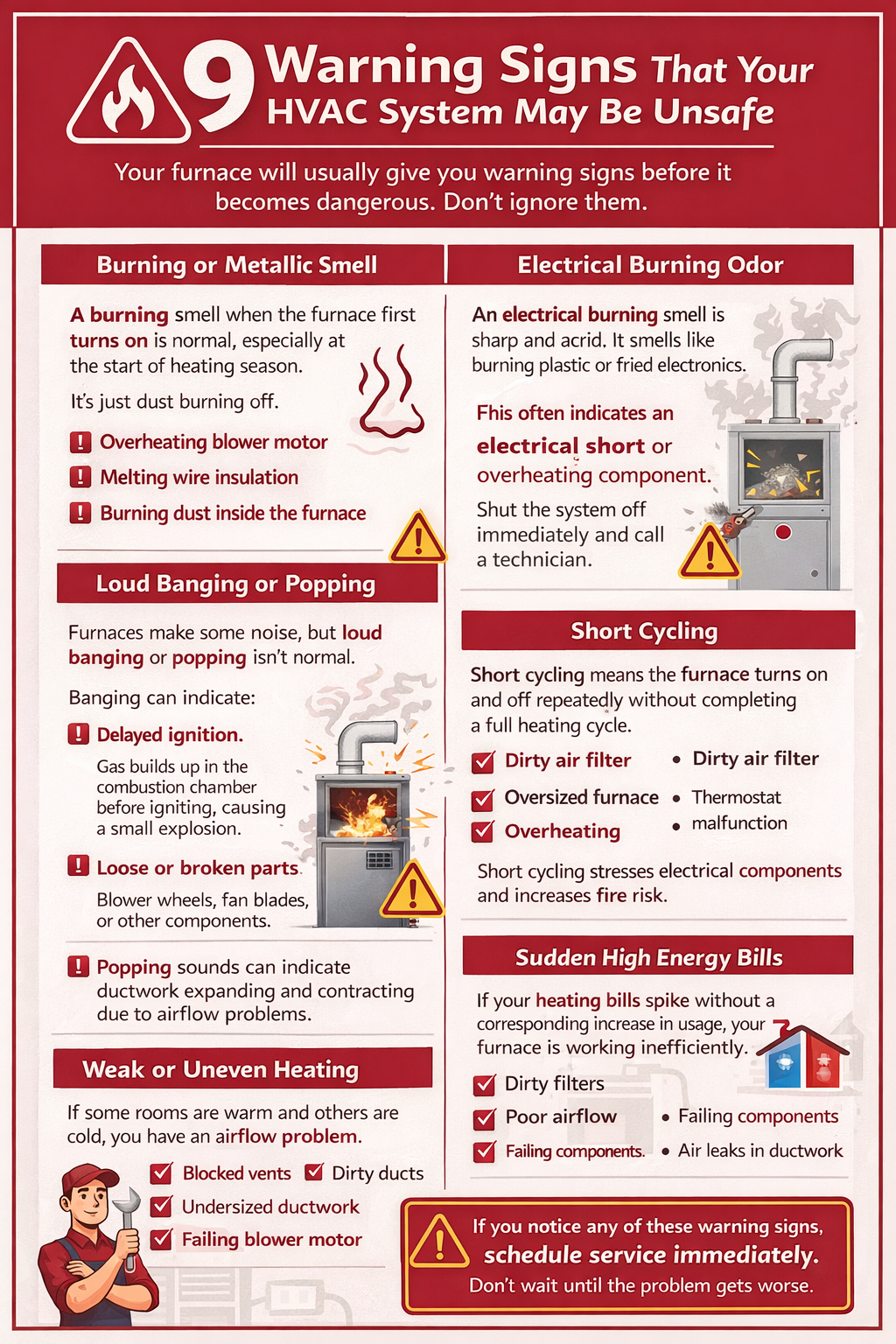
Warning signs are usually present for weeks, months, or even years before a fire starts. Strange smells, unusual noises, uneven heating, and higher energy bills are all red flags.
If you catch these signs early and address them, you can prevent a fire before it happens.
That’s why a maintenance plan matters. It catches problems while they’re still small.
5. Does Homeowners Insurance Cover HVAC Fires?
Yes, most standard homeowners policies cover fire damage, including fires that originate in your HVAC system. However, coverage may be reduced or denied if the insurer determines the fire resulted from long term neglect or failure to maintain the property.
Let’s break that down.
• Covered Perils vs Exclusions
A typical homeowners insurance policy covers fire as a named peril. This means if your home is damaged by fire, the insurance company will pay to repair or rebuild it.
This includes fires that start in your HVAC system, as long as the fire was sudden and accidental.
But there’s a catch. Insurance policies don’t cover damage caused by:
Wear and tear. Normal aging and deterioration aren’t covered.
Gradual deterioration. Damage that happens slowly over time isn’t covered.
Failure to maintain. If the insurance company determines you didn’t take reasonable care of your property, they can reduce or deny your claim.
This is where HVAC fires get complicated. If a fire starts because you never changed the filter or ignored obvious warning signs, the insurer might argue that you failed to maintain the system.
• What Insurance Adjusters Look For
When a fire happens, the insurance company sends an adjuster to investigate. Their job is to determine the cause of the fire and whether the policyholder acted responsibly.
For HVAC fires, adjusters look at:
System age. How old is the furnace? Is it past its expected lifespan?
Service history. Do you have records showing the system was maintained regularly?
Evidence of unresolved problems. Were there warning signs you ignored?
If you can’t provide service records, the adjuster may assume you neglected the system. That assumption can cost you thousands of dollars in denied claims or reduced payouts.
6. Why Insurance Companies Investigate HVAC Related Fires Closely
Insurance companies don’t just write checks. They investigate every claim to make sure it’s legitimate and covered under the policy.
HVAC fires get extra scrutiny because they’re often preventable.
• Fire Origin Analysis
After a fire, investigators examine the burn patterns, electrical systems, and mechanical components to determine where and how the fire started.
For HVAC fires, this includes:
Burn pattern examination. Where did the fire start? Did it originate in the furnace, ductwork, or electrical panel?
Electrical inspection. Were there signs of arcing, short circuits, or overloaded wiring?
Mechanical failure analysis. Did a component fail? Was the failure due to a defect or lack of maintenance?
Investigators can tell the difference between a sudden mechanical failure and a problem that developed over time due to neglect.
• Maintenance History Review
One of the first things the insurance company will ask for is proof of maintenance.
They’ll request:
Invoices from HVAC companies. Did you have the system serviced regularly?
Service dates. When was the last time a technician inspected the system?
Repair documentation. If you had repairs done, do you have receipts?
If you can’t provide this documentation, the insurance company may argue that you didn’t take reasonable care of your property.
This is especially true for older systems. If your furnace is 15 years old and you can’t prove it was ever maintained, that’s a red flag to the adjuster.
• Older Systems Face More Scrutiny
Systems that are 15 years or older are more likely to be investigated closely.
Why? Because older systems are more prone to failure. Heat exchangers crack, electrical components wear out, and motors degrade.
If your system is old and poorly maintained, the insurance company may argue that the fire was inevitable and that you should have replaced the system sooner.
Repeated repair history is another red flag. If your furnace has been repaired multiple times in recent years, the adjuster may question why you didn’t replace it.
The burden of proof shifts to you. You need to show that you took reasonable care of the system despite its age.
7. How an HVAC Maintenance Plan Protects Your Insurance Claim
A maintenance plan doesn’t just keep your system running safely. It creates a documented record that protects you during an insurance claim.
Here’s how.
• Consistent Documentation
Every time a technician services your system, they create a written report. This report includes:
Annual service reports with the date, technician name, and work performed.
Technician notes describing the condition of the system and any recommendations.
Repair logs showing what was fixed and when.
This documentation proves you maintained the system regularly. It shows the insurance company that you acted responsibly.
Without this documentation, you’re relying on your word alone. And in a fire claim, your word isn’t enough.
• Proof of Reasonable Care
Insurance policies require policyholders to take reasonable care of their property. This is called the duty to mitigate loss.
For HVAC systems, reasonable care means:
- Changing filters regularly
- Scheduling annual inspections
- Addressing repairs promptly
- Replacing systems that are unsafe or beyond repair
A maintenance plan demonstrates that you met this duty. It shows you didn’t neglect the system.
This reduces the insurance company’s ability to argue that you were negligent. It shifts the focus from your behavior to the mechanical failure itself.
• Easier Claims Process
When you have documentation, the claims process goes faster.
The adjuster doesn’t have to guess whether you maintained the system. They can see the service records. They know a licensed technician inspected the furnace and found it safe.
This leads to:
Faster approval. The insurance company can process the claim without extensive investigation.
Less dispute risk. There’s less room for the insurer to argue neglect.
Reduced payout reductions. You’re more likely to receive the full amount you’re entitled to.
For Texas homeowners, this protection is critical. Fire damage can cost tens of thousands of dollars. A denied or reduced claim can devastate your finances.
A maintenance plan is a small investment that protects a much larger asset: your home.
8. What Is Included in a Professional HVAC Maintenance Plan in Texas?
Not all maintenance plans are created equal. A professional HVAC Maintenance Plan should include thorough inspections and testing, not just a quick look at the filter.
Here’s what you should expect.
• Combustion Safety Testing
For gas furnaces, combustion safety is critical. The technician should test:
– Gas pressure check. Is the gas pressure within the manufacturer’s specifications? Too much or too little pressure affects combustion and safety.
– Flame sensor cleaning. The flame sensor detects whether the burner is lit. If it’s dirty, the furnace won’t stay on. Cleaning it ensures reliable operation.
– Burner alignment. Burners should produce a steady, blue flame. If the flame is yellow, flickering, or uneven, the burners need adjustment.
• Electrical Component Testing
Electrical failures are a leading cause of HVAC fires. The technician should inspect and test:
– Capacitor testing. Capacitors store electrical energy to start motors. A failing capacitor can cause the motor to overheat or fail to start.
– Contactor inspection. The contactor is a switch that controls power to the compressor and fan. Worn contacts create resistance and heat.
– Wire tightening. Loose connections cause arcing and heat buildup. The technician should tighten all electrical terminals.
• Heat Exchanger Inspection
The heat exchanger should be inspected for:
– Visual crack detection. The technician uses a flashlight and mirror to look for cracks, rust, or holes.
– Structural integrity check. Is the heat exchanger warped or sagging? These are signs of stress and potential failure.
A cracked heat exchanger is a serious safety issue. If found, the furnace should be shut down immediately.
• Airflow and Static Pressure Testing
Proper airflow is essential for safe operation. The technician should measure:
– Static pressure. This measures the resistance to airflow in your ductwork. High static pressure means the system is working too hard.
– Balanced airflow. The technician ensures air is distributed evenly throughout your home.
Poor airflow causes overheating, short cycling, and premature equipment failure.
• Thermostat and Control Calibration
Your thermostat controls when the system runs. If it’s not calibrated correctly, your furnace may:
– Short cycle. Turn on and off too frequently, which stresses components.
– Run too long. Overheat and waste energy.
The technician should test and calibrate the thermostat to ensure accurate temperature control.
• Written Service Documentation
At the end of every visit, you should receive a signed inspection report with a detailed HVAC maintenance checklist.
This report should include:
- Date of service
- Technician name and license number
- Components inspected
- Problems found
- Recommendations for repairs or replacement
- Confirmation that the system is safe to operate
Keep these reports in a safe place. They’re your proof of maintenance.
9. Warning Signs That Your HVAC System May Be Unsafe
10. Cost of an HVAC Maintenance Plan in Texas
One of the most common questions homeowners ask is: how much does a HVAC maintenance plan cost?
• Average Annual Cost Range
In Texas, a typical HVAC maintenance plan costs between $150 and $400 per year, depending on the provider and what’s included.
Some plans cover just heating or cooling. Others cover both. Plans that include both systems usually cost more, but they provide year round protection.
• Factors That Influence Price
Several factors affect the cost of a maintenance plan:
– System size. Larger systems require more time to inspect and service, so plans cost more.
– Number of units. If you have multiple HVAC units in your home, you’ll pay more. Some companies offer discounts for multiple units.
– Age. Older systems may require more frequent inspections or additional services, which can increase the cost.
– Level of plan coverage. Basic plans include one or two visits per year. Premium plans may include unlimited service calls, priority scheduling, and repair discounts.
• Cost Comparison
Let’s put the cost in perspective.
– Maintenance plan vs emergency repair:
A maintenance plan costs $150 to $400 per year. An emergency repair on a cold winter night can cost $500 to $1,500 or more.
Catching a small problem during a maintenance visit can save you hundreds or thousands of dollars in emergency repairs.
– Maintenance plan vs fire damage deductible:
If your furnace causes a fire, you’ll have to pay your homeowners insurance deductible before coverage kicks in. Deductibles typically range from $1,000 to $5,000.
A $200 maintenance plan that prevents a fire is a lot cheaper than a $2,500 deductible.
– Long term savings:
A well maintained furnace lasts longer. In Texas, the average HVAC system lasts 12 to 15 years. With proper maintenance, you can extend that to 15 to 20 years.
Replacing a furnace costs $3,000 to $7,000 or more. If you can delay replacement by even two or three years through regular maintenance, you’ve saved thousands.
A maintenance plan isn’t an expense. It’s financial protection.
Conclusion
Your heating system is one of the hardest working appliances in your home. During Texas cold snaps, it runs for hours or even days at a time.
That kind of stress reveals weak points. Dirty filters, dust buildup, worn electrical connections, and aging heat exchangers can all turn into fire hazards.
And if a fire happens, your insurance company will investigate. They’ll ask for proof that you maintained the system. Without that proof, your claim could be reduced or denied.
An HVAC maintenance plan protects you in two ways. It keeps your system safe by catching problems early. And it creates a documented record that proves you acted responsibly.
For $150 to $400 per year, you get safety, peace of mind, and insurance protection. That’s a small price to pay to protect your home and your family.
Don’t wait until something breaks. Schedule your inspection today.
R10 Heat and Air , 817-395-1200 , leroy@rtenservice.com , www.r10heatandair.com
FAQ Section About HVAC Maintenance Plan
What is an HVAC maintenance plan?
An HVAC maintenance plan is a scheduled service agreement where a licensed technician inspects, cleans, and documents your heating and cooling system at least once per year. The plan includes safety checks, component testing, filter replacement, and written service reports. It’s designed to keep your system running safely and efficiently while creating a record of regular care.
Is an HVAC maintenance plan worth it in Texas?
Yes. Texas has unpredictable winters with sudden cold fronts that put stress on heating systems. Dry air and high dust levels in Texas homes cause filters to clog faster and dust to accumulate inside the furnace. A maintenance plan catches these problems before they cause breakdowns or fires. It also creates documentation that protects your insurance claim if something goes wrong. For $150 to $400 per year, it’s a smart investment.
Does insurance require HVAC maintenance?
No. Homeowners insurance policies don’t formally require you to maintain your HVAC system. However, most policies include language requiring you to take reasonable care of your property. If a fire happens and the insurance company determines you neglected maintenance, they can reduce or deny your claim. A maintenance plan proves you met this duty.
How often should HVAC systems be serviced?
At minimum, your HVAC system should be serviced once per year. Ideally, you should schedule service twice per year: once before heating season and once before cooling season. In Texas, where systems run year round, twice per year service catches problems before they escalate.
Can lack of maintenance cause insurance denial?
Yes. If a fire investigator determines the fire resulted from long term neglect or failure to maintain the system, the insurance company can reduce or deny your claim. This is especially true for older systems. Without service records proving regular maintenance, the burden of proof shifts to you. A maintenance plan eliminates this risk.
How long do HVAC systems last in Texas?
The average HVAC system in Texas lasts 12 to 15 years. However, with regular maintenance, you can extend that lifespan to 15 to 20 years. Texas systems work harder than systems in milder climates because they run year round, which is why maintenance is so important.
Can I document filter changes myself?
Yes. If you change your own filters, take photos and keep receipts. Document the date you changed the filter and store the records in a safe place. However, self documented filter changes aren’t a substitute for professional maintenance. Insurance adjusters look for service records from licensed technicians, not just proof you changed the filter.
What happens if I skip maintenance for years?
Skipping maintenance for years increases your risk of mechanical failure and fire. Dust builds up, components wear out, electrical connections loosen, and heat exchangers crack. Small problems turn into expensive repairs or dangerous conditions. If a fire happens, you’ll have no documentation to prove you maintained the system. This can result in a denied insurance claim.


