

You just spent more than $8,000 on a new HVAC system. The salesperson mentioned a 10-year warranty. You feel protected.
Then three years later, your AC stops working on the hottest day of summer.
The technician tells you it’s a failed capacitor. The part is covered under warranty. Great news, right?
Then comes the bill: $425.
Wait. What?
This confusion happens thousands of times every day across the country. Homeowners expect their warranty to mean “free repairs.” But that’s not how HVAC warranties actually work.
I’m going to walk you through exactly what your warranty covers, what it doesn’t, and why you’ll still pay for repairs even when parts are free. No industry jargon. No runaround. Just the straight truth about what the warranty on your new HVAC system really means.
By the end of this article, you’ll know exactly what to expect when something goes wrong, and you’ll never be blindsided by a repair bill again.
Let’s start with the basics.
How HVAC Manufacturer Warranties Typically Work?
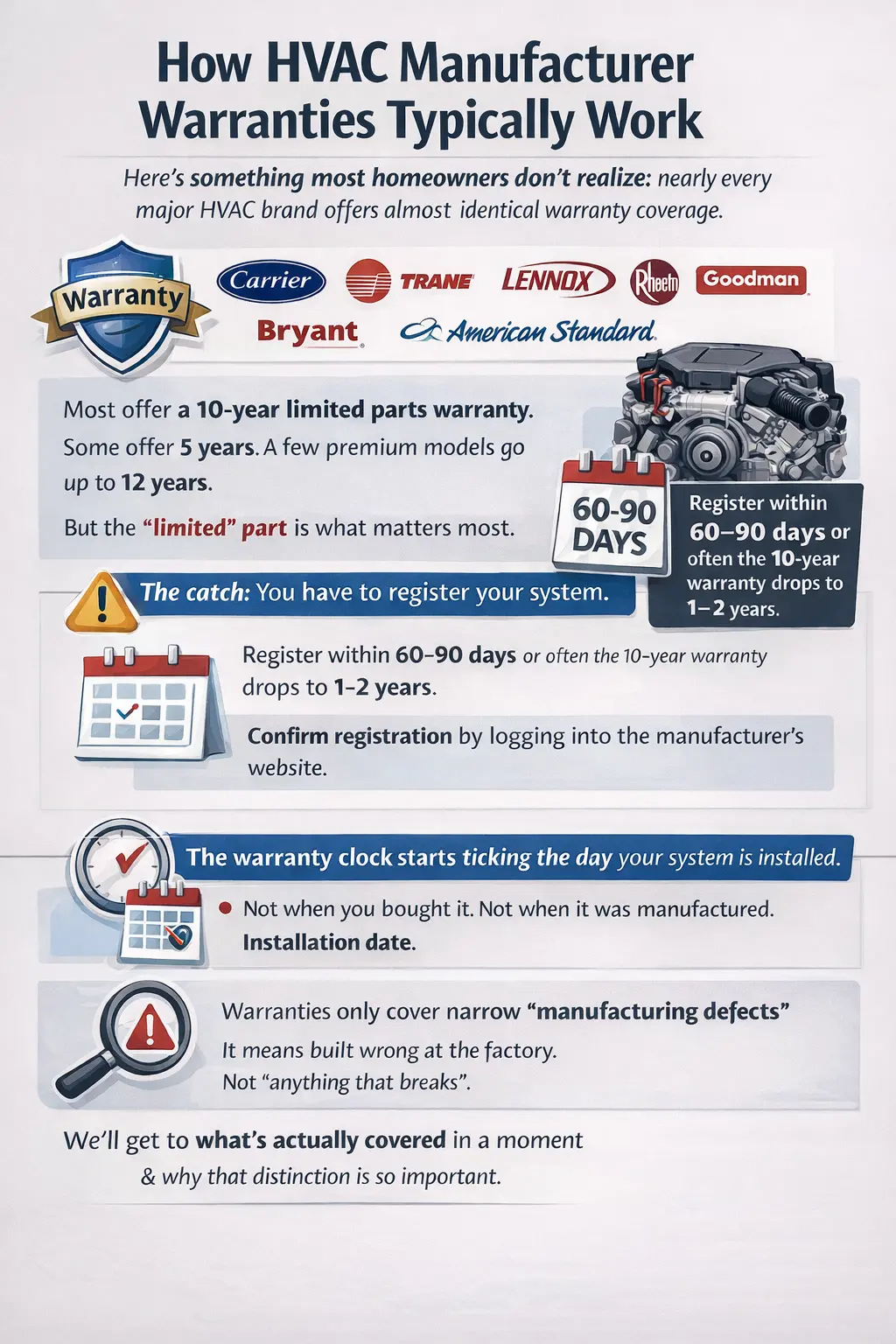
Here’s something most homeowners don’t realize: nearly every major HVAC brand offers almost identical warranty coverage.
Carrier, Trane, Lennox, Rheem, Goodman, Bryant, American Standard. They all follow the same basic structure.
Most offer a 10-year limited parts warranty. Some offer 5 years. A few premium models stretch to 12 years. But the “limited” part is what matters most.
And here’s the catch that trips people up: you have to register your system.
If you don’t register within 60 to 90 days of installation, your 10-year warranty often drops to just one or two years. Your installer should handle this, but it’s worth verifying. Log into the manufacturer’s website with your model and serial number to confirm.
The warranty clock starts ticking the day your system is installed. Not when you bought it. Not when it was manufactured. Installation date.
One more thing: these warranties only cover manufacturing defects. That’s a narrow definition. It doesn’t mean “anything that breaks.” It means something was built wrong at the factory.
That distinction becomes really important when we get to what’s actually covered.
What Is Covered Under the Warranty on My New HVAC System?
Let’s break this down year by year, because coverage changes over time.
First Year Coverage
The first year is when you have the most protection.
The manufacturer covers all parts that fail due to manufacturing defects. That includes compressors, motors, coils, heat exchangers, control boards, fan blades, the works.
But here’s what makes year one special: most reputable HVAC installers also provide a labor warranty for the first year.
This means if something goes wrong in year one, both the part and the installation labor are covered. You might pay a service call fee, usually $75 to $150, but that’s it.
If a compressor fails in month six, you’re not paying $1,200 for the labor to replace it. Your installer eats that cost.
This is why year one is your golden period. Minimal out of pocket expense if something genuinely breaks.
Years 2 Through 10 Parts Coverage
After year one, things change.
The manufacturer still covers replacement parts for manufacturing defects. But now you’re on your own for labor.
Here’s what’s typically covered under the parts warranty:
Compressors. The heart of your system. If it fails due to a manufacturing defect, the manufacturer sends a replacement.
Motors. Blower motors, condenser fan motors, inducer motors. All covered if they fail from defects.
Coils. Both evaporator coils inside and condenser coils outside. These are expensive components, so having them covered matters.
Heat exchangers. In furnaces, these can crack. When they do, it’s a serious safety issue. Most manufacturers offer extended coverage on heat exchangers, sometimes lifetime limited warranties.
Control boards. The electronic brains of your system. When they go bad, the replacement part is covered.
That sounds like pretty good coverage, right?
It is. But here’s what it doesn’t tell you.
The manufacturer covers the wholesale cost of the part. They don’t cover the diagnosis. They don’t cover the technician’s time. They don’t cover the truck that brought the technician to your house.
And they definitely don’t cover refrigerant, installation supplies, or any of the ancillary costs that come with actually making the repair happen.
That’s where the surprise bills come from.
Important: Dig out your actual warranty certificate and read it. What I’m describing here is typical, but your specific coverage might vary. Some manufacturers have quirks. Some models have exceptions. Know what you actually have.
What the HVAC Warranty Does Not Cover?
This is the section that will save you from sticker shock.
Labor Costs
After the first year, labor is almost never covered by the manufacturer’s warranty.
You pay for everything except the physical part itself.
That includes:
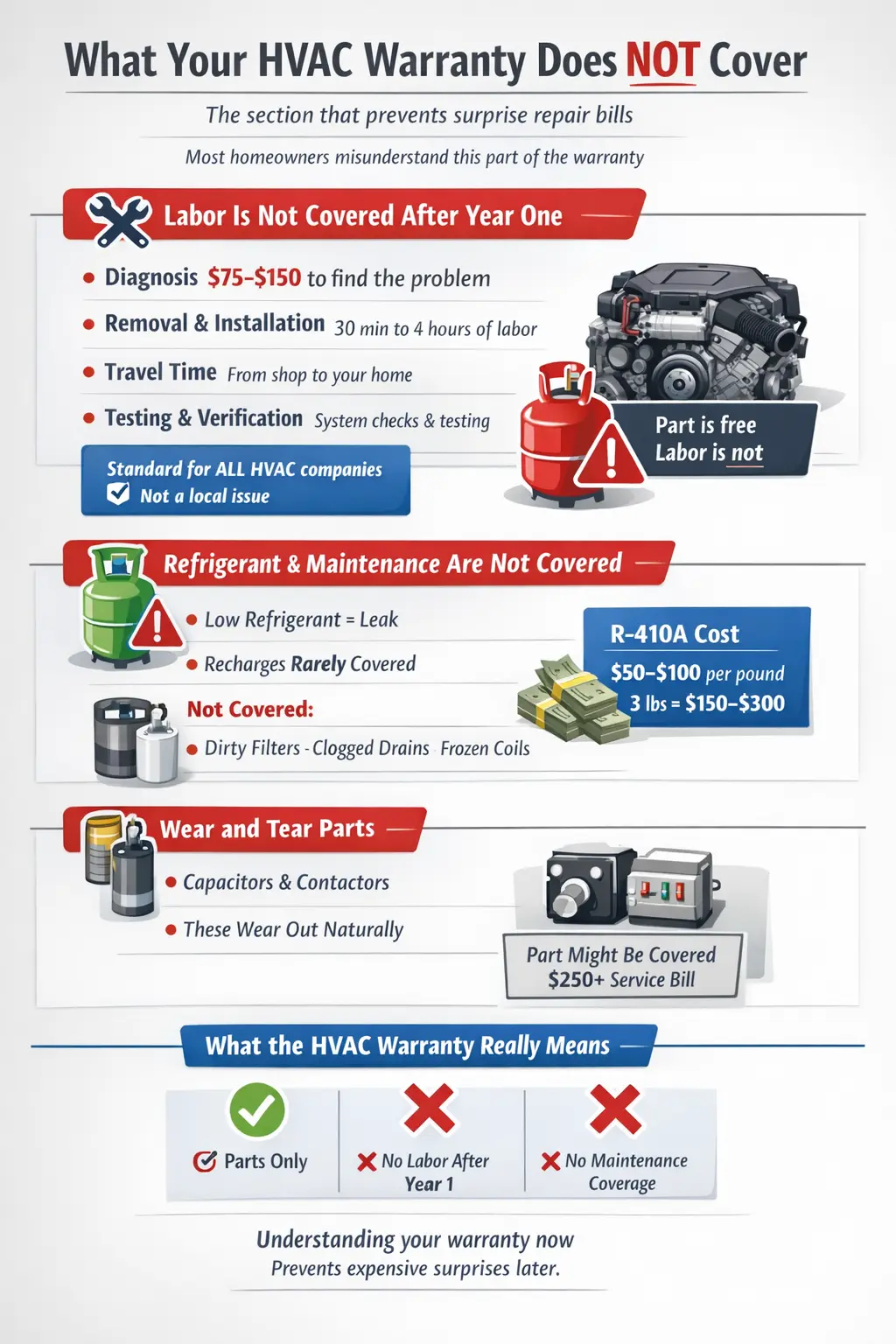
Diagnosis. The technician has to figure out what’s wrong. That takes time, testing equipment, and expertise. Most companies charge $75 to $150 for a diagnostic visit.
Removal and installation. Someone has to physically take out the broken part and install the new one. Depending on what broke, this could take 30 minutes or four hours.
Travel time. The service truck doesn’t drive itself to your house. You’re paying for the technician’s time from the moment they leave the shop.
Testing and system verification. After the HVAC repair, the tech has to make sure everything works properly. They’ll run the system, check pressures, verify temperatures, and document the repair.
This is standard across the entire HVAC industry. It’s not your local company being greedy. It’s how warranties work for every manufacturer.
Think of it this way: if your car engine fails under warranty, the dealer gives you a new engine. But you still pay for the mechanic to install it. Same principle.
Refrigerant and Maintenance Related Costs
Here’s another big one: refrigerant is rarely covered under warranty.
If your system is low on refrigerant, that’s almost never a manufacturing defect. It means there’s a leak somewhere, or it wasn’t charged correctly during HVAC installation.
Recharges are not warrantied unless they’re directly tied to a covered component failure. And even then, you’re usually paying for the refrigerant itself.
A pound of R-410A refrigerant can cost $50 to $100 or more depending on market prices. If your system needs three pounds, that’s $150 to $300 right there, and it’s not covered.
Routine maintenance issues are excluded entirely. Dirty filters, clogged drains, frozen coils from restricted airflow—none of that is a manufacturing defect.
If you don’t change your filter and your evaporator coil ices up and damages the blower motor, that’s on you. The warranty won’t cover it.
This is why maintenance matters. More on that later.
Wear Items and Expendable Parts
Some parts wear out naturally over time. They’re consumable items, like brake pads on a car.
Capacitors are the perfect example.
Capacitors help start motors and keep them running. They’re electrical components that degrade naturally with use. They might last three years. They might last ten.
When a capacitor fails, is it a manufacturing defect? Or is it normal wear and tear?
Most manufacturers treat capacitors as wear items. Same with contactors, which are electrical switches that cycle on and off thousands of times.
Here’s the frustrating part: even if the manufacturer agrees to cover the part under warranty, you’re still paying labor.
So if a $15 capacitor fails, and the part is technically warrantied, you might still get a $300 bill because you’re paying for the diagnosis, the service call, and the installation.
Homeowners hate this. But it’s reality.
Common Scenario: The “Cheap” Repair That Isn’t Free
Let me walk you through a real-world example that happens constantly.
It’s July. Your AC stops working. The house is getting hot.
You call an HVAC company. They send a technician out the next day.
The tech runs diagnostics. He checks the thermostat, inspects the outdoor unit, tests voltage and amperage. Takes about 30 minutes.
He finds the problem: the start capacitor has failed.
He gives you the estimate: $250 to $650, depending on whether he has the part on his truck or needs to source it.
You’re confused. “Isn’t this covered under warranty? My system is only four years old.”
Here’s what’s actually happening.
The capacitor itself might wholesale for $8 to $20. It’s a small cylindrical component about the size of a Red Bull can.
But you’re not paying for the part. You’re paying for:
The diagnostic visit. That’s $75 to $150 right there, because the tech had to figure out what was wrong.
The technician’s time. He’s trained, licensed, and certified. His labor rate might be $100 to $150 per hour.
The service truck. It’s stocked with parts, tools, gauges, and costs money to operate.
Testing after the repair. The tech installs the new capacitor, starts the system, and verifies everything is running correctly.
If the part is already on the truck, the repair happens immediately. Total cost might be $250 to $350.
If the part has to be ordered or picked up, you’re paying for an extra trip. Now you’re at $450 to $650.
None of this is covered by your manufacturer’s warranty. It’s all labor and service costs.
This is why a “cheap” repair still costs hundreds of dollars, even when you have a valid warranty.
Major Repairs: Why a “Free” Part Can Still Cost $1,200 to $1,500
Small repairs are one thing. Major component failures are where costs really add up.
Blower Motor Example
Let’s say your blower motor fails in year five. This is the motor that pushes air through your ductwork.
Good news: the manufacturer covers the replacement motor under warranty. The part might retail for $400 to $800, and you’re getting it for free.
Bad news: you’re about to get a bill for $1,200 to $1,500.
Here’s why.
Diagnosis and travel. The technician has to come out, diagnose the problem, and verify it’s actually a motor failure. That’s one visit, usually $100 to $150.
Warranty verification. The tech contacts the manufacturer or distributor, confirms the warranty status, and orders the part. This involves office time that gets billed to your job.
Part sourcing and pickup. The motor has to be ordered and picked up from the supplier. The tech might need to make a special trip to the parts house. That’s more time and mileage.
Installation and alignment. Replacing a blower motor isn’t a five-minute job. The tech has to access the air handler, disconnect electrical connections, remove the blower assembly, swap the motor, reinstall everything, and ensure proper alignment.
System testing. After installation, the tech runs the system, checks airflow, verifies temperatures, and makes sure there are no vibration or noise issues.
Return of failed part. Many manufacturers require the failed part to be returned to verify the warranty claim. The tech has to document, photograph, and ship the old motor back.
Total labor hours? Three to five hours isn’t uncommon, especially when you account for multiple trips.
At $100 to $150 per hour, you’re looking at $300 to $750 in labor alone. Add the service call, and you’re easily at $1,000 to $1,200.
That’s for a “free” part.
Larger Component Repairs
The same principle applies to bigger components.
Compressor replacements. Even though the part is free, you’re paying for refrigerant recovery, system evacuation, compressor installation, vacuum procedures, leak testing, and recharging the system. Total cost: $1,500 to $2,500 or more.
TXV valves. Thermostatic expansion valves regulate refrigerant flow. When they fail, it requires recovering refrigerant, replacing the valve, evacuating the system, and recharging. Cost: $800 to $1,500.
Coil replacements. Evaporator or condenser coils are covered, but installation is labor intensive. Recovery, installation, brazing, pressure testing, evacuation, and recharge. Cost: $1,200 to $2,500.
Control boards. These are usually easier, but you’re still paying for diagnosis, programming, and system verification. Cost: $400 to $800.
Here’s the kicker: refrigerant is never covered under parts warranties.
If a compressor fails and the system needs four pounds of R-410A at $75 per pound, that’s $300 in refrigerant alone. It’s not a part. It’s a consumable. You pay for it.
Same with brazing supplies, nitrogen for leak testing, vacuum pump time, oil, filter driers, and any other materials needed to complete the repair.
The “free” part is just one piece of a much bigger expense.
Why These Costs Are Normal and Not a Scam
I know this sounds frustrating. Some homeowners feel ripped off.
But here’s the reality of running an HVAC service business.
Licensed and certified technicians. Your tech went through years of training. They hold EPA certifications, state licenses, and manufacturer certifications. They’re not minimum wage workers. They’re skilled tradespeople earning $50,000 to $80,000 per year, and you’re paying for that expertise.
Specialized equipment. HVAC work requires expensive tools. Refrigerant recovery machines cost $2,000 to $3,000. Vacuum pumps, manifold gauges, leak detectors, multimeters, and diagnostic tablets add thousands more. That equipment has to be maintained and calibrated.
Insured service vehicles. The trucks you see driving around are fully stocked with parts, tools, and safety equipment. They’re insured, maintained, and cost $50,000 to $70,000 each. Fuel, insurance, and maintenance aren’t free.
Supplier and manufacturer processes. When a tech orders a warranty part, someone at the supply house has to pull it, verify it, and process the paperwork. Someone at the HVAC company has to coordinate with the manufacturer. This is real labor that gets billed somewhere.
Office labor for warranty claims. Filing warranty claims takes time. Photos, serial numbers, failure descriptions, technician notes—it all has to be documented and submitted. Larger companies have staff dedicated to this.
Overhead costs. Rent, utilities, phone systems, scheduling software, accounting, insurance, worker’s comp, payroll taxes. These are real costs that get factored into labor rates.
A typical HVAC service company operates on 10% to 15% profit margins after all expenses. They’re not getting rich off your repair.
This isn’t a scam. It’s a business providing skilled labor using expensive equipment.
You’re paying for the service, not the part.
How to Reduce Surprise Costs With a New HVAC System
Now that you know how warranties actually work, let’s talk about protecting yourself.
Review Your Warranty Documents
This should be step one after installation.
Find your manufacturer warranty certificate. It usually comes in the paperwork your installer left behind, or it was emailed to you after registration.
Read the fine print. Know exactly what’s covered and for how long.
Check whether you registered the system. Log into the manufacturer’s website with your model and serial number. Confirm registration. If it’s not registered and you’re still within the 60 to 90 day window, do it immediately.
Also review your installer’s labor warranty. Many good companies offer one to two years of labor coverage beyond the first year. Some offer five years. This is separate from the manufacturer’s warranty and can save you serious money.
Get all of this in writing. Know what you have.
Consider Extended Labor Warranties
Some homeowners buy extended labor warranties, sometimes called maintenance agreements or service contracts.
These typically cost $100 to $300 per year, depending on the plan and your location.
What do they cover?
Most include one or two annual maintenance visits. They also cover labor for repairs, which is the biggest expense after year one.
Some even cover refrigerant charges up to a certain amount per year. That alone can save you $200 to $500 on a single repair.
Are they worth it?
It depends on your situation.
If you’re on a fixed income, a retiree, or just someone who wants predictable costs, they make sense. You pay a small amount each year to avoid surprise $1,000 bills.
If you’re handy, have emergency savings, and are comfortable with risk, you might skip it and pay as you go.
There’s no universal right answer. But for many homeowners, the peace of mind is worth the cost.
Keep Up With Annual Maintenance
This is the single best thing you can do to avoid non-warrantied failures.
Annual maintenance typically costs $100 to $200 per visit. A good tech will:
Clean your condenser coils. Check refrigerant levels. Inspect electrical connections. Test capacitors and contactors. Measure airflow. Check ductwork. Replace or clean filters. Verify thermostat operation.
This catches small problems before they become expensive failures.
A dirty coil can cause a compressor to overheat and fail. That’s not a manufacturing defect. That’s neglect. The warranty won’t cover it.
But if you keep your system maintained, you dramatically reduce the chance of premature failure.
Plus, many manufacturers require proof of annual maintenance to keep the warranty valid. Miss the maintenance, void the warranty.
Read your warranty certificate. If it requires maintenance, take it seriously.
An ounce of prevention is worth a pound of cure. That saying exists for a reason.
Final Takeaways for Homeowners
Let’s recap what you need to remember about the warranty on your new HVAC system.
Parts warranties do not equal free repairs. The manufacturer covers the component. You cover everything else. This is standard across the industry, not a scam or a ripoff.
Labor is the largest cost after year one. Diagnosis, installation, testing, travel time. It all adds up. Expect to pay $300 to $1,500 for repairs even when the part is free.
Wear items and refrigerant are usually excluded. Capacitors, contactors, and refrigerant are consumables. They wear out naturally. Don’t expect warranty coverage.
Understanding the warranty upfront avoids frustration. Read your paperwork. Know what’s covered. Register your system. This prevents surprise bills and angry phone calls.
The bottom line is this: your warranty is valuable, but it’s not a magic shield against all repair costs.
Manufacturers stand behind their products. If a compressor fails in year six due to a factory defect, they’ll replace it. That’s worth thousands of dollars.
But they’re not running a charity. They’re not paying technicians to drive around the country fixing systems for free.
You’re responsible for the labor. Always have been. Always will be.
Now you know what to expect. When your capacitor fails in year four and you get a $400 bill, you won’t be shocked. You’ll understand exactly what you’re paying for.
FAQs
- What does the warranty on my new HVAC system usually cover?
It typically covers replacement parts that fail due to manufacturing defects, not labor.
- Does a 10 year HVAC warranty include labor costs?
No. Labor is usually only covered during the first year, if offered by the installer.
- Why am I charged for repairs if the part is under warranty?
Because diagnosis, labor, travel time, and installation are not covered by the manufacturer.
- Are capacitors covered under my HVAC warranty?
Often no. Capacitors are commonly considered wear items and may not qualify as defects.
- Is refrigerant included in HVAC warranty repairs?
No. Refrigerants and recharges are generally excluded from manufacturer warranties.
- Why can a “free” motor replacement still cost over $1,000?
The part may be free, but labor, logistics, testing, and refrigerant handling add significant cost.
- Are HVAC warranties the same across major brands?
Yes. Most major manufacturers offer similar limited parts warranties when systems are registered.
- What happens if my system is low on refrigerant?
Recharging refrigerant is not covered unless it is directly tied to a warrantied defect.
- Can an extended labor warranty help reduce repair costs?
Yes. Extended labor warranties can cover labor and sometimes refrigerant costs.
- Does annual maintenance affect my HVAC warranty?
Yes. Regular maintenance may be required to keep your warranty valid.


