

Welcome to your new home in Fort Worth! If you just bought your first home here, congratulations. You’ve made a great investment in a wonderful community with history, growth, and real character.
Now, let me be straight with you. One system in your home will affect your comfort more than just about anything else. That’s your HVAC system.
Fort Worth summers get hot and humid. We’re talking about temperatures regularly hitting the mid-90s, sometimes creeping toward 100 degrees. And when winter rolls around, you need reliable heat for those chilly months. Your HVAC system handles both of these challenges. Without it working properly, you’re going to be uncomfortable, and your energy bills will skyrocket.
The good news? Taking care of your HVAC system isn’t complicated once you understand the basics. This guide walks you through everything you need to know. We’ll cover what types of systems work best here in Fort Worth, how to understand your warranty, what safety checkups matter, maintenance tips that actually work, and how to find an HVAC company you can really trust.
By the time you finish reading this, you’ll feel confident about your HVAC system. You’ll know what to look for, when to schedule service, and how to avoid expensive problems down the road.
Let’s get started.
What Type of HVAC System Is Best for the Fort Worth Climate?
When you’re buying a new home, the HVAC system is already installed. You might not have chosen it yourself. But understanding what you have helps you use it better and maintain it properly.
Fort Worth’s climate is pretty specific. Summers are hot and humid. Winters are mild to cool, not brutally cold. This matters because different HVAC systems perform better under different conditions.
| HVAC Type | Best For | Climate Suitability | Pros | Cons |
| Central Air Conditioning | Whole home cooling | Hot humid summers common in Fort Worth | Even cooling throughout home, highly efficient for large spaces, proven technology | Higher installation cost, requires existing ductwork |
| Heat Pump Systems | Both cooling and heating | Mild to moderate winter temperatures | Energy efficient all year, single system handles both seasons, lower operating costs | Less effective during extreme cold, may need backup heating |
| Split Systems | Zoned cooling and heating | Variable needs for different rooms | Flexible temperature control, high efficiency, customizable comfort | More complex installation, requires multiple zones |
| Ductless Mini Split | Homes without ductwork | Hot summers and moderate winters | Easy installation without extensive ductwork, wall-mounted units, retrofitting friendly | Higher cost per zone, need multiple units for whole home |
| Furnace with AC | Heating priority with AC backup | Cooler months in winter | Powerful heating capability, traditional reliability | Less energy efficient for cooling, maintains two separate systems |
Pro Tip: Most Fort Worth homes perform best with central air conditioning or a heat pump system. Central AC is the tried-and-true choice that’s been working in Texas for decades. Heat pumps are becoming increasingly popular because they handle both heating and cooling efficiently in our moderate winters.
Before making any changes to your system, talk to a certified HVAC technician. They can evaluate your specific home and tell you what makes the most sense for your situation.
Understanding HVAC Warranties in Fort Worth
This is where a lot of homeowners get confused. And confusion costs money.
When you buy an HVAC system, it comes with protection. That protection is your warranty. But warranties aren’t all the same. Understanding what you have matters tremendously.
1. Manufacturer Warranties Explained
The manufacturer of your AC unit or heat pump stands behind their product. They warranty their parts against defects for a set period of time.
Standard manufacturer warranties run from five to ten years for major components. The compressor, condenser coil, and evaporator coil are usually covered. These are the expensive parts that fail occasionally.
Here’s the important part: a manufacturer warranty covers the part itself. If your compressor fails in year three and you’re still under warranty, the manufacturer replaces the compressor for free. That’s a big deal. A compressor replacement might cost $1,500 or more.
But here’s what it doesn’t always cover: the labor to install that new compressor. This is where people get surprised.
2. Labor Warranties from Your Installing Company
The company that installed your HVAC system might offer a separate labor warranty. This covers the cost of a technician coming out and installing replacement parts.
Labor warranties vary all over the place. Some companies offer one year. Some offer three years. The best companies offer five years or even longer on labor.
This is something to ask about when you’re comparing HVAC companies. A strong labor warranty gives you real peace of mind. It means if something breaks, you’re not paying a technician’s service call and labor charges.
The labor warranty only applies if the installing company is still in business and you haven’t violated any terms. This is why choosing a reputable, established company matters more than just picking whoever is cheapest.
3. Extended Warranties
Beyond the manufacturer warranty and labor warranty, you can buy extra protection. These are extended warranties or service plans.
An extended warranty might cover parts for an additional five years. Some include priority service, meaning your repair calls move to the front of the queue. Others include regular maintenance visits.
The question is whether you need them. If your HVAC system is properly maintained, it usually runs well beyond the standard warranty period. Most systems last fifteen to twenty years with good care.
That said, if you’re keeping your home for the long term and want maximum peace of mind, an extended warranty isn’t a bad idea. Just read the fine print carefully. Make sure you understand exactly what’s covered.
4. How to Get the Best Warranty Coverage
First, register your system with the manufacturer right after installation. I can’t stress this enough. Manufacturers need proof that your system was installed properly by a qualified technician. Registration gives you that proof. Without it, they might deny warranty claims.
Second, ask your installing company detailed questions about their labor warranty. Get it in writing. What exactly does it cover? Are there any conditions that void the warranty? Does the warranty transfer if you sell your home?
Third, compare before you buy. Don’t just look at system cost. Look at the complete warranty package. A cheaper system with a one-year labor warranty might cost you more in the long run than a higher-quality system with a five-year labor warranty.
Fourth, understand what voids your warranty. Nearly every warranty requires regular professional maintenance. If you skip tune-ups, the manufacturer might deny your claim. Keep receipts and documentation of all service work.
Fifth, ask about transferability. If you sell your home, can the new owner use the warranty? Some warranties transfer to new owners, others don’t. This might affect your home’s resale value.
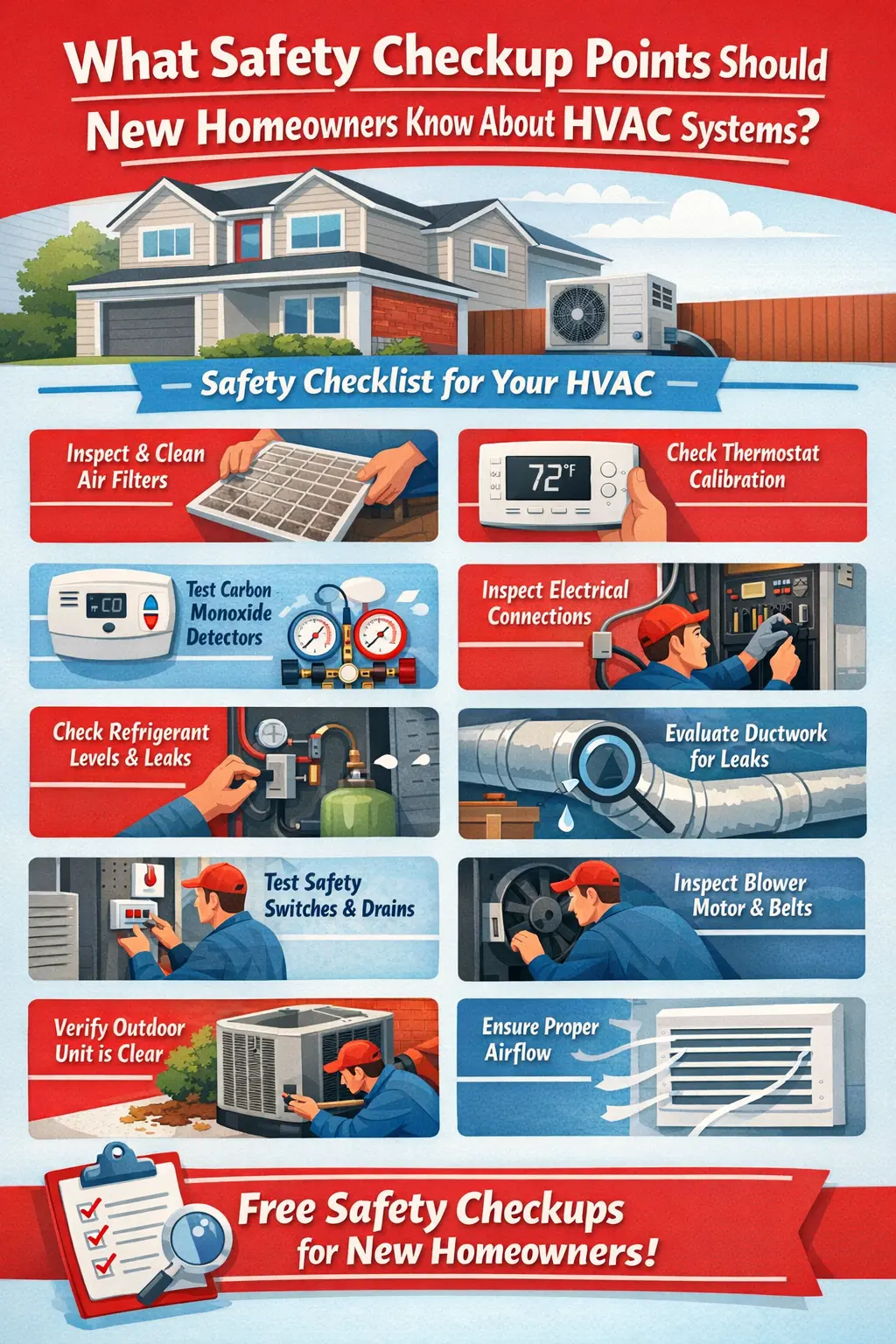
Which Safety Checkup Points Should New Homeowners Know About HVAC Systems?
Your HVAC system handles air quality and comfort in your home. When your HVAC goes wrong, it affects your health and safety, not just your comfort.
This is why safety checkups matter. A lot.
1. Air Filter Inspection and Cleaning
Let’s start with the simplest thing: your air filter.
Your HVAC system pulls air from your home through a filter. That filter traps dust, pollen, pet hair, and other particles. Clean air flows through your system and back to your home.
When that filter gets clogged, several things happen. First, your system works harder to pull air through a blocked filter. This uses more electricity and costs you money. Second, less air flows through your system, so some rooms don’t get cooled or heated as effectively. Third, your air quality actually decreases because the clogged filter isn’t trapping particles efficiently anymore.
A professional should inspect your filter during a checkup. Many homeowners should change or clean their filter every one to three months, depending on pets, allergies, and air quality in your area.
2. Thermostat Calibration
Your thermostat tells your HVAC system when to run. If it’s not calibrated correctly, your system doesn’t know when to start cooling or heating.
Imagine your thermostat thinks it’s 72 degrees when it’s actually 78 degrees. It won’t kick on your AC even though you’re hot. Or it might think it’s colder than it actually is and run your heat unnecessarily.
A technician can check your thermostat with proper instruments. They’ll make sure it’s reading the actual temperature in your home accurately. If it’s off, they can adjust it or replace it if needed.
3. Carbon Monoxide Detection
If your HVAC system burns gas, this matters. Gas furnaces produce carbon monoxide as a byproduct of combustion. Your system should vent that carbon monoxide safely outside through a flue pipe.
If that flue pipe gets blocked or develops a crack, carbon monoxide enters your home. Carbon monoxide is odorless and colorless. You can’t detect it without a detector.
A carbon monoxide detector is your protection. A professional should test these during a safety checkup. They’ll make sure detectors are working and positioned correctly.
4. Electrical Connections and Controls
Your HVAC system has electrical components that control how it operates. Connections, wiring, capacitors, and circuit boards all need to be intact and working properly.
Over time, vibration from running equipment can loosen electrical connections. Heat can stress components. Moisture can cause corrosion. A technician inspects all electrical connections for tightness, corrosion, and damage.
Loose connections can cause your system to shut down unexpectedly. Corroded components can fail completely. Catching these problems early prevents breakdowns.
5. Refrigerant Levels and Leak Detection
Your AC system uses refrigerant to cool your home. Refrigerant circulates through your outdoor unit and indoor coils, absorbing heat and releasing it outside.
Your system should have a specific amount of refrigerant. Not too much, not too little. If levels are too low, your system can’t cool effectively. If levels are too high, your system works inefficiently.
Worse, refrigerant can leak. A small leak might seem like no big deal, but it means you’re constantly losing refrigerant. Eventually, you’ll lose enough that your system barely cools.
A technician uses special instruments to measure refrigerant levels and check for leaks. If they find a leak, they locate it, repair it, and recharge your system.
6. Ductwork Evaluation
Ducts carry cool or warm air from your HVAC system to every room in your home. If your ducts are leaking, that air escapes into walls, attics, or crawl spaces instead of reaching your living spaces.
Leaky ducts mean you need to run your system longer to reach your target temperature. That costs money. It also means some rooms don’t get proper conditioning.
A technician can inspect accessible ductwork for leaks, damage, and separation. They check connection points where sections of duct join together. They look for holes or deterioration in the duct itself.
Sealing duct leaks is one of the most cost-effective efficiency improvements you can make. In many cases, sealing ducts saves enough on energy bills to pay for the service in just a few years.
7. Airflow Testing
Your HVAC system only works if air actually flows through it. A technician tests airflow at vents and returns throughout your home.
They’re looking for weak spots. If one room barely gets air, there’s a problem. Maybe a duct is blocked. Maybe the damper controlling flow to that zone is closed. Maybe the unit isn’t powerful enough for your home’s size.
Good airflow means balanced comfort throughout your home. Every room should get adequate cooling or heating.
8. Safety Switches and Condensate Drains
HVAC systems have safety switches that shut the system down if something goes wrong. Your AC system produces water as it cools. That water needs to drain away properly through a condensate drain line.
If that drain gets blocked, water backs up into your system. This can damage equipment and cause mold growth. A technician inspects that drain and makes sure water flows freely.
Safety switches get tested to confirm they work. If something’s wrong, they’ll shut the system down before damage occurs.
9. Blower Motor and Belt Inspection
The blower motor pushes air through your system. Some systems use belts to transfer power from the motor. These components wear out over time.
A technician listens for unusual noises from the motor. They check the belt for wear, fraying, or deterioration. They might lubricate the motor if needed.
A failing blower motor means inadequate airflow throughout your home. Replacing a motor is expensive. Catching wear early and replacing a belt before it breaks is way cheaper.
10. Outdoor Unit Inspection
Your outdoor AC unit sits outside exposed to weather and debris. Over time, grass, leaves, dirt, and sticks accumulate around it.
A technician clears debris from around the outdoor unit. They check that airflow isn’t blocked. They inspect the unit for physical damage. They look for signs of rust or corrosion.
You can do some of this maintenance yourself. Keep a three-foot clearing around your outdoor unit. Don’t let grass grow right up to it. Don’t stack firewood or storage items against it.
Which HVAC Maintenance Tips Should New Homeowners Follow?
You can do a lot to keep your HVAC system running smoothly between professional service visits.
1. Filter Changes and Cleaning
I mentioned this already, but it’s worth repeating because it’s so important.
Check your filter once a month. Most filters need changing every one to three months. If you have pets, allergies, or poor air quality in your area, change it more frequently.
A clogged filter is the single biggest reason HVAC systems underperform. It’s also the easiest thing to fix yourself. A new filter costs five to twenty dollars. It takes two minutes to change.
Your air handler probably has a door or panel that accesses the filter. Open it. Note the size of your current filter. Write it down. When you go to the store, buy the exact same size. Slide the old one out. Slide the new one in. Done.
2. Seasonal Professional Tune-ups
Before cooling season hits, schedule a spring AC tune-up. That’s usually March or April here in Fort Worth.
Before heating season arrives, schedule a fall heating tune-up. That’s September or October.
A tune-up takes a couple hours. A technician makes sure everything is working properly. They clean components, tighten connections, check refrigerant levels, test controls, and inspect safety equipment.
A tune-up costs a couple hundred dollars. It prevents breakdowns that cost a thousand or more. It extends your system’s life by years. It improves efficiency and lowers your energy bills.
This is not optional if you want your system to last. It’s maintenance, like oil changes for your car.
3. Keeping Your Outdoor Unit Clear
Your outdoor AC unit needs airflow to work efficiently. Keep plants, branches, and debris away from it.
Trim back bushes and trees so at least three feet of clear space surrounds the unit. Don’t store items against it. Don’t stack firewood nearby. Don’t let grass grow around it.
You can clean the outdoor unit yourself with a gentle spray from a garden hose. Use low pressure. You’re removing dust and leaves, not blasting the coils.
In spring, after storms, check your outdoor unit. Make sure nothing got knocked against it. Make sure no branches are hanging over it.
4. Ductwork Sealing and Insulation
Your ducts lose more energy than you might think. Leaks let conditioned air escape. Uninsulated ducts let heat transfer through duct walls.
You probably can’t access all your ductwork. But a professional can. They can seal leaks with mastic sealant or specialized tape. They can add insulation where needed.
Sealing ducts improves efficiency and comfort. Your system doesn’t have to run as long to reach your target temperature.
5. Thermostat Maintenance
Check your thermostat batteries once a year. Most modern thermostats run on batteries as backup power. If batteries die, your thermostat might not work properly.
If your thermostat isn’t digital, consider upgrading to a programmable or smart thermostat. You can set different temperatures for different times of day.
A smart thermostat learns your patterns and optimizes comfort while saving energy. Some models integrate with your phone, so you can adjust temperature from anywhere.
6. System Performance Monitoring
Get to know how your system normally sounds and runs. Listen for unusual noises. Feel the air coming from vents. Notice if cooling or heating takes longer than usual.
Strange sounds might mean a fan blade is bent. Weak airflow might mean a filter is clogged. Everything taking longer might mean refrigerant is low or efficiency is declining.
Catching problems early saves money. If you notice something unusual, call a technician.
What are the Benefits of Regular HVAC Maintenance?
You’re probably wondering if all this regular HVAC maintenance is worth the effort and expense. Let me tell you exactly what you get from it.
1. Better Energy Efficiency and Lower Bills
A well-maintained HVAC system runs at peak efficiency. It doesn’t waste energy. Studies show that regular maintenance improves efficiency by ten to fifteen percent.
On an average Fort Worth home, that’s thirty to fifty dollars a month in savings. Over a year, that’s four hundred to six hundred dollars. Over a decade, it’s four to six thousand dollars.
You’re spending a couple hundred dollars on maintenance to save thousands on energy bills. That’s a no-brainer investment.
2. Longer System Lifespan
HVAC systems typically last fifteen to twenty years. Regular maintenance helps yours reach or exceed that lifespan.
A system that gets neglected might fail after ten or twelve years. A system that’s maintained regularly often runs for twenty-five years or more.
The difference in cost is huge. Replacing an HVAC system costs three to eight thousand dollars. Get a few extra years out of your current system through maintenance, and you’ve saved yourself thousands.
3. Fewer Breakdowns and Costly Repairs
Nothing’s worse than your AC failing during a heat wave or your heat going out on a cold night. Emergency service calls cost more than regular maintenance. Emergency repairs often involve higher labor charges.
Regular maintenance catches small problems before they become big breakdowns. You avoid emergency situations. You save money on repairs.
4. Improved Air Quality
A maintained HVAC system distributes clean air throughout your home. Filters are fresh, ducts are sealed and clean, components aren’t degrading.
This matters if you have allergies, asthma, or respiratory issues. Good air quality affects everyone’s health and comfort.
5. Enhanced Comfort
When your HVAC system is working at its best, your home is consistently comfortable. Every room reaches your target temperature. Air flows smoothly through ducts. You’re not dealing with hot spots or cold spots.
Comfort might seem like a small thing, but you spend a lot of time in your home. Consistent comfort throughout means you’re happy in your own space.
How to Find the Best HVAC Company You Can Trust in Fort Worth?
Eventually, you’ll need to hire an HVAC company. Choosing the right one makes all the difference between a good experience and a frustrating one.
1. Verify Licensing and Insurance
Before you hire anyone, check that they’re licensed. In Texas, HVAC contractors need to be licensed by the state. That license means they’ve met training and experience requirements.
Ask for their license number. Look it up on the Texas Department of Licensing and Regulation website. Make sure it’s current and in good standing.
Insurance is equally important. Ask for proof of liability insurance and workers compensation insurance. If something goes wrong or someone gets hurt, you want to know they’re covered.
An unlicensed or uninsured contractor cutting corners to save money isn’t saving you anything. You’re taking on huge liability.
2. Look for Local Experience
Fort Worth has specific climate challenges. You want a company that understands our summers and winters. A company that’s been serving Fort Worth for years knows what works in our area.
Ask how long they’ve been in business locally. Ask what systems they install most frequently. Ask if they’ve worked on homes similar to yours.
A company with deep local roots will give you better advice tailored to your specific situation.
3. Read Online Reviews and Testimonials
Check Google reviews, Yelp, Angie’s List, and Facebook for reviews from past customers.
Look for patterns. A company might have one bad review in a sea of great reviews. That’s normal. If you see multiple complaints about the same issue, that’s a red flag.
Pay attention to how companies respond to negative reviews. Do they address concerns professionally? Do they seem defensive? The way they handle criticism tells you something about how they operate.
4. Ask for References and Customer Feedback
Don’t just rely on online reviews. Ask the company directly for references from past customers. A reputable company will give you these willingly.
Call those references. Ask specific questions. Did work get completed on time? Was the work quality good? Did the technician explain things clearly? Would they hire this company again?
If a company won’t provide references, that’s suspicious. Move on to someone else.
5. Clarify Warranties and Service Guarantees in Writing
As I mentioned earlier, warranties matter. Get everything in writing. What exactly does their warranty cover? How long does it last? What conditions might void it?
If they offer any service guarantees, get those in writing too. If they guarantee your system will work at a certain efficiency level and it doesn’t, what happens? Do they come back and fix it? Do they refund part of the cost?
Written agreements protect both you and the company.
6. Compare Prices, but Focus on Value
You’ll probably get quotes from multiple companies. Prices will vary. Don’t just go with the cheapest.
Compare what you’re getting for the price. Are they using quality equipment? Do they offer a solid warranty? What about labor warranty? Do they include a tune-up or maintenance plan?
Sometimes paying a bit more gets you better equipment, better warranty, or better service. That extra investment pays for itself through reliability and efficiency.
7. Ensure Technicians Are Properly Certified
Ask if technicians are NATE certified. NATE stands for North American Technician Excellence. Certification means they’ve passed rigorous exams proving their knowledge and skills.
Not every technician needs to be NATE certified, but having some on staff shows the company invests in quality training.
You can also ask about other certifications. Some states and manufacturers offer their own certifications.
Conclusion
Your HVAC system is one of the most important investments in your Fort Worth home. Understanding how it works, maintaining it properly, and choosing the right service company puts you in control.
You now know what types of systems work best in Fort Worth’s climate, how warranties actually protect you, what safety checkups matter, what maintenance you should do, and how to find an HVAC company you can trust.
The bottom line is simple: regular maintenance saves money, keeps your family comfortable, and extends your system’s life. Take care of your HVAC system, and it takes care of you.
Ready to get your HVAC system inspected? Contact a trusted local Fort Worth HVAC company today. Schedule that seasonal tune-up. Change that filter. Keep your system running strong. Your home, your comfort, and your wallet will all thank you.
Frequently Asked Questions
1. How often should I schedule an HVAC checkup?
At least twice a year. Once before cooling season and once before heating season.
2. Are HVAC safety checkups necessary every year?
Yes. This protects your home and can prevent costly repairs later.
3. What is the difference between a warranty and a maintenance plan?
A warranty protects parts and defects. A maintenance plan keeps your system running well and may prevent issues.
4. Do warranties cover labor?
Standard manufacturer warranties usually do not include labor. Labor coverage often comes from the installing company.
5. How can I improve HVAC efficiency?
Change filters regularly, schedule tune ups, seal ducts, and use a programmable thermostat.
6. Can I do HVAC maintenance myself?
You can change filters and clean around the outdoor unit. More complex tasks require professional service.


