

Your furnace blower motor is the heart of your home’s heating system. It’s what pushes warm air through your ducts and into every room. When it fails, you’re not just facing a repair bill.
You’re facing cold nights, uncomfortable family members, and the stress of finding a trustworthy contractor who won’t overcharge you.
Understanding the furnace blower motor replacement cost in Fort Worth (typically $450 to $1,200) gives you the power to budget properly, avoid price gouging, and make informed decisions about repair versus replacement.
This guide breaks down every cost factor, from motor types to labor rates, so you can approach this inevitable repair with confidence instead of confusion.
1. Average Furnace Blower Motor Replacement Cost in Fort Worth
Let’s talk numbers.
If your blower motor needs replacing in Fort Worth, you’re looking at somewhere between $450 and $1,200.
I know that’s a pretty wide range. But here’s why.
The lower end of that spectrum typically covers standard single-speed motors. These are the workhorses you’ll find in older, basic furnace systems. They’re reliable, straightforward, and more affordable to replace.
The higher end? That’s where variable-speed and ECM (electronically commutated motor) technology comes into play.
According to HVAC industry data, Fort Worth homeowners spend an average of $650 on blower motor replacements. That’s right in the middle of our range, which makes sense given the mix of furnace types in North Texas homes.
Local labor rates matter too.
Fort Worth sits in a competitive HVAC market. You’ve got established companies and newer startups all vying for your business. This competition can work in your favor, but it also means prices vary depending on who you call.
System design plays a role as well.
Some furnaces have easy-access blower compartments. Others? Not so much. If your HVAC tech needs to disassemble half your furnace to reach the motor, that adds time and cost.
Here’s something I learned from a veteran Fort Worth HVAC contractor: seasonal demand affects pricing. During those unexpected cold snaps we get in January and February, emergency service calls spike. And emergency rates can add $100 to $300 to your bill.
The U.S. Department of Energy recommends budgeting for HVAC repairs as part of regular home maintenance. For a blower motor specifically, setting aside $500 to $800 gives you a realistic cushion.
One more thing about Fort Worth specifically.
Our climate isn’t as harsh as, say, Minnesota. But we do run our heating systems enough that blower motors experience regular wear. Texas HVAC professionals report that most blower motors last 10 to 20 years in our region, depending on usage and maintenance.
The bottom line? Plan for around $650 if you need a standard replacement. Budget closer to $1,000 if you have a high-efficiency system. And always get multiple quotes before committing.
2. Factors That Affect Furnace Blower Motor Replacement Cost
Not all blower motor replacements cost the same.
Several factors push the price up or down. Let’s break them down so you know exactly what you’re paying for.
1. Type of Furnace and Motor Required
Your furnace type determines which motor you need.
Single-stage furnaces use simpler motors. Two-stage systems need more sophisticated components. And modulating furnaces? They require the most advanced (and expensive) motors available.
I spoke with a Fort Worth HVAC technician who put it this way: “If you drive a Honda Civic, you buy Civic parts. If you drive a Mercedes, you buy Mercedes parts.” Same principle applies to furnaces.
Carrier, Trane, and Lennox high-efficiency models typically require ECM motors that cost $400 to $800 just for the part.
Meanwhile, Goodman and Rheem basic models often use PSC motors that run $150 to $350.
2. Age and Brand of the Heating System
Older systems present unique challenges.
If your furnace is 15+ years old, finding the exact replacement motor gets trickier. HVAC manufacturers discontinue parts over time. Your technician might need to source a compatible universal motor instead.
Universal motors work, but they sometimes require modifications to fit properly. That means additional labor hours.
Brand matters because of parts availability. Popular brands like Carrier and Trane have parts readily available in Fort Worth. Less common brands? You might wait days for shipping, and that delays your repair.
I’ve seen situations where homeowners with obscure furnace brands paid $200 more just because the motor had to be special-ordered from out of state.
3. Accessibility of the Blower Assembly
Here’s where things get interesting.
Some furnaces have blower motors that are incredibly easy to access. You remove a panel, disconnect a few wires, unbolt the motor, and you’re done. Quick and straightforward.
Other furnaces hide the blower motor behind layers of components.
I’m talking about systems where the technician has to remove the heat exchanger, disconnect gas lines, or work around tight clearances in a cramped closet. That one-hour job suddenly becomes a three-hour ordeal.
According to HVAC contractors, accessibility issues can add $100 to $250 to your labor costs.
Where your furnace is located matters too. Attic installations in Fort Worth homes often require more time because technicians work in confined, hot spaces. Garage installations are usually easiest. Closet installations fall somewhere in between.
4. Additional Part Replacements
Blower motors rarely fail alone.
When a motor burns out, related components often need attention. The capacitor, which helps start the motor, frequently shows signs of wear. Capacitors cost $15 to $50, plus labor to install.
Control boards sometimes suffer damage from electrical issues that caused the motor failure. A new control board runs $150 to $400.
The blower wheel itself might be damaged or caked with debris. Cleaning adds minimal cost, but replacement adds $75 to $200.
Wiring connections can corrode over time. If your technician discovers faulty wiring, expect to pay for repairs to bring everything up to local electrical codes.
Smart HVAC technicians identify these issues during the initial diagnosis. They’ll give you a comprehensive quote that includes necessary related repairs.
5. Condition of Ductwork and Airflow Restrictions
This factor surprises many homeowners.
Your ductwork affects how hard your blower motor works. Restricted airflow from dirty filters, closed vents, or undersized ducts forces the motor to strain.
If your ducts have leaks or poor design, the new motor will work overtime from day one. That shortens its lifespan dramatically.
Responsible HVAC contractors check airflow during blower motor replacement. If they discover significant restrictions, they’ll recommend addressing those issues simultaneously.
Duct sealing costs $300 to $1,000 depending on scope. But it protects your investment in the new motor and improves overall system efficiency.
Fort Worth homes built before 2000 often have ductwork that doesn’t meet modern ACCA Manual D standards. If your system falls into this category, your HVAC contractor should discuss options with you.
The key takeaway? The actual motor is just one piece of the puzzle. All these factors combine to determine your final replacement cost.
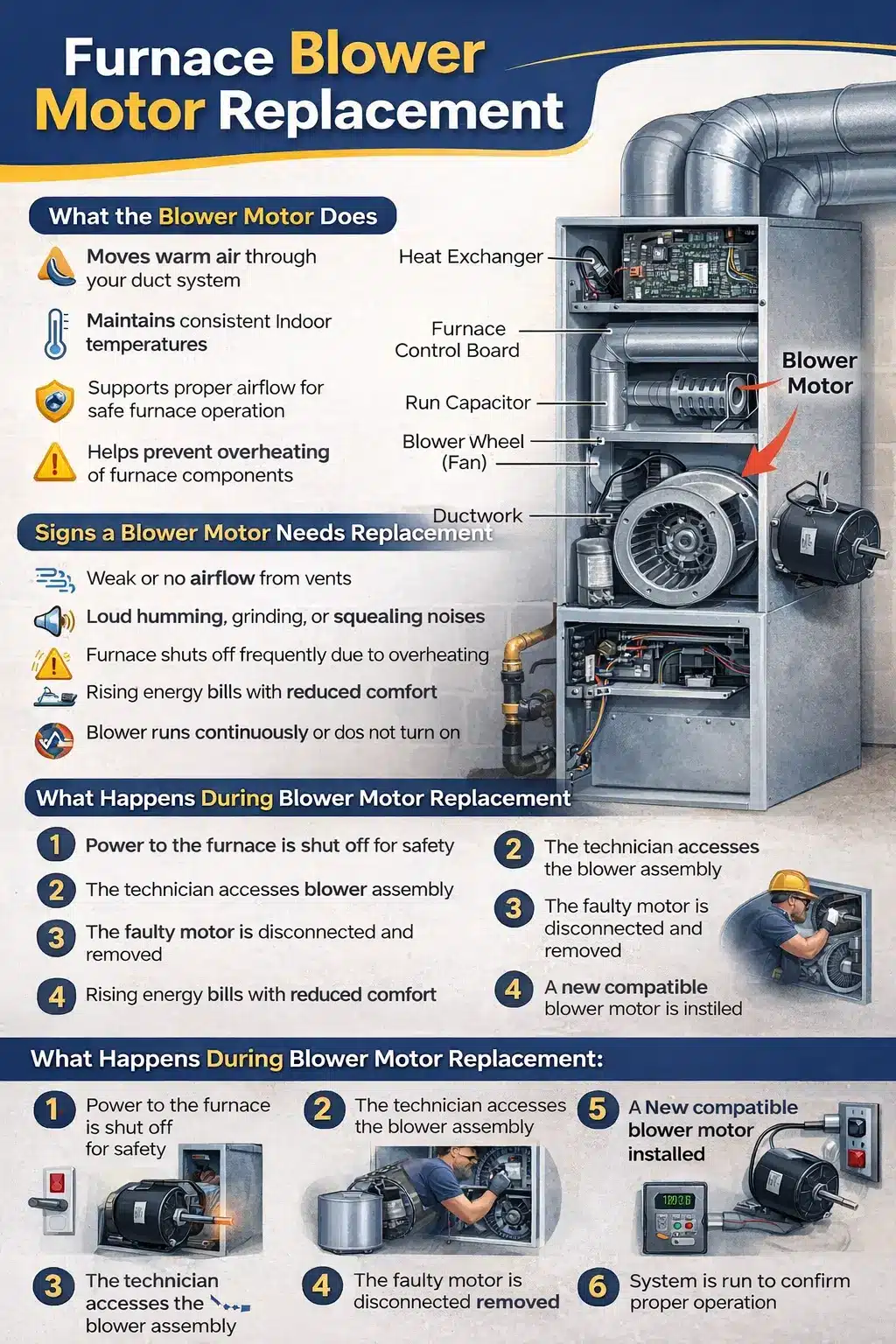
3. How Blower Motor Type Impacts Replacement Cost
Motor type makes a massive difference in both upfront cost and long-term value.
Let’s compare the two main types you’ll encounter.
1. PSC Motors
PSC stands for permanent split capacitor.
These motors have been the HVAC industry standard for decades. You’ll find them in older furnace systems and budget-friendly models still sold today.
Here’s what you need to know about PSC motors.
They’re simple, mechanical devices. They run at one speed (full blast). When your thermostat calls for heat, the PSC motor kicks on at 100%. When the temperature is reached, it shuts off completely.
This on-off operation works, but it’s not particularly efficient or comfortable.
From a cost perspective, PSC motors are the more affordable option. The motor itself typically costs $150 to $350. Installation is straightforward because these motors have been around forever. Every HVAC technician knows how to install them.
Total replacement cost with a PSC motor usually lands between $450 and $700 in Fort Worth.
The simplicity of PSC motors means fewer electronic components that can fail. That’s actually a plus if you value reliability over efficiency.
But there are drawbacks.
PSC motors consume more electricity than modern alternatives. According to the Department of Energy, PSC motors are only about 60% efficient at converting electrical energy to mechanical work.
They’re also noisier. That full-speed operation creates more sound than you’ll get from variable-speed alternatives.
And comfort suffers too. Single-speed operation means you get temperature swings throughout your home. Hot and cold spots are common with PSC motor systems.
If your furnace currently has a PSC motor and you’re just looking for a like-for-like replacement, this might be your best option. The lower cost makes sense if your furnace is older and you’re not planning major upgrades.
2. ECM Variable Speed Motors
ECM stands for electronically commutated motor.
These are the modern, high-tech solution that’s become standard in high-efficiency furnaces.
ECM motors are fundamentally different from PSC motors.
Instead of running at one speed, ECM motors adjust their speed based on your home’s heating needs. They can operate anywhere from 25% to 100% capacity, making tiny adjustments to maintain perfect comfort.
This variable-speed operation delivers serious benefits.
First, energy efficiency. ECM motors are up to 85% efficient at converting electrical energy to mechanical work. That translates to lower utility bills.
ENERGY STAR data shows ECM motors use 20% to 40% less electricity than comparable PSC motors. Over a year, that could save Fort Worth homeowners $100 to $200 on electricity costs.
Second, comfort. Variable-speed operation eliminates the temperature swings you get with single-speed motors. Your home maintains more consistent temperatures throughout every room.
Third, air quality. ECM motors can run at low speeds continuously, which means constant air filtration. Your air gets filtered even when the furnace isn’t actively heating.
Fourth, noise reduction. Low-speed operation is whisper-quiet. You’ll barely notice when your furnace is running.
Now for the cost considerations.
ECM motors are significantly more expensive upfront. The motor itself costs $400 to $800. Add labor, and you’re looking at total replacement costs of $800 to $1,200.
That’s nearly double what you’d pay for a PSC motor.
The advanced electronics in ECM motors also mean more potential failure points. Control boards and sensors can malfunction, leading to more expensive repairs down the road.
But here’s the thing.
If you have a high-efficiency furnace, you don’t have a choice. These systems are designed around ECM motor technology. Installing a PSC motor in a high-efficiency furnace would be like putting a carburetor in a modern fuel-injected car. It just doesn’t work.
And if you’re planning to keep your furnace for another 10+ years, the energy savings from an ECM motor can offset the higher initial cost.
Let me share some math.
Say you save $150 per year on electricity with an ECM motor versus a PSC motor. Over 10 years, that’s $1,500 in savings. Even accounting for the extra $300 to $400 upfront cost, you come out ahead.
Plus, many utility companies in Texas offer rebates for high-efficiency HVAC equipment. Check with Oncor or your local utility provider to see if rebates are available. Some homeowners recover $100 to $300 through these programs.
The decision between PSC and ECM motors ultimately depends on your furnace type, budget, and long-term plans for your home.
4. Labor Costs for Furnace Blower Motor Replacement
Labor represents a significant chunk of your total replacement cost.
Understanding what you’re paying for helps you evaluate quotes from different HVAC companies.
1. Typical Labor Range
In Fort Worth, labor costs for blower motor replacement typically fall between $150 and $400.
That’s for standard service during normal business hours (usually defined as Monday through Friday, 8 AM to 5 PM).
HVAC contractors base their labor rates on several factors. They need to cover technician wages, vehicle expenses, insurance, licensing, overhead, and yes, profit.
The average HVAC service rate in Fort Worth runs about $75 to $150 per hour. This is consistent with rates across Texas metro areas like Dallas, Austin, and Houston.
Most blower motor replacements take one to three hours.
A straightforward replacement in an easily accessible furnace? One to two hours. More complex situations with accessibility challenges or additional repairs? Three hours or more.
Here’s what goes into that time.
The technician starts with diagnosis to confirm the blower motor is actually the problem. This involves testing electrical connections, checking capacitors, and ruling out other issues. That’s 30 to 45 minutes right there.
Then comes the actual replacement work.
The technician has to shut down power to the furnace, remove access panels, disconnect wiring, unbolt the old motor, install the new motor, reconnect everything, and test the system thoroughly.
Testing is crucial. A good technician doesn’t just install the motor and leave. They verify proper airflow, check amp draw to ensure the motor isn’t overworking, and confirm the system cycles correctly.
Some companies charge a flat rate for blower motor replacement. Others bill by the hour. Flat-rate pricing has become more common because it gives you cost certainty upfront.
2. Emergency and After-Hours Service
This is where costs can really jump.
If your furnace dies on a Sunday night in January, you’re looking at emergency service rates.
Emergency rates in Fort Worth typically add $100 to $300 to your standard labor cost. Some companies charge even more. I’ve seen emergency fees as high as $500.
After-hours service evenings, weekends, and holidays comes with premium pricing too. Even if it’s not a true “emergency,” you’ll pay more for the convenience of immediate service outside normal business hours.
Most HVAC companies structure their rates in tiers:
- Normal business hours: Standard rate
- After-hours (weekday evenings): 1.5x standard rate
- Weekends: 1.5x to 2x standard rate
- Holidays and true emergencies: 2x to 3x standard rate
Here’s my advice: if your furnace quits but you can survive with space heaters for a day or two, wait for normal business hours. The savings can be substantial.
But if you have young children, elderly family members, or health conditions that make cold temperatures dangerous, don’t hesitate to call for emergency service. Your family’s safety is worth the extra cost.
3. Complex Furnace Layouts
Some furnace installations are just plain difficult to work on.
Attic installations present challenges, especially in Fort Worth’s summer heat when techs are working in 130-degree attic spaces. The physical demands slow down work and increase labor time.
Closet installations with minimal clearance force technicians to work in awkward positions. What should take an hour can stretch to two or three.
Building codes in Fort Worth require adequate service clearance around furnaces, but plenty of older homes don’t meet modern standards. If your furnace was installed before codes were updated, service access might be limited.
Horizontal furnaces (common in attic installations) often require more labor than vertical units. The blower motor orientation makes removal and installation more challenging.
Some furnace brands also have design quirks that add labor time.
I know HVAC techs who groan when they see certain manufacturers because they know those units take longer to service. The motor might be buried behind other components, or the mounting system might be unnecessarily complicated.
Premium HVAC companies factor this into their quotes. Budget companies might give you a low estimate, then hit you with additional charges once they see the actual installation.
That’s why I always recommend getting detailed written estimates that specify what’s included.
4. Ways to Keep Labor Costs Reasonable
Shop around, but don’t just pick the cheapest quote.
The lowest bidder might cut corners or lacks experience. Consumer Reports recommends getting at least three quotes from licensed, insured contractors.
Check reviews on Google, Yelp, and the Better Business Bureau. Look for patterns in customer feedback about pricing transparency and quality of work.
Consider service agreements or maintenance plans.
Many Fort Worth HVAC companies offer annual furnace maintenance plans that include discounts on repairs. If you’re already enrolled in one of these programs, you might get 10% to 20% off labor costs.
Time your repair strategically if possible.
Spring and fall are the slow seasons for HVAC companies. You might find better rates or special promotions during these periods.
And here’s something many homeowners don’t know: some companies offer senior discounts, military discounts, or first-responder discounts. Always ask about available discounts before accepting a quote.
The bottom line on labor costs? Expect to pay $150 to $400 for standard service. Budget more for emergency situations. And remember that quality work from experienced technicians is worth paying for.
5. Repair vs Replacement Cost Considerations
When your blower motor starts acting up, you face a key decision.
Should you repair it or replace it?
Let’s look at when each option makes sense.
1. When Repair Might Be an Option
Some blower motor issues are actually minor problems that don’t require full motor replacement.
Electrical connection problems sometimes cause motors to stop working. A loose wire or corroded terminal might be the culprit. Fixing this costs $75 to $150 significantly less than motor replacement.
Capacitor failure is another repairable issue.
The capacitor helps start the motor and keep it running. When it fails, the motor won’t start or will run intermittently. Capacitor replacement costs $75 to $200, including parts and labor.
A stuck or seized motor sometimes responds to repair attempts. If bearings are just starting to wear but haven’t failed completely, a technician might be able to lubricate them and buy you some additional time.
But here’s the reality: these repairs are often temporary fixes.
If your motor is old and showing signs of wear, repair might keep it running for a few months or maybe a year. Then you’re back to square one, paying for another service call.
Most experienced HVAC technicians will be honest about this. They’ll tell you whether a repair is likely to provide long-term value or if you’re throwing good money after bad.
2. When Replacement Is the Better Choice
Bearing wear is a classic sign that replacement is necessary.
Motor bearings wear out over time, especially with constant use. When bearings fail, you’ll hear squealing, grinding, or screeching noises from your furnace.
Trying to repair worn bearings rarely works. Even if a technician can temporarily lubricate them, failure is imminent.
Overheating damage requires replacement too.
Motors overheat when they work too hard usually due to restricted airflow from dirty filters or blocked vents. Once a motor has overheated and suffered internal damage, replacement is the only reliable fix.
Age of the motor matters significantly.
If your blower motor is 10+ years old, replacement makes more sense than repair. You’re essentially at or beyond the expected lifespan. According to HVAC manufacturers, blower motors typically last 10 to 20 years.
Age of the entire furnace factors into the decision too.
Here’s a critical consideration: if your furnace is 15+ years old, you need to think carefully about motor replacement.
Putting a $1,000 motor into a 17-year-old furnace doesn’t always make financial sense. The average furnace lifespan is 15 to 20 years. If your furnace is near the end of its expected life, that motor replacement might only buy you a few years.
In these situations, some Fort Worth homeowners choose to install a less expensive PSC motor if their system allows it rather than investing in a premium ECM motor.
Others decide to replace the entire furnace, especially if they can capture tax credits or utility rebates available for high-efficiency equipment.
3. Cost-Benefit Analysis
Let’s run through a scenario.
Your blower motor fails. Repair costs $200, but your technician warns you it’s a temporary fix. Full motor replacement costs $750.
If the furnace repair buys you 3 to 6 months, you’ve spent $200 to delay the inevitable. Then you’ll spend $750 anyway. Total cost: $950.
If you replace the motor now, you spend $750 once and you’re done for another 10+ years.
The math favors replacement in most cases.
But what if your furnace is 18 years old and motor replacement costs $1,000?
A new high-efficiency furnace costs $3,500 to $6,000 installed. That’s obviously more expensive, but you get 20% to 30% better energy efficiency, better comfort, improved reliability, and warranty coverage.
If you’re planning to stay in your Fort Worth home for another 5 to 10 years, furnace replacement might actually be the smarter financial move.
Energy savings from a new furnace can amount to $200 to $400 per year on heating costs. Over 10 years, that’s $2,000 to $4,000 in savings (nearly enough to pay for the furnace itself).
4. Reducing Future Breakdown Risks
Replacement dramatically reduces your risk of additional breakdowns.
An old, repaired motor is a liability. You never know when it’ll quit again. And when it does, you’ll face another service call, another diagnostic fee, and another repair bill.
A new motor comes with warranty coverage. Most manufacturers provide 1 to 5-year warranties on replacement motors. If something goes wrong during that period, you’re covered.
Plus, installing a new motor gives your HVAC technician an opportunity to inspect related components. They can identify and address issues with capacitors, control boards, or wiring that might cause problems later.
Think of motor replacement as preventive maintenance for your furnace’s future reliability.
The peace of mind alone is worth something. Knowing you won’t wake up to a cold house because your jury-rigged motor finally gave up? That has value.
6. Ways to Reduce Furnace Blower Motor Replacement Cost
Nobody wants to overpay for HVAC repairs.
Here are practical strategies to minimize your blower motor replacement costs.
1. Schedule Routine Furnace Maintenance
This is the single most effective way to avoid expensive repairs.
Annual furnace maintenance costs $80 to $150 in Fort Worth. During a maintenance visit, your HVAC technician inspects your blower motor, tests its performance, and identifies potential issues before they become failures.
Catching problems early saves money.
A technician might notice your motor is drawing higher-than-normal amperage a sign of impending failure. Addressing this before complete failure means you can plan for replacement at your convenience rather than paying emergency rates.
Maintenance also includes cleaning components that affect motor performance.
Dirty blower wheels make motors work harder. Cleaning the blower wheel improves efficiency and extends motor life.
Many Fort Worth HVAC companies offer maintenance agreements that include priority service, discounted repairs, and extended warranties. These plans typically cost $150 to $300 per year and can save you hundreds on repairs.
Service agreements from companies like Trane and Carrier’s maintenance plans often pay for themselves with the first major repair.
2. Replace Air Filters Regularly
This seems almost too simple to matter.
But dirty air filters are one of the leading causes of blower motor failure.
When your filter is clogged, airflow drops dramatically. Your blower motor has to work much harder to pull air through the system. This increased workload causes motors to overheat and fail prematurely.
HVAC manufacturers recommend changing filters every 1 to 3 months depending on filter type and usage.
Standard 1-inch filters need monthly replacement. Higher-quality pleated filters last 2 to 3 months. Premium HEPA filters might last up to 6 months.
Filters are cheap $5 to $25 depending on quality. Replacing them regularly could add years to your blower motor’s life.
Set a calendar reminder on your phone. Every month, check your filter. If it looks dirty, replace it. This five-minute task can prevent a $1,000 repair.
Fort Worth’s air quality varies throughout the year. Spring brings pollen. Summer brings dust. During high-pollen seasons, you might need to change filters more frequently.
If you have pets, increase filter replacement frequency. Pet dander clogs filters faster than normal household dust.
3. Address Unusual Noises or Weak Airflow Early
Your furnace tells you when something’s wrong.
Squealing, grinding, or humming noises from the blower area indicate bearing problems. Catching these early lets you replace the motor on your schedule rather than during an emergency.
Weak airflow from vents signals the blower motor is struggling. Don’t ignore this. The longer you wait, the more damage occurs.
Intermittent operation where the blower starts and stops randomly points to electrical issues or a failing motor.
Call an HVAC professional when you notice these symptoms. An early diagnostic visit costs $75 to $150. That’s far less than an emergency replacement on a freezing night.
Some Fort Worth homeowners try to “push through” furnace problems, hoping they’ll resolve on their own. This almost never works. Small problems become big problems. Big problems become expensive problems.
4. Check Manufacturer Warranty Coverage
This is huge and often overlooked.
Many blower motor failures occur within the manufacturer’s warranty period. If your furnace is less than 10 years old, check your warranty documentation before paying for repairs.
Most furnace manufacturers provide 5 to 10-year warranties on parts, including blower motors.
If your motor is covered, you’ll only pay for labor typically $150 to $400. That’s a massive savings compared to paying for both parts and labor.
Where do you find warranty information?
Start with paperwork from your original furnace installation. Warranties are usually included in the installation documentation.
If you can’t find your paperwork, look for the furnace model and serial number. This information is on a metal plate attached to your furnace. With the model and serial number, you can call the manufacturer directly or check their website.
Carrier warranty lookup, Trane warranty information, Lennox warranty checker, and Rheem warranty page let you verify coverage online.
Some manufacturers require registration for warranty activation. If your furnace was never registered, you might still be able to register it retroactively.
Warranty coverage usually requires professional installation of the replacement motor. DIY installation might void your warranty. Always use a licensed HVAC contractor for warranty-covered repairs.
5. Use Professional Installation to Prevent Repeat Failures
Speaking of professional installation this isn’t the place to cut corners.
I’ve seen homeowners try to save money by hiring unlicensed handymen or attempting DIY motor replacement. This backfires more often than not.
Improper installation causes premature motor failure. If the motor isn’t mounted correctly, it vibrates excessively. Vibration kills bearings quickly.
Incorrect electrical connections can damage the new motor immediately or cause it to fail within months.
Licensed HVAC contractors in Texas must meet specific training and certification requirements. They understand proper installation procedures and local electrical codes.
They also have proper tools. Installing a blower motor requires specific torque on mounting bolts, proper wire sizing, and correct capacitor matching. Professional techs have the equipment to do this right.
Plus, professional installation comes with warranties on the labor. If something goes wrong due to installation error, the contractor stands behind their work.
Trying to save $200 on labor by going with an unlicensed installer could cost you a $1,000 motor if the installation fails.
Better Business Bureau recommendations include verifying licensing, insurance, and references before hiring any HVAC contractor.
6. Additional Money-Saving Tips
Buy parts vs. labor bundling.
Some homeowners purchase motors online at lower prices than what contractors charge. This can save money, but verify the motor is correct for your system. Installing the wrong motor causes immediate failure.
Most contractors charge more for parts than you’d pay online because they include warranty coverage and the convenience of having the right part immediately available.
Combine services when possible.
If you need a blower motor and your furnace is due for maintenance, schedule both at the same time. You’ll only pay one service call fee instead of two.
Consider off-season scheduling.
Spring and fall are slow periods for HVAC companies. You might find promotional pricing or discounts during these months.
Ask about financing options.
Many HVAC companies partner with financing providers to offer payment plans. If unexpected motor replacement strains your budget, financing can spread costs over several months with manageable payments.
Look for rebates and incentives.
Texas utility companies and federal energy programs sometimes offer rebates for high-efficiency HVAC upgrades. While these typically apply to full system replacements rather than individual motors, it’s worth checking if you’re considering upgrading to an ECM motor.
Oncor’s residential rebate programs and other Texas utility rebates can provide $100 to $500 back on qualifying equipment.
Get multiple quotes but evaluate carefully.
Three quotes give you a good sense of fair market pricing. But don’t automatically choose the cheapest option.
Evaluate what’s included in each quote. Does it cover just the motor? Are related components like capacitors included? What warranty comes with the work?
Sometimes a mid-range quote from a highly-rated contractor provides better long-term value than the lowest bid from an unknown company.
Angi, HomeAdvisor, and local Fort Worth contractor directories can help you find reputable HVAC professionals.
The goal isn’t just to find cheap service. It’s to find fair pricing for quality work that solves your problem permanently.
Conclusion
Understanding furnace blower motor replacement costs helps you make smart decisions when your heating system needs repair.
In Fort Worth, expect to pay $450 to $1,200 for blower motor replacement. The exact cost depends on motor type, your furnace model, accessibility, and whether additional repairs are needed.
PSC motors cost less upfront but use more energy. ECM motors cost more initially but deliver better efficiency and comfort. Choose based on your furnace type and long-term plans.
Labor runs $150 to $400 for standard service. Emergency calls and complex installations cost more.
Replacement usually makes more financial sense than repair, especially for older motors showing signs of wear.
Protect your investment through regular maintenance, timely filter changes, and addressing problems early. Check warranty coverage before paying for repairs. Always use licensed professionals for installation.
Smart planning and preventive care minimize both repair costs and the chances of future breakdowns. Your blower motor keeps your Fort Worth home comfortable year-round. Taking care of it and replacing it properly when needed ensures reliable heating when you need it most.
Frequently Asked Questions
How long does a furnace blower motor typically last?
Most blower motors last 10 to 20 years with proper maintenance. In Fort Worth’s climate, expect motors to last toward the middle of this range around 12 to 15 years. Variable-speed ECM motors often last longer than standard PSC motors because they run at lower speeds most of the time, which reduces wear. Regular filter changes and annual maintenance significantly extend motor life. If your motor fails before 10 years, it might indicate airflow restrictions, electrical issues, or installation problems that need addressing.
Can I replace a blower motor myself to save money?
While technically possible for someone with electrical and HVAC experience, DIY blower motor replacement isn’t recommended for most homeowners. You need to work safely with electrical connections, match the correct motor specifications, ensure proper mounting to prevent vibration, and verify the system operates correctly after installation. Improper installation can damage the new motor immediately or cause premature failure. Most importantly, DIY installation typically voids manufacturer warranties and might violate local building codes in Fort Worth. The labor savings of $150 to $400 aren’t worth risking a $400 to $800 motor or creating safety hazards.
What are the signs my blower motor is failing?
Watch for these common warning signs: squealing, grinding, or screeching noises from your furnace indicate bearing problems. Weak airflow from vents means the motor is struggling to move air. The blower starting and stopping randomly points to electrical or overheating issues. Unusual humming sounds suggest the motor is trying to start but can’t. Your furnace running but no air coming through vents indicates complete motor failure. Higher-than-normal energy bills can signal an overworking motor. If you notice any of these symptoms, schedule a diagnostic visit with an HVAC professional before the motor fails completely.
Does homeowners insurance cover blower motor replacement?
Standard homeowners insurance policies typically don’t cover blower motor replacement because it’s considered normal wear and tear rather than sudden damage from a covered peril. However, if motor failure results directly from a covered event like electrical surge damage from lightning your policy might provide coverage. Check your specific policy details or contact your insurance provider. Some homeowners opt for home warranty plans that cover HVAC component failures, though these plans have their own costs, deductibles, and limitations. Review terms carefully before purchasing.
How much does an emergency blower motor replacement cost in Fort Worth?
Emergency blower motor replacement in Fort Worth costs $550 to $1,500 or more, depending on the time and circumstances. Standard replacement costs of $450 to $1,200 get an additional $100 to $300 emergency fee added on. After-hours service on weeknights might add 50% to labor costs. Weekend emergency calls often double labor rates. Holiday emergencies can triple standard rates. If you can safely wait until normal business hours using space heaters temporarily you’ll save significantly. However, don’t risk your family’s safety in extreme cold. Many Fort Worth HVAC companies offer 24/7 emergency service when you truly need it.
Should I replace just the motor or the entire furnace?
This decision depends primarily on your furnace’s age and condition. If your furnace is less than 12 years old and has been well-maintained, replacing just the motor makes sense. You’ll get another 10+ years from the system. If your furnace is 15+ years old, consider the total cost of ownership. Putting a $1,000 motor into a 17-year-old furnace might only buy you a few years before other components fail or the heat exchanger cracks. A new high-efficiency furnace costs $3,500 to $6,000 but provides better energy efficiency, improved reliability, warranty coverage, and modern comfort features. Calculate potential energy savings often $200 to $400 annually and factor in available rebates and tax credits for new efficient equipment. If you’re planning to stay in your Fort Worth home long-term, full replacement might provide better value.


