
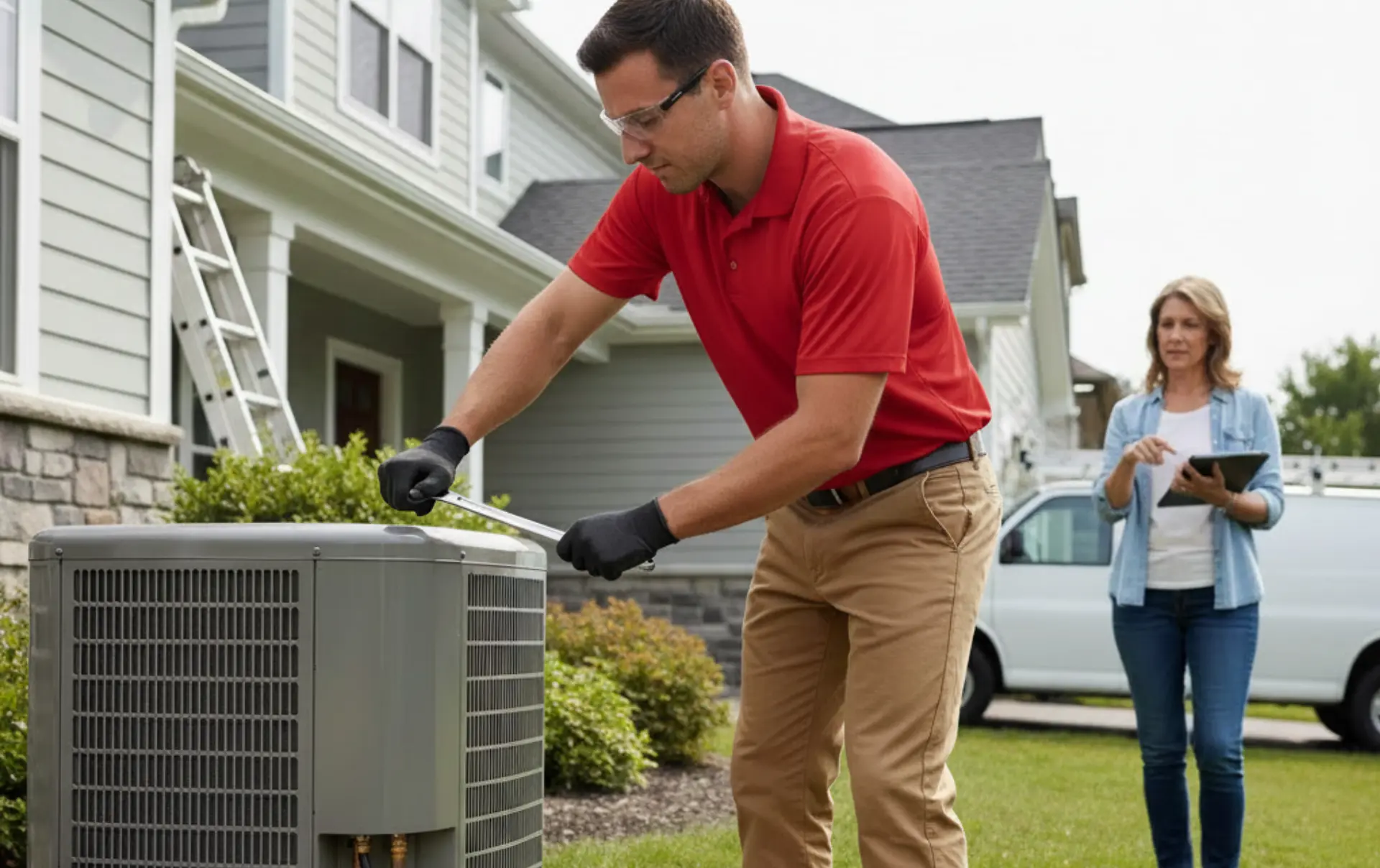
When planning a new heat pump installation, most homeowners have one question first how much will the heat pump installation cost?
The truth is, heat pump installation cost can vary based on system type, home size, efficiency ratings, and even local climate.
In this guide, we’ll answer the most common homeowner questions about heat pump installation cost, break down pricing by system type, and help you estimate your total investment before you replace your system.
Let’s dive into what you really need to know about pricing your comfort upgrade.
How Much Does It Cost to Install a Heat Pump?
Here’s the straightforward answer: most homeowners in Fort Worth can expect to pay between $5,000 and $15,000 for a complete heat pump installation.
That’s a pretty wide range, right?
The variation comes down to several factors specific to your home and the system you choose.
1. Average Heat Pump Installation Cost in Fort Worth
In the Fort Worth area specifically, you’re looking at costs that align closely with national averages, with some regional adjustments.
A standard air-source heat pump installation typically runs $5,500 to $11,000 for most residential properties.
This includes both the equipment and professional installation labor.
Fort Worth’s moderate climate actually works in your favor here. You don’t need the heavy-duty systems required in extreme northern climates, which can help keep costs more manageable.
But you also need sufficient cooling capacity for those Texas summers, which factors into the sizing and pricing equation.
2. Breaking Down Equipment vs. Labor Costs
Understanding where your money goes helps you make smarter decisions.
Here’s how the cost typically splits:
- Equipment costs usually account for 60-70% of your total investment. This includes the outdoor unit, indoor air handler or furnace, thermostat, refrigerant lines, and all necessary components.
A quality heat pump unit alone can range from $3,000 to $8,000 depending on brand, efficiency rating, and capacity.
- Labor costs make up the remaining 30-40% of your total. This covers the actual HVAC installation work, including electrical connections, refrigerant line installation, ductwork modifications if needed, thermostat wiring, startup testing, and permit fees.
Professional installation labor in Fort Worth typically runs $75 to $150 per hour, and a standard installation takes one to three days depending on complexity.
Don’t be tempted to cut corners on installation to save money. A poorly installed heat pump can lose 30% or more of its efficiency, costing you far more in the long run through higher energy bills and premature equipment failure.
3. Factors That Influence Your Total Heat Pump Installation Cost
Several key variables determine where your project lands within that $5,000 to $15,000 range.
- Unit size matters tremendously. A 2-ton heat pump for a small home costs significantly less than a 5-ton system for a larger property.
- Brand selection impacts pricing. Premium brands like Carrier, Trane, and Lennox typically cost more upfront but often deliver better reliability and warranty coverage. Mid-tier brands like Goodman and Rheem offer solid performance at more budget-friendly prices.
- Efficiency ratings drive cost differences. A standard 14 SEER2 system costs less than a high-efficiency 20+ SEER2 model, but the more efficient unit saves you money every month on utility bills.
Your existing infrastructure plays a huge role. If you already have ductwork in good condition, you’ll pay less. If ducts need modification or you’re adding a heat pump to a home without existing ducts, expect higher costs.
Accessibility and installation complexity affect labor time. A straightforward HVAC replacement takes less time than a complex installation requiring significant modifications.
When to Expect Higher Heat Pump Installation Quotes
Certain situations naturally push costs toward the higher end of the spectrum.
You’ll likely see quotes above $10,000 if you’re installing a high-efficiency system in a larger home, adding or extensively modifying ductwork, choosing a geothermal system, upgrading your electrical panel to handle the new system, or installing in a difficult-to-access location.
When to Expect Lower Heat Pump Installation Quotes
On the flip side, you might land on the lower end of the cost range if you’re replacing an existing system with similar equipment, choosing a standard efficiency model, installing in a smaller home requiring a smaller capacity unit, working with a contractor during their off-season, or qualifying for significant rebates and incentives.
The key takeaway here is simple: get multiple quotes from licensed, reputable HVAC contractors in Fort Worth.
This gives you a realistic picture of what your specific installation will cost and helps you identify outliers that might signal either corner-cutting or price gouging.
Heat Pump Installation Cost Breakdown by System Type
Not all heat pumps are created equal, and the type of system you choose has a massive impact on your installation cost.
Let’s break down what you can expect to pay for each major heat pump type.
1. Air-Source Heat Pump: $5,000–$11,000
This is the most common residential heat pump option, and for good reason.
Air-source heat pumps extract heat from outdoor air in winter and dump heat outside in summer. They’re the workhorse of residential HVAC and offer the best balance of performance and affordability for most Fort Worth homeowners.
Installation cost range: $5,000 to $11,000 installed
What influences the price within this range:
A basic 2-ton, 14 SEER2 air-source system might cost $5,000 to $6,500 installed in a smaller home with existing ductwork.
A premium 4-ton, 20+ SEER2 system with variable-speed technology and advanced features could run $9,000 to $11,000 or more.
Most Fort Worth homeowners land somewhere in the middle, paying around $7,000 to $8,500 for a quality mid-efficiency system properly sized for their home.
Air-source heat pumps work efficiently in Fort Worth’s climate since extreme cold snaps are relatively rare. They deliver both heating and cooling from a single system, replacing both your furnace and air conditioner.
2. Ductless Mini-Split Heat Pump: $4,000–$9,000
Ductless mini-splits are perfect for homes without existing ductwork, room additions, converted garages, or targeted comfort zones.
Installation cost range: $4,000 to $9,000 installed
How pricing breaks down:
A single-zone system (one outdoor unit, one indoor unit) typically costs $4,000 to $6,000 installed.
Multi-zone systems with one outdoor unit serving multiple indoor units range from $6,000 to $9,000 or more, depending on the number of zones.
The beauty of ductless systems is their installation flexibility. They require only a small hole through your wall for refrigerant lines and electrical connections, making installation less invasive than ducted systems.
Many Fort Worth homeowners use ductless mini-splits to add climate control to specific areas without extending ductwork throughout their entire home. This targeted approach can save money compared to installing full ductwork.
Installation costs are lower because there’s no ductwork involved, but you’ll see individual air handlers mounted on walls in each zone, which some homeowners consider less aesthetically appealing than central systems.
3. Geothermal Heat Pump: $15,000–$30,000
Geothermal systems represent the most efficient heat pump technology available, but they come with significantly higher upfront costs.
Installation cost range: $15,000 to $30,000 installed
Why such a dramatic price difference:
Geothermal heat pumps use the constant temperature of the earth as a heat source and heat sink, rather than outdoor air. This makes them incredibly efficient in all weather conditions.
The higher cost comes primarily from ground loop installation. Your contractor must either drill vertical boreholes or excavate horizontal trenches to bury ground loops several feet underground.
This earth-moving work represents a substantial portion of the installation cost.
For a typical Fort Worth home, you’re looking at:
Vertical closed-loop systems: $20,000 to $30,000 (requires drilling 150-400 feet deep)
Horizontal closed-loop systems: $15,000 to $25,000 (requires more land area but less drilling)
Pond/lake systems: $15,000 to $20,000 (if you have a suitable water body on your property)
The massive upfront investment pays off over time. Geothermal systems can reduce heating and cooling costs by 40-70% compared to conventional systems, with lifespans of 25+ years for the indoor components and 50+ years for the ground loops.
4. Hybrid Heat Pump: $7,000–$13,000
Hybrid systems combine an electric heat pump with a gas furnace backup, automatically switching between the two based on outdoor temperature and cost-efficiency.
Installation cost range: $7,000 to $13,000 installed
What makes hybrid systems unique:
These dual-fuel systems give you the best of both worlds. The heat pump handles most of your heating and cooling needs efficiently, while the gas furnace kicks in during very cold weather when heat pumps lose efficiency.
In Fort Worth, where extreme cold is rare but does happen, a hybrid system provides backup heating capacity without the cost premium you’d pay for an oversized heat pump.
Costs are higher than standard air-source heat pumps because you’re essentially installing two heating systems. But if you have natural gas service and want maximum efficiency across all weather conditions, the investment makes sense.
Comparison Table Summary
| Heat Pump Type | Average Cost Range (Installed) | Notes |
| Air-Source Heat Pump | $5,000–$11,000 | Most common residential option |
| Ductless Mini-Split Heat Pump | $4,000–$9,000 | Ideal for homes without existing ductwork |
| Geothermal Heat Pump | $15,000–$30,000 | High upfront cost but major long-term savings |
| Hybrid Heat Pump | $7,000–$13,000 | Combines electric and gas for better efficiency |
The right system type for your home depends on your budget, existing infrastructure, property characteristics, and long-term plans.
A quality HVAC contractor will assess your specific situation and recommend the system type that delivers the best value for your unique circumstances.
What Affects the Total Heat Pump Installation Cost In Fort Worth?
Now let’s dig into the specific factors that move your installation cost up or down.
Understanding these variables helps you anticipate costs and make informed decisions.
1. Size and Layout of Your Home
Your home’s square footage is the starting point for system sizing, but it’s not the only consideration.
A 2,000-square-foot ranch with an open floor plan has different requirements than a 2,000-square-foot two-story home with closed-off rooms.
Tonnage requirements (cooling capacity) directly impact equipment cost:
- 1.5-2 ton systems: Suitable for 600-1,200 sq ft
- 2.5-3 ton systems: Suitable for 1,200-1,800 sq ft
- 3.5-4 ton systems: Suitable for 1,800-2,400 sq ft
- 5+ ton systems: Suitable for 2,400+ sq ft
Each jump in tonnage typically adds $500 to $1,500 to your equipment cost.
But here’s what many homeowners don’t realize: bigger isn’t always better. An oversized heat pump cycles on and off too frequently, reducing efficiency and comfort while increasing wear and tear.
Professional load calculations using Manual J methodology account for your home’s insulation levels, window quality and placement, ceiling height, local climate data, and occupancy patterns.
This ensures proper sizing, which is critical for both performance and cost-effectiveness.
Fort Worth’s climate requires systems capable of handling summer temperatures regularly exceeding 95°F, which influences capacity requirements compared to milder climates.
2. Existing HVAC Infrastructure
Your current setup has a huge impact on installation complexity and cost.
If you have existing ductwork in good condition, you’re looking at a relatively straightforward installation. The contractor can use your existing ducts with minor modifications.
If your ductwork is old, leaky, or undersized, you’ll need duct sealing, HVAC repair, or replacement. This can add $2,000 to $5,000 or more to your project cost.
If you don’t have ductwork at all, you’re facing either the cost of installing a complete duct system (adding $5,000 to $15,000) or choosing a ductless mini-split system instead.
Electrical considerations also matter. Heat pumps require substantial electrical capacity. If your electrical panel is outdated or lacks capacity for the new system, you’ll need an upgrade.
Panel upgrades typically cost $1,500 to $3,000, but they’re essential for safe, code-compliant operation.
Many older Fort Worth homes built before 2000 may need electrical upgrades when switching to heat pump technology.
3. Energy Efficiency Ratings
Efficiency ratings directly correlate with both equipment cost and long-term operating expenses.
SEER2 (Seasonal Energy Efficiency Ratio 2) measures cooling efficiency. Higher numbers mean more efficient cooling.
- Basic efficiency: 14-15 SEER2
- Mid-tier efficiency: 16-18 SEER2
- High efficiency: 19-22+ SEER2
Each 2-point jump in SEER2 rating typically adds $800 to $1,500 to equipment cost.
HSPF2 (Heating Seasonal Performance Factor 2) measures heating efficiency. Again, higher is better.
- Basic efficiency: 7.5-8.0 HSPF2
- Mid-tier efficiency: 8.5-9.5 HSPF2
- High efficiency: 10+ HSPF2
Here’s the trade-off you need to consider: higher efficiency systems cost more upfront but save you money every month on utility bills.
In Fort Worth, where you’ll use both heating and cooling substantially throughout the year, investing in higher efficiency often pays for itself within 5-7 years through energy savings.
Texas summers are long and hot, making high SEER2 ratings particularly valuable for managing cooling costs.
4. Local Installation and Permitting Costs
Fort Worth and surrounding cities require permits for HVAC installations, which adds to your cost.
Permit fees in the Fort Worth area typically run $50 to $200 depending on your specific municipality and the scope of work.
Your contractor should handle permit procurement and ensure all work meets local building codes. Never skip permits to save money unpermitted work can cause problems with insurance claims, home sales, and system warranties.
Regional labor costs in the Dallas-Fort Worth metroplex fall in the middle range compared to national averages. You’ll pay more than rural areas but less than high-cost-of-living cities like San Francisco or New York.
Experienced, licensed HVAC technicians in Fort Worth charge $75 to $150 per hour for installation labor, which is reasonable for skilled trades requiring licensing and ongoing training.
5. Brand and Warranty Coverage
Brand selection impacts both initial cost and long-term value.
Premium brands (Carrier, Trane, Lennox, American Standard) typically cost 15-30% more than budget brands but often include:
- Longer warranty periods (10-12 years vs. 5-7 years)
- Better build quality and component reliability
- More advanced features and technology
- Stronger dealer support networks
Mid-tier brands (Rheem, Ruud, York, Coleman) offer solid performance and reliability at more moderate prices.
Budget brands (Goodman, Amana, Frigidaire) deliver basic functionality at the lowest price points.
Here’s my honest take after years in the HVAC industry: the brand matters less than the quality of installation and regular maintenance.
A mid-tier system properly installed and maintained will outperform a premium system that’s improperly installed or neglected.
That said, warranty coverage matters. A comprehensive 10-year parts warranty provides peace of mind and protects your investment.
Extended warranties typically add $300 to $800 to your upfront cost but can save you thousands if major components fail.
Pro Tip for Fort Worth Homeowners Looking for Heat Pump Installation
Regional pricing in Fort Worth tends to run slightly below major coastal cities but above rural areas.
Competition among HVAC contractors is healthy here, which works in your favor. Get at least three quotes from licensed contractors with solid reputations.
Spring and fall are often slower seasons for HVAC companies, and you might find better pricing or promotional offers during these shoulder seasons compared to the peak summer cooling season or winter heating season.
Don’t make your decision based solely on the lowest bid. Consider the contractor’s experience, reputation, warranty offerings, and the specific equipment they’re proposing.
The cheapest quote often means either lower-quality equipment or rushed installation that will cost you more in the long run.
How Does Geothermal Heat Pump Installation Cost Compare to Other Systems?
Geothermal heat pumps represent the pinnacle of HVAC efficiency technology, but that performance comes with a substantial price tag.
Let’s break down what makes geothermal different and whether the investment makes sense for your Fort Worth property.
1. Average Geothermal Heat Pump Installation Cost in Texas
In Texas, including the Fort Worth area, geothermal heat pump systems typically cost $18,000 to $28,000 for a complete residential installation.
This is roughly 2-3 times the cost of a conventional air-source heat pump.
The breakdown looks something like this:
- Equipment costs: $5,000 to $10,000 for the heat pump unit itself
- Ground loop installation: $10,000 to $18,000 for drilling or excavation and loop installation
- Labor and installation: $3,000 to $6,000 for indoor components, connections, and system startup
That ground loop installation is the major cost driver that sets geothermal apart from other systems.
2. Drilling and Ground Loop Installation Explained
Understanding what goes into ground loop installation helps explain the cost.
Geothermal systems work by circulating fluid through buried pipes (ground loops) that exchange heat with the earth. The earth maintains a relatively constant temperature of 50-60°F several feet below the surface, which is perfect for efficient heat exchange.
Vertical closed-loop systems are most common in residential applications where land area is limited.
The contractor drills one or more boreholes 150 to 400 feet deep. High-density polyethylene (HDPE) pipe loops are inserted into each borehole, which is then filled with grout to maximize heat transfer.
A typical Fort Worth home requires 2-4 boreholes depending on system size and soil conditions.
Drilling costs $15 to $40 per foot, so a system requiring three 200-foot boreholes could cost $9,000 to $24,000 just for the drilling and loop installation.
Horizontal closed-loop systems require more land area but less deep drilling.
Trenches 6-10 feet deep and 100-400 feet long are excavated. Loops of pipe are laid in the trenches in various configurations before being covered.
If you have the available land area, horizontal systems typically cost $15,000 to $22,000 total somewhat less than vertical systems but requiring more property space.
Pond or lake systems are the least expensive option if you have a suitable water body on your property.
Loops are submerged in the pond or lake, eliminating the need for drilling or extensive excavation. These systems can cost $15,000 to $20,000 total.
The water body must meet specific depth and volume requirements to ensure consistent performance, which limits this option to properties with adequate water features.
3. Long-Term Savings vs. Upfront Investment
Here’s where geothermal systems shine: operational efficiency.
Geothermal heat pumps achieve heating efficiency ratings of 300-500% (HSPF2 of 9-14+) and cooling efficiency of 15-25 SEER2.
This translates to real-world savings. A Fort Worth homeowner might pay:
$2,400 annually for heating and cooling with a standard efficiency air-source heat pump
$1,200-$1,500 annually for heating and cooling with a high-efficiency air-source heat pump
$800-$1,100 annually for heating and cooling with a geothermal heat pump
That’s potential savings of $1,300 to $1,600 per year compared to a standard system, or $400 to $700 per year compared to a high-efficiency air-source system.
Using these numbers, a geothermal system could pay for its additional cost premium in 10-18 years depending on energy prices and system comparison.
Beyond the payback period, you continue enjoying lower utility bills for the life of the system.
Longevity is another geothermal advantage. The indoor components typically last 25+ years, while ground loops can last 50+ years. This is significantly longer than air-source systems, which typically last 15-18 years.
When you factor in avoided replacement costs over decades, the total lifecycle cost often favors geothermal.
4. Ideal Property Types for Geothermal Systems
Geothermal isn’t right for every property or every homeowner.
You’re a great candidate for geothermal if you:
- Have adequate property space for loop installation. Vertical systems need space for drilling equipment access. Horizontal systems need substantial open land area.
- Plan to stay in your home long-term. The payback period means you need at least 10-15 years to realize the full financial benefits.
- Have suitable soil conditions. Rocky soil increases drilling costs. Very sandy or dry soil may reduce heat transfer efficiency.
- Value environmental benefits. Geothermal systems have the lowest carbon footprint of any HVAC technology.
- Are building a new home or doing major renovations. Ground loop installation is much easier and less expensive when incorporated into new construction.
- Have high energy costs. If your current utility bills are already high, geothermal savings accumulate faster.
Fort Worth’s clay-rich soil conditions are generally favorable for geothermal installations, making it a viable option for many properties in the area.
You’re probably not a good candidate if you:
- Have limited property access or space
- Plan to move within 5-10 years
- Need to minimize upfront costs
- Have a smaller home with already-modest energy bills
- Have underground utilities or obstacles that complicate loop installation
Additional Cost Considerations
Federal tax credits can significantly reduce geothermal’s net cost. The Inflation Reduction Act offers a 30% tax credit for geothermal heat pump installations through 2032, potentially saving you $5,400 to $8,400 on a typical system.
Financing programs specifically for geothermal systems can spread the cost over time while you immediately begin enjoying energy savings.
Property value impacts vary, but energy-efficient homes with geothermal systems often command premium prices in the real estate market.
The bottom line: geothermal represents a premium HVAC solution with unmatched efficiency and longevity. The high upfront cost is real, but so are the long-term savings and environmental benefits.
For the right property and the right homeowner with a long-term perspective, it’s an investment that pays dividends for decades.
How Can You Reduce Heat Pump Installation Cost In Fort Worth?
The good news is that you don’t have to pay full retail for your heat pump installation.
Several strategies can significantly reduce your out-of-pocket costs.
1. Federal and Local Rebates for Heat Pumps
The Inflation Reduction Act has made heat pumps more affordable through substantial tax credits and rebates.
Federal tax credits offer 30% off the cost of qualified heat pump installations, up to $2,000 for air-source systems and 30% with no dollar limit for geothermal systems.
This means:
- Air-source heat pump at $8,000 installed = $2,000 tax credit (maximum)
- Geothermal heat pump at $24,000 installed = $7,200 tax credit
These are tax credits, not deductions, meaning they directly reduce your tax liability dollar-for-dollar. You claim them when you file your federal taxes for the year of installation.
Energy Star rebates vary by state and utility provider. While specific programs change, Texas homeowners have historically had access to utility rebates of $300 to $1,500 for high-efficiency heat pump installations.
Check with Oncor, TXU Energy, Reliant, or your specific utility provider for current rebate programs. Many Fort Worth residents receive Oncor electric service, which periodically offers HVAC efficiency rebates.
Local municipality programs sometimes offer additional incentives. Fort Worth and surrounding cities occasionally run energy efficiency programs with rebates or low-interest financing for qualifying upgrades.
The City of Fort Worth’s Environmental Services Department maintains information on current programs at fortworthtexas.gov.
Income-qualified programs provide even larger incentives for eligible households. The Inflation Reduction Act includes Home Efficiency Rebates (formerly HOMES) and Home Electrification and Appliance Rebates (HEEHRA) that can cover up to 100% of costs for qualifying low- to moderate-income households.
These programs are administered at the state level, so check with Texas state energy offices for availability and requirements.
2. Financing Options and 0% Interest HVAC Programs
Many HVAC contractors partner with financing companies to offer payment plans that make heat pump installations more manageable.
0% interest financing is commonly available for 12-24 months with approved credit. This lets you spread payments over time without paying interest.
A $7,000 installation financed at 0% for 18 months means payments of about $389 per month far more manageable than a lump sum.
Extended financing terms with low interest rates (typically 4-8% APR) stretch payments over 5-10 years, reducing monthly payments even further.
PACE programs (Property Assessed Clean Energy) allow you to finance energy efficiency upgrades through your property taxes. Payments are attached to the property, not the borrower, and the obligation transfers if you sell.
Utility financing programs sometimes offer preferential rates for energy-efficient equipment installations. Check with your electric and gas providers for available programs.
The key to smart financing: calculate whether your monthly energy savings offset your monthly payment. If your new heat pump saves you $100 per month on utilities and your payment is $125 per month, your net cost is only $25 monthly pretty manageable for significantly improved comfort and equipment.
3. Choosing the Right Size Unit Can Help
Here’s an often-overlooked cost-saving strategy: proper system sizing.
Many homeowners assume bigger is better, but oversized systems waste money in multiple ways:
Higher upfront costs – Larger capacity units cost more to purchase and install
Reduced efficiency – Oversized systems short-cycle, running in brief bursts that never reach optimal efficiency
Uncomfortable conditions – Short cycling creates temperature swings and fails to adequately dehumidify
Increased wear – Frequent cycling wears components faster, shortening equipment life
On the flip side, undersized systems run constantly, struggle to maintain comfort during extreme weather, and wear out prematurely from overwork.
Professional load calculations using ACCA Manual J methodology cost $200-$500 but ensure you’re not spending thousands on unnecessary capacity.
A proper calculation considers your home’s specific characteristics and determines the optimal system size not too big, not too small.
This might save you $1,000 to $3,000 compared to the “rule of thumb” approach some contractors use.
In Fort Worth’s climate, proper sizing is especially important because you need adequate cooling capacity for summer heat without massive overkill that compromises shoulder-season performance.
4. Seasonal Promotions and Utility Incentives
Timing your installation strategically can save money.
Spring and fall are shoulder seasons when HVAC contractors are less busy. Many companies offer promotional pricing during these periods to maintain steady workflow.
You might see discounts of $500 to $1,500 during slower seasons compared to peak summer or winter pricing.
End-of-year promotions are common as contractors try to meet annual sales goals and clear inventory. November and December sometimes offer the best deals of the year.
Manufacturer rebates vary throughout the year. Premium brands like Carrier, Trane, and Lennox periodically offer rebates of $500 to $2,000 on specific models or product lines.
Utility peak-demand programs in Texas sometimes offer enhanced rebates for installing smart thermostats or agreeing to brief load management during extreme peak demand events.
Multiple-system discounts can save money if you’re installing systems in multiple units (such as a duplex or investment properties).
5. Combining Strategies for Maximum Savings
Smart homeowners stack multiple strategies to maximize savings.
Here’s an example:
Base system cost: $8,500
Manufacturer rebate: -$750
Federal tax credit (30%): -$2,325
Utility rebate: -$500
Off-season discount: -$500
Net cost: $4,425
That’s nearly 50% off through strategic timing and incentive stacking.
Not every installation will achieve this level of savings, but combining even two or three of these approaches can reduce your net cost by 20-40%.
How Long Does a Heat Pump Last and Is It Worth the Installation Cost?
Understanding the lifespan and long-term value of heat pumps helps you evaluate whether the installation cost makes financial sense.
Let’s look at what you can realistically expect from your investment.
1. Average Lifespan of a Heat Pump System
A properly installed and maintained heat pump typically lasts 15 to 18 years in the Fort Worth area.
This is slightly shorter than the 20-25 year lifespan some homeowners expect, and there’s a reason why.
Heat pumps in Texas work hard. Unlike northern climates where the system might sit idle for months at a time, Fort Worth heat pumps operate year-round cooling through long, hot summers and heating during winter months.
This constant use accumulates operating hours faster than systems in milder climates.
Component-specific lifespans:
- Compressor: 12-18 years (the heart of the system and most expensive component)
• Air handler/indoor unit: 15-20 years
• Outdoor coil: 15-20 years
• Refrigerant lines: 20+ years if properly installed
• Thermostat: 10-15 years for traditional models, 8-12 years for smart thermostats
Geothermal systems last significantly longer: 25+ years for indoor components and 50+ years for ground loops.
Several factors influence whether your system reaches the upper or lower end of the expected lifespan.
2. Maintenance Impact on Cost and Performance
Regular maintenance is the single biggest factor determining whether your heat pump lasts 12 years or 20 years.
Professional maintenance twice annually (spring and fall) keeps your system running efficiently and catches small problems before they become expensive failures.
Annual maintenance costs $150 to $300 per visit, or you can purchase a service agreement for $250 to $500 annually that includes two visits plus priority service and discounts on repairs.
That might seem like an unnecessary expense, but consider this: well-maintained heat pumps maintain 95% of their original efficiency throughout their lifespan. Neglected systems lose 20-25% efficiency within 5-7 years.
For a system that originally cost $300 monthly to operate, that efficiency loss means you’re now paying $375 monthly an extra $900 per year wasted on unnecessary energy consumption.
Over the system’s lifespan, that’s $10,000+ in wasted energy costs, far exceeding what you’d have spent on regular maintenance.
Maintenance also prevents catastrophic failures. A $200 annual tune-up might catch a failing capacitor that costs $300 to replace. If that capacitor fails completely, it can damage the compressor a $2,000 to $4,000 repair that might total the entire system.
What maintenance includes:
- Cleaning coils and checking for corrosion
- Testing refrigerant levels and checking for leaks
- Inspecting and cleaning the blower assembly
- Checking electrical connections and testing capacitors
- Lubricating moving parts
- Testing safety controls and thermostat accuracy
- Inspecting ductwork for leaks
- Checking airflow and temperature differential
DIY maintenance helps too. Changing your air filter every 1-3 months (depending on filter type and household conditions) costs $10-$30 but significantly impacts efficiency and component longevity.
Keeping outdoor unit surroundings clear of debris, plants, and obstructions ensures proper airflow.
3. Energy Efficiency Benefits and ROI Comparison
Heat pumps deliver impressive returns compared to older heating and cooling systems.
Let’s run some numbers for a typical 1,800 square-foot Fort Worth home.
Scenario 1: Replacing an old system with a standard efficiency heat pump
- Old system annual costs: $2,800 (15-year-old 10 SEER AC + 80% AFUE furnace)
- New system annual costs: $1,800 (16 SEER2 heat pump)
- Annual savings: $1,000
- Installation cost after rebates: $6,000
- Payback period: 6 years
Scenario 2: Replacing with a high-efficiency heat pump
- Old system annual costs: $2,800
- New system annual costs: $1,400 (20 SEER2 heat pump)
- Annual savings: $1,400
- Installation cost after rebates: $8,500
- Payback period: 6.1 years
Notice that the high-efficiency system has a similar payback period despite higher upfront costs because the energy savings are proportionally larger.
Beyond the payback period, you continue enjoying reduced energy costs for the remaining life of the system. In the examples above, that’s 9-12 additional years of $1,000-$1,400 annual savings.
Additional financial benefits:
Reduced maintenance costs compared to older systems. New heat pumps have better components and fewer breakdown-prone parts than aging equipment that’s constantly nickel-and-diming you with repairs.
Improved home value. Energy-efficient HVAC systems are attractive to buyers. Real estate studies suggest high-efficiency systems can add 60-75% of their cost to home value.
Increased comfort has monetary value too. Better temperature control, improved humidity management, and quieter operation enhance your quality of life in ways that are hard to quantify but absolutely real.
Environmental benefits might not show up on your bank statement, but reducing your carbon footprint and energy consumption has real societal value.
What’s the Best Way to Get an Accurate Heat Pump Installation Cost Near Fort Worth?
Generic price ranges are helpful for budgeting, but you need specific numbers for your actual home.
Here’s how to get accurate pricing that reflects your real-world installation cost.
1. Why In-Home Consultation or Inspection Matters
Online estimates and phone quotes are educated guesses at best.
Every home is different, and factors affecting your installation cost can only be evaluated on-site.
A proper in-home consultation includes:
- Complete home assessment – Your Heating contractor in Fort Worth walks through your home, noting square footage, room layout, ceiling heights, insulation quality, window types and placement, and sun exposure.
- Existing system evaluation – They inspect your current equipment, ductwork condition, airflow issues, thermostat location, and electrical capacity.
- Load calculation – Using ACCA Manual J methodology, they calculate your actual heating and cooling requirements based on your home’s specific characteristics and Fort Worth’s climate data.
- Infrastructure assessment – They identify any necessary upgrades to ductwork, electrical systems, thermostat wiring, or ventilation.
- Access evaluation – They determine equipment placement options, identify installation challenges, and plan equipment and material delivery routes.
This comprehensive assessment takes 45-90 minutes for a thorough contractor.
Beware of companies that give you a firm quote after a 10-minute walkthrough they’re either extremely experienced and can miss important details, or they’re making assumptions that could lead to change orders and cost overruns later.
2. Free Estimate or Quote Process Explained
Most reputable Fort Worth HVAC contractors offer free estimates with no obligation.
Here’s what to expect in the quote process:
- Initial contact – You reach out via phone, website, or email describing your needs. The company schedules an in-home consultation at your convenience.
- In-home visit – A salesperson, estimator, or technician visits your home to perform the assessment described above. This visit should be pressure-free and educational.
- System recommendations – Based on their assessment, they recommend specific system types, sizes, and efficiency levels appropriate for your home and budget.
- Detailed written quote – Within 24-48 hours, you receive a written estimate including equipment specifications (make, model, efficiency ratings), installation scope of work, total cost broken down by equipment and labor, warranty information, and timeline for completion.
- Quote review – The company should be available to answer questions, explain options, and discuss financing if needed.
Conclusion
Understanding your heat pump installation cost upfront helps you make a confident, budget-smart decision.
Throughout this guide, we’ve covered the key factors that determine what you’ll actually pay for a new heat pump system in Fort Worth.
Most Fort Worth homeowners pay $5,000 to $15,000 for heat pump installation, with the exact cost depending on system type, home size, efficiency ratings, and existing infrastructure.
Air-source heat pumps offer the best balance of cost and performance for most homes, while ductless mini-splits work perfectly for homes without existing ductwork.
Geothermal systems carry premium upfront costs but deliver unmatched efficiency and longevity.
Several factors affect your total investment, including your home’s size and layout, ductwork condition, desired efficiency levels, and local installation costs specific to the Fort Worth area.
FAQ About Heat Pump Installation Cost
How much does a 5-ton heat pump cost to install?
A 5-ton heat pump installation typically costs $8,500 to $13,000 in the Fort Worth area.
The wide range depends on efficiency ratings, brand selection, and installation complexity.
A basic 14-15 SEER2 system might cost $8,500 to $10,000, while a premium 18-20+ SEER2 high-efficiency system could run $11,000 to $13,000 or more.
Five-ton systems are designed for larger homes, typically 2,400-3,000 square feet. Make sure you actually need a 5-ton system before purchasing one oversizing wastes money both upfront and through reduced efficiency.
Professional load calculations ensure you’re getting the right size for your home’s actual requirements.
Additional factors affecting 5-ton system costs include ductwork condition and modifications needed, electrical panel upgrades if required, thermostat upgrades or zoning systems, and warranty coverage options.
Labor costs for larger systems run slightly higher because the equipment is heavier and more complex to install, but the percentage increase is modest compared to the equipment cost difference.
How much does a geothermal heat pump cost to install?
Geothermal heat pump installation costs $18,000 to $30,000 for most Fort Worth residential properties.
This breaks down into roughly $5,000 to $10,000 for the heat pump equipment itself, $10,000 to $18,000 for ground loop installation, and $3,000 to $6,000 for labor and system setup.
The ground loop installation is the major cost driver. Vertical closed-loop systems requiring deep drilling typically cost more ($20,000-$30,000 total) than horizontal systems requiring trenching ($15,000-$25,000 total).
If you have a suitable pond or lake on your property, you might achieve lower costs ($15,000-$20,000 total) using a pond loop system.
The federal tax credit covers 30% of geothermal installation costs with no dollar cap, potentially saving you $5,400 to $9,000 on a typical system.
This significantly reduces your net investment and shortens the payback period through energy savings.
Long-term savings justify the higher upfront cost. Geothermal systems can reduce heating and cooling costs by 40-70% compared to conventional systems and last 25+ years for indoor components and 50+ years for ground loops.
What is the average cost to install a heat pump?
The average cost to install a heat pump in Fort Worth is $7,500 to $9,500 for a standard residential system.
This represents a mid-tier efficiency air-source heat pump (16-18 SEER2) properly sized for an average home (1,600-2,200 square feet) with existing ductwork in reasonable condition.
This average includes equipment costs of $4,500 to $6,000 for the complete system, labor costs of $2,500 to $3,000 for professional installation, and permits and miscellaneous costs of $500 to $500.
Keep in mind that “average” is just a starting point. Your actual cost could be lower if you have a smaller home, choose standard efficiency equipment, install during off-season promotions, or qualify for substantial rebates.
Your cost could be higher if you have a larger home requiring more capacity, choose high-efficiency equipment, need ductwork modifications or repairs, or require electrical panel upgrades.
The best approach is getting multiple quotes specific to your home rather than relying on average figures.
What’s average for one home might be completely inappropriate for another due to differences in size, layout, existing infrastructure, and homeowner preferences.
How much does a 2-ton heat pump cost to install?
A 2-ton heat pump installation typically costs $5,000 to $8,000 in Fort Worth.
Two-ton systems are appropriate for smaller homes, typically 900-1,400 square feet, making them one of the more affordable capacity options.
Basic efficiency models (14-15 SEER2) usually cost $5,000 to $6,500 installed, while high-efficiency models (18-20 SEER2) run $6,500 to $8,000 installed.
The lower capacity means less expensive equipment and slightly reduced labor costs compared to larger systems.
However, don’t choose a 2-ton system solely to save money if your home actually requires more capacity.
An undersized system will run constantly, struggle to maintain comfort, and wear out prematurely from overwork. The modest upfront savings will be lost many times over through higher energy bills, reduced comfort, and shorter equipment life.
Professional load calculations determine whether a 2-ton system is appropriate for your specific home.
Factors like insulation quality, window efficiency, ceiling height, and sun exposure all affect sizing requirements beyond just square footage.
If you have a smaller home or are looking at a single-zone ductless mini-split for a specific area, a 2-ton system might be perfect for your needs and budget.
How much does it cost to install a ductless heat pump?
Ductless heat pump installation costs $4,000 to $9,000 depending on the number of zones you’re installing.
A single-zone ductless mini-split system (one outdoor unit serving one indoor unit) typically costs $4,000 to $6,000 installed.
This is often the most affordable heat pump option because there’s no ductwork installation required.
Multi-zone systems serving 2-4 indoor units from a single outdoor unit cost $6,000 to $9,000 installed, or roughly $2,000 to $2,500 per additional zone beyond the first.
Ductless systems are ideal if your home doesn’t have existing ductwork and you want to avoid the $8,000 to $15,000 cost of installing a complete duct system, if you’re adding climate control to a specific area like a garage conversion, sunroom, or addition, if you want independent temperature control for different zones of your home, or if you’re supplementing an existing central system in problem areas.
Installation is minimally invasive, requiring only a 3-inch hole through your exterior wall for refrigerant lines and electrical connections.
Most installations are completed in one day.
The trade-off is aesthetics. Indoor units mount visibly on your walls or ceiling rather than hiding behind vents like central systems.
Some homeowners love the modern look, while others prefer the invisibility of ducted systems.
Efficiency-wise, ductless systems are excellent, often achieving 18-25 SEER2 ratings because there’s no duct loss reducing performance.


